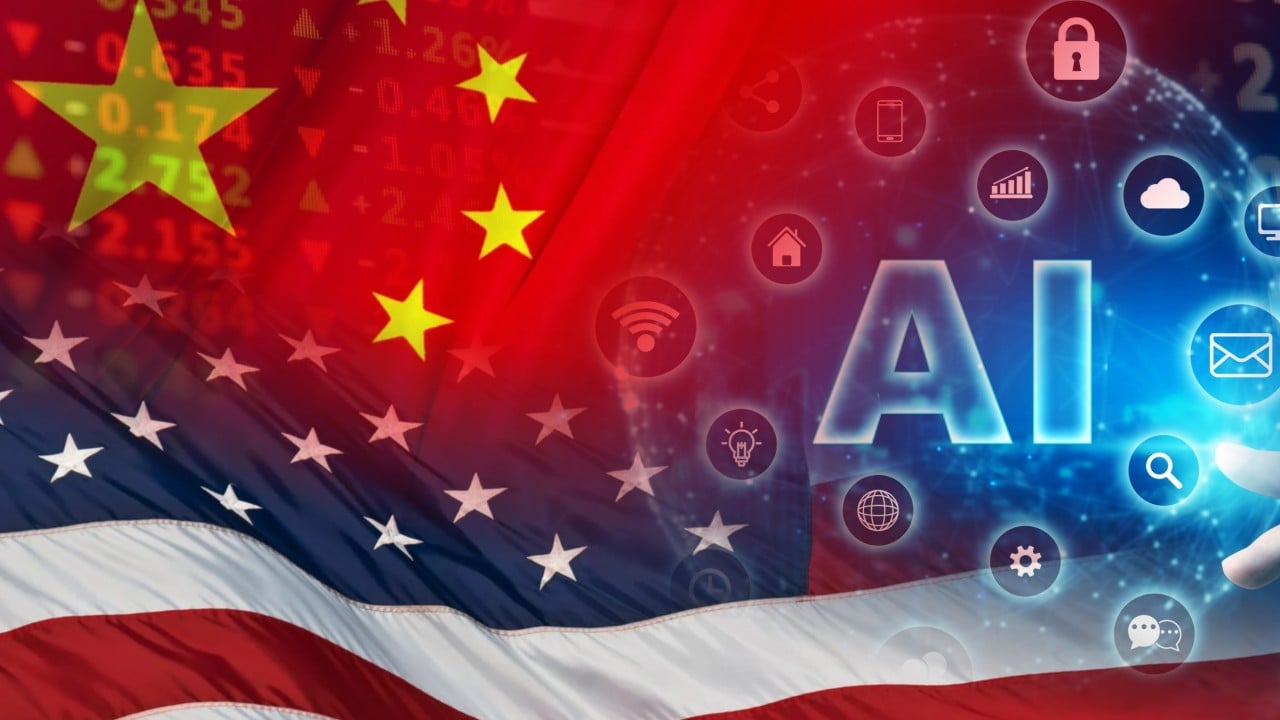
Washington is panicking about the wrong AI race. Listen to any recent congressional hearing and you will hear a familiar, frantic chorus. Lawmakers keep shouting that the next massive technology revolution must stay in America, not move to China. They point to the White House's 2026 "Winning the Race" AI Action Plan and use words like "dominance" to justify stripping away regulations.
But our politicians are obsessed with the wrong scoreboard.
Right now, American labs build the most advanced frontier large language models. Companies like OpenAI, Anthropic, and xAI pour billions into creating systems with incredible reasoning and math capabilities. We are winning the raw technology sprint. Yet, focusing entirely on who has the biggest model or the most gigawatt-scale data centers misses the actual threat. The real competition is not about who builds the best artificial intelligence. It is about who uses it most effectively.
The Dangerous Illusion of the Model Lead
If you look strictly at raw computing power, America looks safe. China is struggling under massive US export controls that block access to top-tier semiconductor chips. Alibaba planned to spend $53 billion on AI over three years, but money cannot completely replace missing hardware.
Because of this, Chinese models generally trail American ones by several months on classic industry benchmarks. But do not confuse a hardware bottleneck with a lack of strategy. Chinese labs are skipping the obsession with achieving theoretical Artificial General Intelligence. Instead, they are engineering around their weaknesses. They rely heavily on mixture-of-experts architectures to wring high performance out of limited computer chips.
While American executives brag about training clusters with hundreds of thousands of AI accelerators, Chinese firms are focusing on extreme efficiency. They want cheap, fast, deployable software. They are winning the open-source landscape, offering high-quality open-weight models that developers around the world are downloading for free. If American technology is too expensive, too heavily restricted, or locked behind corporate walls, the rest of the world will simply build on China's foundation.
Beijing Is Already Automating the Physical World
The true economic and military edge does not belong to the nation that writes the best code in a Silicon Valley vacuum. It belongs to the nation that embeds that code into the actual economy.
Look at manufacturing and robotics. China's "AI Plus" initiative focuses directly on integrating smart systems into tangible industries like healthcare, drug discovery, and factory automation. Take a company like Unitree. They manufactured more than 5,000 humanoid robots last year alone and are moving toward a massive public listing.
Now look at how the typical American business approaches the technology. Most companies are stuck using it for basic office tasks like drafting emails, writing marketing copy, or summarizing PDF documents. We are optimizing white-collar workflows while our primary global competitor is automating the physical infrastructure of tomorrow.
If American hospitals, shipping companies, utilities, and factories do not learn how to deeply integrate these tools into their daily operations, our superior underlying models will not matter. A slightly less powerful model attached to a highly efficient automated factory will beat a world-class model that stays trapped inside a browser tab every single time.
The Clumsy Washington Pivot to Corporate Ownership
The panic inside Washington has gotten so intense that it is driving bizarre, unprecedented political alliances.
Recently, President Trump shocked the tech sector by backing an idea to give regular Americans individual equity stakes in major AI labs. This came right after progressive Senator Bernie Sanders suggested a massive 50 percent tax on tech stocks to seed a national sovereign wealth fund. Tech executives like Sam Altman have actually been walking the halls of Congress pitching a version of this public wealth fund, desperate to quell growing public anger over job losses.
But this corporate-government fusion introduces massive risks. Tech investors like David Sacks have already warned that dragging the state directly into the ownership structure of private tech labs mirrors the exact Chinese Communist Party style of control we say we want to avoid.
When the state becomes a financial partner with technology monopolies, regulation becomes compromised. Speed gets prioritized over safety. Defense Secretary Pete Hegseth recently ordered the rapid integration of automated systems into military hardware, stating plainly that the risks of moving too slowly outweigh the risks of imperfectly aligned software. We are cutting red tape so fast that we risk building an environment of reckless deployment, driven by a fear of Beijing.
Step Away From the Hype and Take Action
If you are running a business or planning a career, you cannot rely on Washington politicians to solve this transition. You need to focus on local execution rather than national anxieties. Stop waiting for the next paradigm shift or the next software update to fix your productivity.
- Move past basic text generation: If your organization is only using these systems to generate content or answer basic customer support questions, you are losing ground. Look for hard operational bottlenecks in your workflow that can be automated through custom APIs.
- Prioritize local implementation over raw model size: You do not always need the absolute largest, most expensive model to solve a specific business problem. Small, fine-tuned, open-source models are often faster, cheaper, and safer for proprietary data.
- Invest in technical management talent: The hardest part of the current shift is not coding. It is figuring out how human workers should collaborate with automated agents without exposing sensitive data. Train your managers to understand data pipelines, not just basic software interfaces.
The ultimate winner of this economic shift will not be decided by congressional decrees or federal equity stakes. It will be decided by the millions of managers, workers, and entrepreneurs who figure out how to put these tools to work in the real world today.