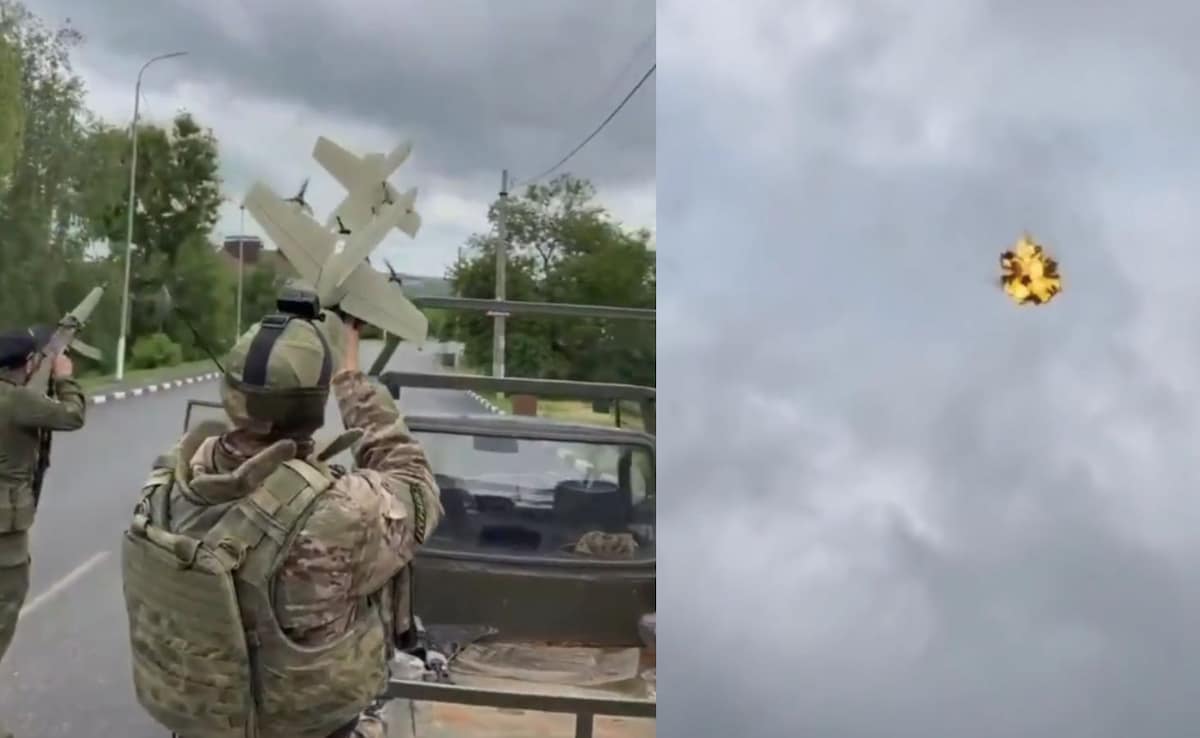
A lone soldier stands in a muddy trench somewhere along the Donbas front, peering into a grey sky. He holds a compact, pistol-grip launcher weighing barely six kilograms. Within seconds, a high-pitched buzz approaches—a Ukrainian first-person view (FPV) kamikaze drone hunting for a target. The soldier raises the weapon, locks a bi-spectral seeker onto the incoming threat, and pulls the trigger. A tiny, cylindrical craft with two sets of X-shaped wings screams out of the tube. This is the Yolka, Russia’s latest autonomous kinetic interceptor drone.
The core premise making waves in military tech circles seems straightforward. Russia has reportedly deployed a portable, $500 "fire-and-forget" interceptor that autonomously tracks and rams enemy drones mid-air, bypassing traditional electronic jamming altogether. Learn more on a related topic: this related article.
But the glossy footage circulating online masks a far more complex and desperate reality. While defense analysts marvel at the integration of artificial intelligence into a weapon that costs less than a used laptop, the introduction of the Yolka is not a sign of absolute dominance. It is an emergency asymmetric response to an economic crisis that is bleeding both sides dry in the airspace below one thousand feet.
The Broken Math of Modern Air Defense
To understand why the Russian military developed a miniature, wing-stabilized battering ram, one must look at the balance sheets of modern warfare. Traditional air defense is failing the cost-exchange test. Additional journalism by Wired highlights comparable perspectives on the subject.
For the past two years, millions of dollars in Western-supplied interceptors like Patriot and NASAMS rounds have been expended to down cheap, mass-produced drones. Ukraine faced an unsustainable economic curve, which led to their own massive push into low-cost interceptor drones like the "Sting." Now, Russia faces the exact same attrition dilemma on the front lines. A standard Russian Tor-M2 or Buk-M3 surface-to-air missile costs hundreds of thousands of dollars to manufacture. Firing one of these sophisticated assets to neutralize a Ukrainian quadcopter assembled from commercial parts for $400 is a mathematical fast track to military insolvency.
The Yolka, which translates to "Fir Tree," shifts the economic burden. At an estimated unit cost of $500, it allows frontline units to protect their immediate airspace without calling in scarce, high-tier air defense assets.
Air Defense Cost-Exchange Ratio (Approximations)
┌─────────────────────────────────┬────────────────────┐
│ Weapon System                   │ Cost Per Shot      │
├─────────────────────────────────┼────────────────────┤
│ Patriot Missile                 │ $3,000,000+        │
│ NASAMS Round                    │ $1,000,000+        │
│ Tor-M2 / Buk-M3 Missile         │ $150,000 - $300,000│
│ Ukrainian "Sting" Interceptor   │ $3,000 - $5,000    │
│ Russian "Yolka" Interceptor     │ $500               │
└─────────────────────────────────┴────────────────────┘
How the Fire and Forget Micro Interceptor Works
The physical design of the Yolka deviates significantly from standard FPV strike drones. It features a compact, highly rigid cylindrical fuselage flanked by dual tandem X-wings. This configuration provides the extreme aerodynamic maneuverability required to match the erratic, high-speed banking maneuvers of modern quadcopters. Driven by four high-RPM electric motors mounted at the rear, the interceptor can achieve sprint speeds between 200 and 250 kilometers per hour, with an operational engagement range extending up to four kilometers.
What truly elevates the platform above crude battlefield modifications is its dual-layered guidance architecture.
- The Bi-Spectral Seeker: The nosecone houses an integrated optical and thermal imaging sensor array. This allows the system to differentiate the friction-heated signature of an enemy drone's electric motors against cold clouds or chaotic ground clutter.
- The Onboard AI Module: The critical vulnerability of traditional electronic warfare is the signal tether between human operator and machine. The Yolka removes the human from the loop immediately after launch. Once the soldier locks the seeker onto a target via a handheld screen, an onboard neural network chip takes over flight tracking.
Because the drone does not rely on a continuous radio frequency control link or external satellite navigation to chase its target, it is fundamentally immune to standard electromagnetic jamming. It does not carry an explosive payload. Instead, it relies strictly on kinetic impact. Traveling at terminal velocity, the 1.3-kilogram carbon-fiber and plastic frame transforms the vehicle into a guided slug, snapping the rotors or shattering the structural arms of the target drone upon impact.
The Hidden Limits of the Kinetic Solution
Despite the tactical elegance of a self-guided $500 drone hunter, the system possesses critical engineering limitations that prevent it from being a definitive solution to the drone crisis.
First, the "fire-and-forget" capability is entirely dependent on the initial human lock-on. In a high-stress frontline environment where FPV drones dive from unexpected angles at over 100 kilometers per hour, a soldier has mere seconds to locate, track, and register a solid sensor lock through a handheld screen. If the target dips behind a tree line or deploys local obscuration, the optical and thermal track breaks, rendering the Yolka useless.
Furthermore, the kinetic-only approach requires absolute pinpoint accuracy. Unlike an anti-aircraft missile that utilizes a proximity fuze to spray shrapnel across a wide radius, the Yolka must physically collide with a rapidly moving object roughly the size of a pizza box. A miss of even a few centimeters means total failure, as the interceptor lacks the battery reserve to loop back around for repeated attempts on a fast-moving target.
The Looming Countermeasure War
The deployment of the Yolka marks the beginning of a rapid evolution in tactical drone design. For months, the primary defense against battlefield UAVs was electromagnetic suppression—flooding the airwaves with noise to sever the pilot's connection. With autonomous, vision-locked interceptors taking the field, the warfare paradigm shifts from electronic manipulation to physical and algorithmic deception.
We are already seeing early signs of this transition. Drone developers are experimenting with low-cost multi-spectral smoke counters and rapid-evasion algorithms designed to spoof terminal AI tracking modules. If an incoming drone can alter its visual or thermal profile for even a fraction of a second during the interceptor’s final approach phase, the neural network will miscalculate the lead angle and strike empty air.
Militaries are also adding lightweight, physical standoff materials to reconnaissance drones to deflect small kinetic impacts, turning the low-altitude sky into an ongoing engineering duel between micro-armor and micro-projectiles.
The Yolka proves that autonomous, low-cost robotic air defense is no longer a concept confined to laboratory tech demonstrations. It is actively patrolling the skies. However, as production lines scale on both sides of the conflict, the temporary advantage provided by these fire-and-forget interceptors will inevitably trigger a new wave of automated countermeasures, ensuring that the battle for electromagnetic and low-altitude supremacy remains violently fluid.