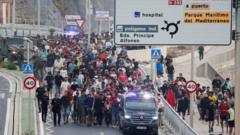
Spain’s bitter condemnation of its European neighbors over the Ceuta migrant crossings is entirely justified and entirely futile. When thousands of desperate people breach the razor wire of the North African enclave, they are technically stepping onto the soil of the European Union. Yet, Madrid is left holding the bag. The core issue is not a sudden, organic surge in global migration. It is a manufactured geopolitical crisis where human lives are weaponized by foreign governments while northern European states hide behind bureaucratic apathy. Spain calls it a selfish response. That is an understatement. It is a fundamental collapse of the shared responsibility mechanism that the European Union pretends to operate.
For decades, the European Union has built its internal cohesion on the idea of borderless travel, enshrined in the Schengen Agreement. But a borderless interior requires an impenetrable exterior. The states along the Mediterranean coast are forced to act as the shield for the entire continent. When that shield cracks under intense, deliberate pressure, the countries safely tucked in the geographical center of Europe suddenly suffer from selective amnesia regarding their treaty obligations.
The Geography of Geopolitical Blackmail
To understand the crisis in Ceuta, you have to look at a map. Ceuta, along with Melilla, are Spanish autonomous cities located on the northern coast of Africa, completely surrounded by Morocco and the Mediterranean Sea. They are historical anomalies, remnants of empire that now serve as the only land borders between the African continent and the European Union.
This geography makes them a structural vulnerability. They are the physical pressure points where the massive economic disparity between the Global North and the Global South collides. But the surges at the border fence are rarely spontaneous. They are dialed up and down by the Moroccan government.
Rabat controls the spigot. When diplomatic relations with Madrid or Brussels sour, the Moroccan border police suddenly look the other way. The most glaring historical precedent occurred in May 2021, when over 8,000 migrants—including thousands of unaccompanied children—swam around the Tarajal breakwater or simply walked through open gates into Ceuta over a period of 36 hours.
This was not a failure of intelligence. It was a calculated retaliation. Spain had quietly admitted Brahim Ghali, the leader of the Polisario Front fighting for Western Sahara independence, into a Spanish hospital for medical treatment. Morocco viewed this as an unforgivable slight and responded by unleashing a human wave against an eight-square-mile city. The message was unmistakable. Cross us, and we will drown your border outposts in chaos.
The Illusion of Shared Burden
When a crisis hits Ceuta, Spanish officials scramble to deploy the military, set up emergency Red Cross tents, and manage the staggering logistics of processing thousands of exhausted people. Almost immediately, calls go out to Brussels demanding solidarity.
Those calls ring hollow across the continent.
The mechanism that dictates European asylum policy is the Dublin Regulation. In its simplest terms, Dublin dictates that the first EU member state an asylum seeker enters is responsible for processing their claim. This legal framework mathematically dooms frontline states like Spain, Italy, and Greece. They are geographically destined to be the continent's waiting rooms.
When the Spanish government accuses its neighbors of a selfish response, they are specifically targeting the refusal of northern and eastern European states to accept mandatory relocation quotas. Countries in the Visegrad Group—historically Poland, Hungary, the Czech Republic, and Slovakia—have built massive domestic political capital by categorically refusing to take in migrants from the southern border. Even wealthier nations like the Netherlands or Austria consistently drag their feet, offering equipment instead of taking people.
If Spain asks for help to absorb 5,000 migrants, a northern European state might offer to send thermal cameras, patrol vehicles, or a financial contribution to the local border guard.
Money does not empty an overcrowded reception center. A thermal camera does not feed an unaccompanied minor sleeping on a warehouse floor in Ceuta.
The Hypocrisy of Distance
The political rhetoric emanating from capitals hundreds of miles away from the Mediterranean is easy to maintain when you do not have bodies washing up on your beaches. States without an external border can afford to take a hardline stance on illegal immigration because Spain is doing the dirty work for them.
The European Union prefers a strategy known as the externalization of borders. Instead of managing migration at the gates of Ceuta, the EU effectively pays third-party countries to act as bouncers. Billions of euros flow into Turkey, Libya, and Morocco through various neighborhood and development funds. The explicit, albeit quietly acknowledged, purpose of this money is to intercept migrants before they ever reach European territory.
This creates a severe moral hazard. If you pay a gatekeeper a fortune to keep the gate locked, that gatekeeper suddenly realizes the immense value of the key.
Morocco knows exactly how vital it is to European border security. By occasionally loosening the controls and allowing a surge into Ceuta, Rabat demonstrates its own indispensability. It is a protection racket played out on an international scale. When the surge subsides, the EU invariably writes another check, signs another cooperation agreement, and praises Morocco as a crucial partner in regional stability. Spain is forced to swallow its pride, smile for the cameras, and repair the fences.
Legal Paralysis on the Ground
The reality of these mass crossings is far more complicated than a simple breach of a wall. The demographic makeup of the migrants fundamentally alters the legal response.
If an adult male crosses the fence, Spanish authorities can often execute a rapid deportation, pushing them back across the border under controversial summary return laws. But when Morocco weaponizes its own youth, pushing unaccompanied minors toward the Spanish enclave, the legal machinery grinds to a halt.
Under international law and Spain’s own child protection statutes, an unaccompanied minor cannot be legally deported without an extensive, nearly impossible process of family reunification. The local government of Ceuta becomes the legal guardian of every single child who crosses the border.
A tiny city with limited resources suddenly finds itself legally responsible for thousands of foreign teenagers. Schools overflow. Social services buckle. Minors end up sleeping in industrial units or wandering the streets.
When the central government in Madrid attempts to distribute these minors across the Spanish peninsula to relieve the pressure on Ceuta, regional governments push back. Local politicians in mainland Spain point to their own strained budgets. The solidarity that Spain begs for from the European Union is often entirely absent within its own domestic borders.
The Domestic Shockwaves
This endless cycle of pressure and abandonment is rewriting the Spanish political map. The recurring scenes of chaos in Ceuta and the Canary Islands serve as daily campaign material for right-wing populist movements.
The Vox party built a significant portion of its national platform on the perceived failure of the central government to protect the southern border. They point to the military deployments and the overwhelmed local police as proof that the state is failing its most basic duty of territorial integrity.
For the central government in Madrid, regardless of whether it leans left or right, the options are severely restricted. A hardline military response draws the condemnation of human rights organizations and fractures fragile coalition governments. A permissive, humanitarian approach immediately draws thousands more migrants, overwhelming the system and infuriating the local electorate.
The Spanish Prime Minister is forced to walk a tightrope, flying to Rabat to offer concessions to the Moroccan King, then flying to Brussels to beg for a coordinated European response that he knows will never materialize. It is an exercise in diplomatic humiliation.
Following the Money Through Frontex
If you want to understand the true priorities of the European Union regarding the Ceuta crossings, look at the budget of Frontex, the European Border and Coast Guard Agency.
Frontex is the fastest-growing agency in the history of the EU. Its budget has exploded into the billions. The agency procures drones, off-road vehicles, and advanced surveillance software. It deploys standing corps officers to border regions.
Yet, Frontex is structurally designed to observe and repel, not to process and distribute. The agency can help Spain spot a rubber boat leaving the Moroccan coast. It can assist in securing the physical perimeter of the fence. It does absolutely nothing to alleviate the demographic pressure once those people are inside Spanish territory.
The northern states are perfectly willing to fund an armed European border guard. They are willing to construct a fortress. But fortress walls only work if the ground beneath them is stable. In Ceuta, the ground is crumbling. The European Union has decided that it is cheaper to heavily arm the external perimeter and ignore the structural rot occurring in the entry halls.
The Architecture of Attrition
Spain’s frustration is not a temporary diplomatic spat. It is the symptom of a union that refuses to integrate its most critical liabilities. The New Pact on Migration and Asylum, fiercely debated in the halls of Brussels, attempts to introduce concepts like "flexible solidarity."
Flexible solidarity is a bureaucratic euphemism. It means a country can choose to pay a fine into a shared fund rather than accept a relocated migrant. It puts a literal price tag on human beings, allowing wealthy member states to buy their way out of the crisis while Spain, Italy, and Greece continue to function as massive holding pens.
The daily reality in Ceuta remains grim. The razor wire is repaired. The breakwater is reinforced. The Spanish Guardia Civil patrols the beaches, watching the Moroccan shore, waiting for the political winds in Rabat to shift. When the next diplomatic dispute arises, the border guards on the other side will step back. The fences will be tested again. Thousands of people will throw themselves against the mesh, driven by a mixture of deep poverty and quiet state coercion.
Madrid will again call Brussels. The northern capitals will issue stern statements of support. Money will change hands in the dark. And Spain will remain, exactly as it always has been, entirely on its own.



