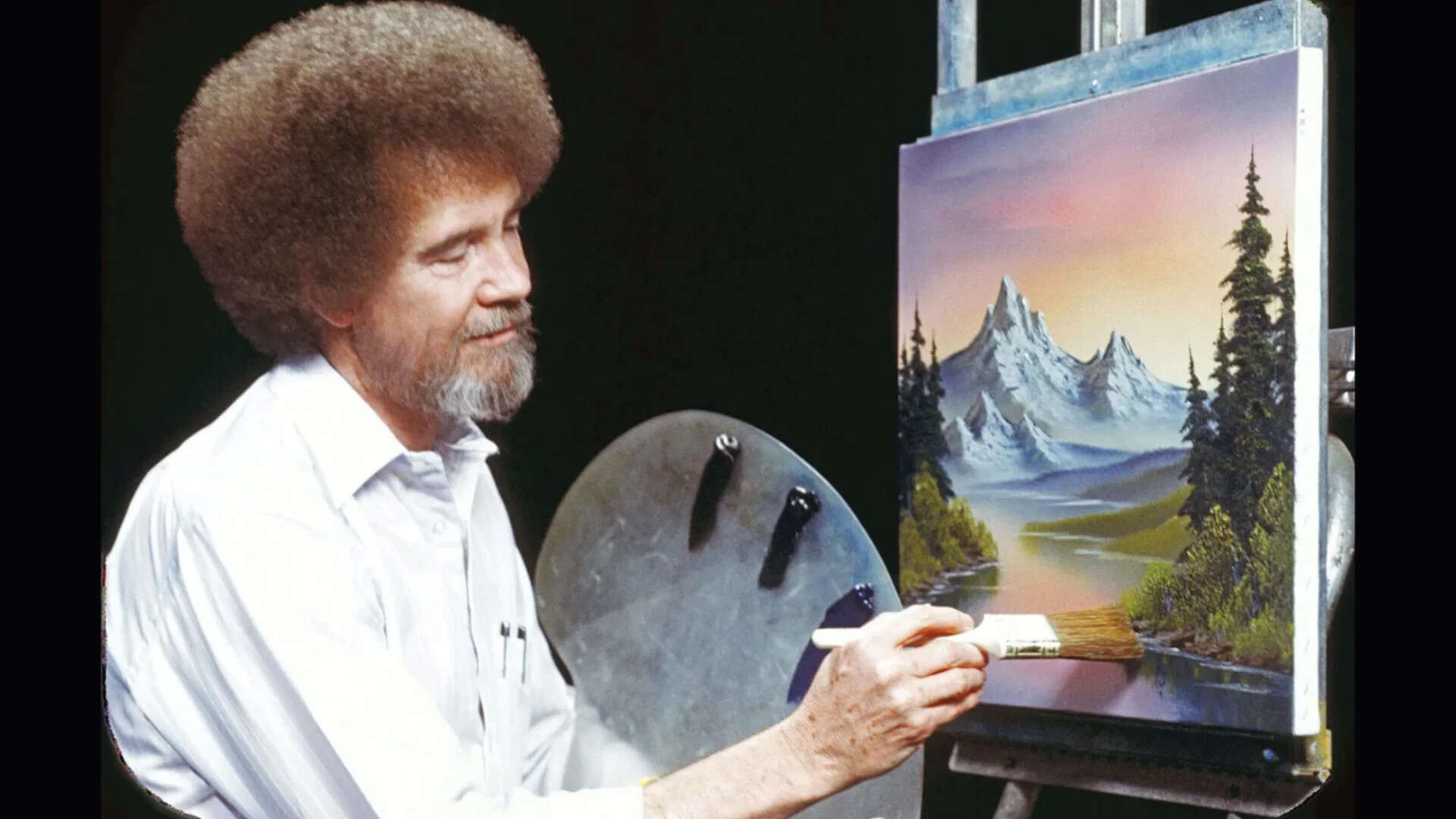
The Myth of the Happy Little Accident
Bob Ross never owned his paintings.
Let that sink in. For decades, millions of viewers tuned in to public television expecting a gentle instructor peacefully gliding a two-inch brush across a stretched canvas, gifting his finished works to local PBS stations or keeping them in cardboard boxes. The reality is far more corporate. Every single canvas painted during the original run of The Joy of Painting became the property of Bob Ross Inc., a private company founded by Bob, Jane, and Annette Kowalski in the mid-eighties. Also making news recently: Why The Love Island UK 2026 Finale Proves the Format Is Exhausted.
When people quote Bob Ross today, especially viral snippets about suffering, resilience, and finding light in the dark, they are leaning on a carefully cultivated persona. They are quoting a brand avatar.
The quote frequently bouncing across social feeds—stating that the very fact you are aware of suffering is enough reason to keep going—gets flattened into an internet meme. It is packaged neatly alongside comforting soundbites about happy little trees. But looking closer at the actual history of the man behind the easel reveals a grueling television schedule, a bitter legal battle over intellectual property after his death, and a commercial machine that capitalized entirely on parasocial comfort. Further insights into this topic are covered by The Hollywood Reporter.
Understanding how that machine operates requires stripping away the pastel sentimentality.
Behind the Canvas Wall
Television production is rarely as calm as it appears through a cathode-ray tube or a high-definition stream. Bob Ross recorded an entire 13-episode season of The Joy of Painting in less than three days.
Think about the physical toll. Thirty minutes per episode, executed in a single take, with no room for error. If the titanium white smeared incorrectly, he had to work around it immediately. The pressure was relentless. Yet, the public received a man who spoke in a soothing, hypnotic whisper, projecting an aura of unshakeable serenity.
[Production Reality vs. Public Perception]
High-pressure studio schedule (13 episodes in 3 days) ---> Filtered through a whisper-soft public persona
That contrast is where the commercial genius lived. Ross was not just an art teacher; he was an early pioneer of asynchronous psychological soothing. Long before autonomous sensory meridian response videos flooded the internet, Bob Ross was using vocal modulation and repetitive physical motion to lower the collective heart rate of an anxious television audience.
The phrase about suffering often attributed to his philosophy actually touches on a deeper psychological mechanism. People do not watch Bob Ross to learn how to mix Prussian blue and yellow ochre. They watch him because the act of witnessing someone masterfully control a chaotic medium provides a temporary illusion of control over their own chaotic lives.
The Corporate Takeover of Serenity
When Bob Ross passed away from lymphoma in 1995, most viewers assumed his legacy belonged to his family. Instead, control of the company and the trademarked name defaulted primarily to the Kowalskis, leading to decades of friction.
A multi-million dollar merchandising empire emerged from those pastel landscapes. Paint sets, instructional books, board games, and licensing deals for everything from Chia Pets to energy drinks flooded retail shelves. The irony is stark. A man who preached the simplicity of nature and the freedom of self-expression became the centerpiece of an aggressively guarded corporate trademark.
When independent artists try to monetize tutorials using his specific wet-on-wet techniques or reference his likeness, they often run into legal walls. Bob Ross Inc. protects its intellectual property with fierce precision.
The comforting quotes shared millions of times online serve as free marketing for this corporate apparatus. Every time an inspirational graphic featuring a silhouette of his afro and a quote about suffering goes viral, it drives awareness back to the brand.
The Mechanics of Comfort Consumption
Why do modern audiences cling so desperately to these mid-eighties television snippets?
Anxiety is at an all-time high. Digital connectivity breeds constant evaluation and public scrutiny. Bob Ross represents a pre-internet sanctuary. He represents an era where mistakes on canvas could be transformed into a friendly little tree with a flick of a fan brush, completely isolated from algorithms and comment sections.
When a quote tells you that your awareness of suffering is proof of your capacity for joy, it offers an immediate cognitive reframing. It turns pain into data. It suggests that suffering is merely the dark underpainting required to make the highlights pop.
It is a poetic metaphor. It is also an oversimplification of human trauma.
Real life does not resolve itself in twenty-eight minutes. A ruined canvas can be scraped away and started over on a fresh wooden board. A ruined career, a chronic illness, or deep-seated grief cannot simply be blended out with a clean brush and some liquid clear.
The Cost of the Paradigm
Clinging to simplified aphorisms allows consumers to bypass the messy work of actual mental health maintenance.
When people share these quotes, they often use them as emotional Band-Aids. They consume the comfort of the message without doing the structural work required to address their underlying stressors. The industry built around the Bob Ross aesthetic thrives on this passive consumption. You buy the branded paint set. You watch the soothing streams. You feel a momentary sense of catharsis.
Nothing changes in your actual environment.
The true legacy of Bob Ross is not found in the inspirational text overlays shared on social networks. It is found in the sheer discipline required to stand under hot studio lights, hour after hour, projecting absolute calm while navigating the quiet struggles of a terminally ill body.
That requires more than a happy little thought. It requires raw, unyielding endurance.
The next time a pastel-tinted quote crosses your screen telling you that awareness of pain is enough to save you, remember the person behind the microphone. Remember the grueling production schedules, the legal battles, and the business empire built on the back of a whisper. Comfort is a product. And the most effective sales pitch ever delivered was wrapped in a flannel shirt and painted with a two-inch brush.