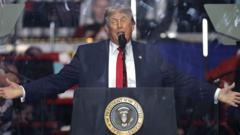
Donald Trump turned the official launch of America’s 250th anniversary into a campaign-style rally on the National Mall, transforming a milestone meant for national unity into a highly partisan spectacle. On Wednesday night, amidst military band performances, stealth bomber flyovers, and country music, the president delivered a brief, 25-minute address that focused heavily on his administration's domestic policy agenda and personal triumphs rather than a shared historical legacy.
By stepping into a vacancy left by mainstream musical acts who boycotted the event over political undertones, the administration laid bare a deep ideological fracture over how the nation's semiquincentennial will be remembered and celebrated. For a more detailed analysis into similar topics, we suggest: this related article.
The Canceled Concerts and the Presidential Substitute
The opening ceremony for the Great American State Fair was originally conceived as a nonpartisan, star-studded cultural festival. Prominent musical groups like the Commodores, country singer Martina McBride, and hip-hop artist Young MC were booked to anchor the festivities. Within days of the kickoff, those acts abruptly canceled their appearances, citing discomfort with the overtly partisan direction the event organizers were taking.
Rather than scaling back the presentation, the administration altered the programming entirely. Transportation Secretary Sean Duffy took the stage to condemn the departing artists and proclaimed Trump the greatest president since George Washington. For further information on this topic, extensive reporting can also be found at TIME.
The musical void was filled by reliable political fixtures. Country artist Lee Greenwood performed his signature anthem, while Alexis Wilkins, the partner of FBI Director Kash Patel, sang the national anthem. Trump openly mocked the departing musicians on social media prior to the event, boasting that the crowd would instead receive the number one attraction in the world, referring to himself.
Commercial Incursion and Corporate Access
Beyond the political rhetoric, the structure of the America 250 celebrations has drawn intense scrutiny from congressional investigators. Lawmakers have raised significant ethics concerns regarding the commercialization of the historic grounds. Democratic Representative Jared Huffman presented documents at a recent congressional hearing alleging that the Trump-affiliated organizing committee has been selling access to special interests under the guise of patriotic sponsorship.
The National Mall, which traditionally serves as a strictly regulated public sanctuary, has seen unprecedented commercial construction. A giant Ferris wheel stands near the Capitol, and the grounds recently hosted a commercial Ultimate Fighting Championship event. A sports competition titled the Patriot Games is also slated for high school students, offering a modest scholarship prize pool but drawing heavy criticism for allowing private corporate entities to effectively commandeer public lands for profit.
The monetization of the semiquincentennial highlights a distinct philosophical shift in how national monuments are managed. Critics argue that public space is being treated as prime retail real estate, while supporters maintain that private partnerships are necessary to fund large-scale spectacles without placing the entire burden on taxpayers.
The Battle Over National Memory
The ideological tug-of-war extends far deeper than corporate sponsorship or missing pop stars. It touches on the very narrative of American history that the government chooses to endorse.
Early in his second term, Trump signed an executive order aimed at removing what the administration called ideological indoctrination from public monuments. Consequently, educational materials and displays referencing slavery, Indigenous history, and the climate crisis were systematically removed from various national parks. While a federal judge recently ordered the administration to reinstate those materials, the conflict over historical revisionism remains intense.
Trump Administration Approval Ratings (June 2026)
--------------------------------------------------
Overall Approval: 37%
Economic Leadership: 33%
Immigration Policy: 40%
Iran Strategy: 34%
The underlying data explains the urgency behind the grand staging on the National Mall. According to recent polling from the Associated Press-NORC Center for Public Affairs Research, the president’s public approval sits at a fragile 37 percent. With inflation persistently outpacing wage growth and interest rates remaining elevated due to an escalating budget deficit, the administration is eager to divert public attention toward foreign policy shifts and structural infrastructure overhauls.
Cosmetic Upgrades and Infrastructure Setbacks
During his brief address, Trump dedicated considerable time to his efforts to alter the visual aesthetic of Washington. He touted a 14.1 million dollar project to renovate the Lincoln Memorial reflecting pool, which included a directive to line the basin so the water would appear an artificial blue.
The project has been plagued by operational failures, including recurring algae blooms and a peeling polyurethane liner. The White House has claimed without evidence that the damage was the result of coordinated vandalism by political opponents, though independent engineering reports point to hasty application and material incompatibility.
Beyond the reflecting pool, the administration has advanced plans for several highly visible monuments, including a massive triumphal arch near Arlington National Cemetery to mark the 250-year milestone. These multi-million dollar cosmetic projects have drawn sharp rebukes from lawmakers who argue that taxpayer funds should be directed toward fixing systemic infrastructure issues, rather than building neoclassical monuments to an administration’s preferred aesthetic.
The rally on the National Mall was designed to project absolute political strength and a unified national spirit, yet the empty swaths of grass visible hours before showtime told a more complicated story. Political analysts note that while these massive events successfully energize the core base of voters, they rarely move the needle among the broader electorate ahead of critical midterms.
With the primary Fourth of July celebrations still to come, the National Mall remains a hyper-politicized zone where the definition of American identity is actively being rewritten by the executive branch.