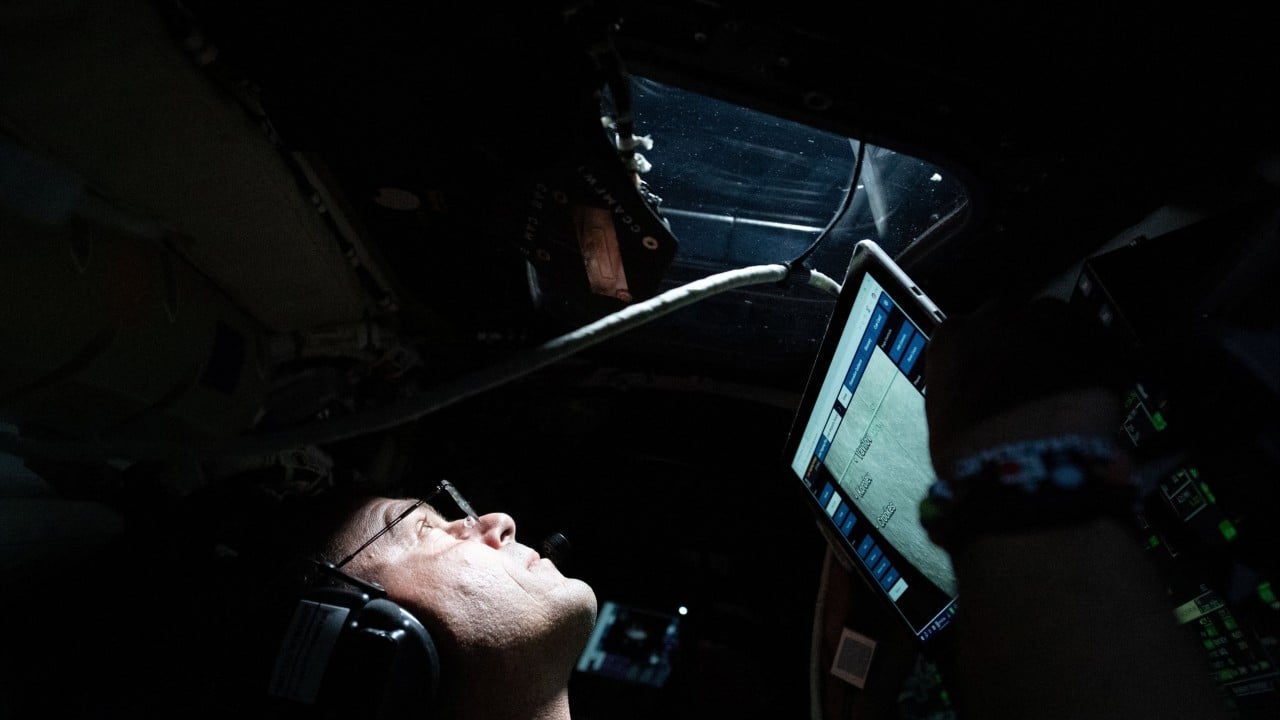
The four astronauts strapped into the Orion capsule for the Artemis II mission are not just coming home from a lap around the moon. They are hurtling toward a violent collision with the Earth’s atmosphere at speeds exceeding 25,000 miles per hour. While the world watches the splashdown as a celebratory moment of triumph, the engineering reality is a calculated risk against the most hostile environment known to man. This isn't a routine shuttle landing. It is a high-stakes test of a heat shield design that has faced quiet internal scrutiny and a logistical recovery operation that must execute with surgical precision in the middle of the Pacific Ocean.
The Skip Reentry Maneuver and the Limits of Tolerance
To understand why this return is different from the Apollo era, you have to look at how Orion hits the air. During the Apollo missions, capsules utilized a direct entry method. They hit the atmosphere, bled off speed through sheer friction, and hoped the heat shield didn't delaminate. Artemis II utilizes a "skip reentry" technique.
Think of it like skipping a stone across a pond. The capsule dips into the upper atmosphere to shed some initial velocity, "jumps" back out into space briefly, and then makes its final descent. This allows NASA to pinpoint the splashdown location with much higher accuracy, regardless of where the capsule originally enters the atmosphere. It also reduces the G-loads on the crew, making the ride slightly less punishing on the human body.
However, this maneuver doubles the thermal stress duration. The heat shield, a thick layer of Avcoat material, must withstand temperatures reaching 5,000 degrees Fahrenheit twice. During the uncrewed Artemis I test, the heat shield experienced "charring" and unexpected material loss—small pieces of the shield flaked off in a way that wasn't predicted by computer models. NASA engineers have spent the intervening years analyzing this "spalling" effect. They claim the safety margins are wide enough to protect the crew, but the reality is that Artemis II is the first time humans will bet their lives on those calculations.
Gravity as a Weapon
At 40,000 feet, the mission enters its most critical mechanical phase. The capsule is no longer a spaceship; it is a falling rock. The sequence of parachute deployment is a choreographed mechanical ballet where a single failure can lead to catastrophe.
First come the two drogue parachutes. These small, high-speed chutes stabilize the capsule and begin the process of slowing it from hundreds of miles per hour to a speed where the massive main chutes can open without shredding. If the drogues fail to deploy or if they tangle, the capsule will begin to tumble. A tumbling capsule cannot maintain the proper orientation for the main chutes, leading to a "ballistic" descent that ends in a lethal impact.
The three main parachutes are the size of football fields. They must inflate in stages—a process called reefing—to prevent the sudden jerk of deceleration from snapping the suspension lines or damaging the capsule’s structure. Even with all three chutes open, the Orion hits the water at roughly 20 miles per hour. It is a controlled crash, designed to be survived, but it is never gentle.
The Pacific Recovery Infrastructure
While the astronauts are the face of the mission, the recovery is an industrial-scale naval operation. The U.S. Navy and NASA’s Exploration Ground Systems team operate out of the well deck of an amphibious transport dock ship. This isn't just about fishing a bucket out of the water.
The recovery team must contend with "toxic venting." Upon splashdown, the capsule’s thrusters may still contain unspent hydrazine or nitrogen tetroxide. These are highly corrosive, lethal vapors. Before divers can even approach the capsule to attach towing lines, the air around the Orion must be cleared and monitored. If the capsule is "smoking" or leaking, the crew remains trapped inside a floating oven until the hazardous materials dissipate.
The Human Toll of Reentry
We often focus on the hardware, but the biological impact on Reid Wiseman, Victor Glover, Christina Koch, and Jeremy Hansen is profound. After days in microgravity, their bodies have begun to shed bone density and fluid volume. The sudden transition from weightlessness to several times the force of Earth's gravity during reentry causes blood to pool in the lower extremities.
The "gray-out" is a very real threat. As G-forces climb, the heart struggles to pump blood to the brain. The astronauts wear pressurized suits designed to squeeze their legs and keep blood flowing upward, but the physical exhaustion of a lunar return is incomparable to a low-Earth orbit splashdown. They will likely be unable to stand on their own for several hours after they are pulled from the waves.
The Geopolitical Stakes of a Clean Splashdown
The Artemis II return is not happening in a vacuum. It is the primary counter-narrative to China’s accelerating lunar program. A successful, flawless recovery cements American hardware as the gold standard for deep-space exploration. A "hard" landing or a mechanical failure during recovery would do more than just delay the Artemis III moon landing; it would shatter the momentum of the entire Artemis Accords.
The program is already under fire for its soaring costs and shifting timelines. Orion’s heat shield issues from the first test flight remain the "elephant in the room" for industry analysts. While NASA leadership projects confidence, the engineering community knows that until a crewed capsule returns without significant material loss from its thermal protection system, the design remains experimental.
The Logistics of the First Hour
The moment the capsule bobs in the water, the clock starts. The Orion is designed to keep the crew safe in the water for up to 24 hours, but the goal is "wheels up" in a helicopter within two.
- Orientation: Five large bags on top of the capsule inflate to ensure it floats right-side up. If it stays upside down (Stable II position), the crew is hanging by their straps, and communication antennas are submerged.
- Thermal Management: Once the heat shield stops burning, the interior of the capsule can actually become hotter as the heat soaks through the structure. The cooling systems must hold until the hatch is opened.
- The Tow: Divers attach a "winch line" and a "fend-off" line. The Navy ship then maneuvers to essentially swallow the capsule into its flooded well deck.
This process is highly sensitive to sea states. High waves can turn the multi-ton capsule into a wrecking ball, capable of crushing recovery boats or injuring divers. The decision to commit to a specific splashdown site is made 48 hours in advance, based on weather patterns that are notoriously fickle in the open ocean.
The Unseen Threat of Space Radiation
While the return focuses on the heat of reentry, the crew will be carrying the invisible effects of the Van Allen radiation belts. Artemis II is the first time since 1972 that humans have passed through these high-energy particle zones. The Orion capsule features "Radiation Area Monitors," but the true data point is the astronauts themselves.
They will have spent the journey in a storm of galactic cosmic rays. The return to Earth marks the end of their exposure, but the long-term monitoring of their health begins the second the hatch opens. This data is the most valuable cargo the mission carries. It will determine if the current shielding is sufficient for the months-long journey to Mars, or if our current deep-space transit designs are fundamentally flawed.
The silence that occurs during the "blackout" phase of reentry—when a sheath of plasma surrounds the capsule and cuts off all radio communication—is the most honest moment of the mission. For those six or seven minutes, the billion-dollar infrastructure, the political grandstanding, and the global PR campaigns vanish. There is only a blunt-body object fighting the laws of thermodynamics.
The success of Artemis II isn't measured by reaching the moon. It is measured by the integrity of a few inches of Avcoat and the deployment of nylon threads in the thin air above the Pacific. Everything else is just noise. High-speed reentry is the ultimate gatekeeper of the heavens, and it does not negotiate. When the main chutes finally blossom against the blue sky, it won't be because of "synergy" or "innovation." It will be because the physics of the heat shield finally, stubbornly, held its ground.