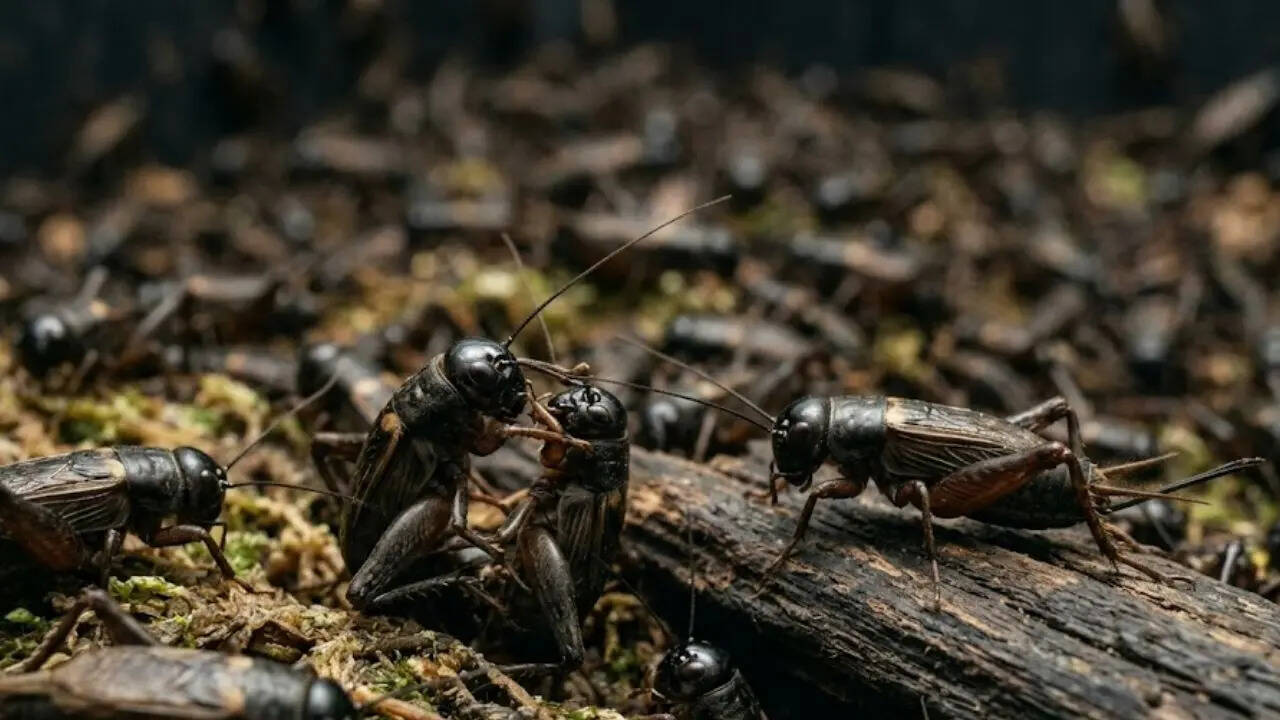
The global protein market is currently betting on a silent workforce of 370 billion crickets. Investors and climate tech startups have spent the last decade selling a vision of "mini-livestock" as the ultimate solution to the environmental wreckage caused by industrial beef and pork production. However, recent breakthroughs in neurobiology and behavioral science are dismantling the primary ethical pillar of this industry: the assumption that insects are biological machines incapable of suffering.
If crickets can feel pain—not just a mechanical reflex, but a subjective experience of distress—the insect farming sector is currently overseeing the largest concentrated expansion of sentient suffering in human history.
This isn't about sentimentality. It is about the fundamental viability of a multi-billion dollar business model. As Western markets grapple with the ethics of animal welfare, the transition from "sustainable protein" to "industrialized cruelty" could happen overnight, leaving early adopters with stranded assets and a public relations nightmare that makes factory farming look like a minor oversight.
The Myth of the Unfeeling Machine
For years, the argument for farming crickets rested on the concept of nociception. Scientists differentiated between a physical response to a harmful stimulus (nociception) and the emotional experience of pain. We were told that insects lacked the complex neural structures, such as a neocortex, required to translate a signal into a feeling.
We were wrong.
New research into insect neurology shows that crickets possess descending pathways from the brain that can modulate their response to injury. This suggests they aren't just reacting; they are processing. When a cricket is injured, it doesn't just limp; it exhibits long-term changes in behavior that indicate a state of "anxiety" or heightened caution. They seek out different environments. They change their mating habits.
The biological hardware is different, but the functional result is the same. Crickets utilize a decentralized nervous system that handles information with incredible efficiency. While a cow has a centralized "CPU" in its skull, a cricket operates on a distributed network of ganglia. Denying their capacity for suffering because they don't have a human-looking brain is like saying a computer doesn't process data because it doesn't have a vacuum tube.
Industrial Scaling and the Density Problem
The business of insect farming is a game of extreme density. To make the economics work, facilities like those in Canada, Vietnam, and the Netherlands must house millions of insects in vertical stacks. These "cricket condos" are designed for maximum output with minimum footprint.
In nature, crickets are territorial. They are aggressive. When you pack them into high-density trays, you trigger a biological stress response that is rarely discussed in investor decks.
- Cannibalism: In high-stress, high-density environments, crickets begin to eat one another. This isn't a natural foraging behavior; it’s a symptom of a system pushed to its breaking point.
- Frantic Mortality: "Natural" death rates in these facilities are often ignored as a cost of doing business, but the sheer volume—billions of individuals—means the scale of the struggle is unprecedented.
- Mass Culling: The methods used to "harvest" these insects, often involving freezing or shredding, are chosen for cost-effectiveness rather than humane standards.
The industry markets itself as a clean, high-tech alternative to the slaughterhouse. But under the LED lights, the reality is a massive biological engine that requires a staggering amount of individual life to produce a relatively small amount of flour.
The Economic Risk of Sentience
If the European Union or the USDA officially recognizes insect sentience—a move that animal welfare advocates are pushing for with increasing success—the cost of production will skyrocket.
Currently, insect farming is cheap because there are virtually no welfare regulations. You can pack them as tight as you want, freeze them alive, and grind them into powder without a single inspection from a welfare officer. Once you mandate "humane" density levels, controlled atmospheres, or anesthesia during slaughter, the price per kilogram of cricket protein will surpass that of premium Wagyu beef.
The "green" premium that consumers are willing to pay has a limit. If the cost of ethical cricket farming doubles, the entire value proposition of insect protein as a cheap, sustainable alternative to soy or whey evaporates. Investors who have poured hundreds of millions into automated cricket factories are betting on the regulatory status quo remaining unchanged. That is a dangerous bet.
The Protein Diversion
We are told we need insects to feed a growing population. This is a half-truth designed to mask a more complex reality of resource management.
A significant portion of farmed crickets isn't destined for human dinner plates. They are being funneled into the pet food industry and aquaculture. We are essentially building a massive, sentient-heavy supply chain to feed our salmon and our Labradors.
This creates a "trophic loss" that is rarely highlighted in sustainability reports. You grow grain, feed it to crickets, then feed the crickets to fish, then eat the fish. At every step, you lose energy. If the crickets are suffering throughout that process, we have created a system that is both thermodynamically inefficient and ethically bankrupt.
The Missing Regulatory Framework
Walk into any commercial cricket farm and you will see "proprietary technology" everywhere. Automated feeding systems, climate-controlled chambers, and robotic harvesting arms. What you won't see are established standards for what constitutes a "good life" for a cricket.
In traditional livestock, we have the "Five Freedoms." In insect farming, we have nothing. There is no consensus on:
- Maximum density: How many crickets per square inch is too many?
- Light cycles: Does 24-hour light to accelerate growth cause neurological damage?
- End-of-life protocols: Is boiling or freezing actually painless for a creature with a distributed nervous system?
Without these standards, the industry is operating in a wild-west environment. History shows us that when the public finds out what happens behind closed doors in unregulated industries, the backlash is swift and permanent. The "yuck factor" associated with eating bugs is already a massive hurdle for the industry. If you add "unnecessary cruelty" to that mix, the market for insect-based snacks will collapse before it ever reaches the mainstream.
Complexity is Not a Defense
The most common defense from industry lobbyists is that crickets are "too simple" to matter. They point to the short lifespan and the sheer number of offspring as proof that individual lives are disposable.
This is a failure of imagination. Complexity does not equal the capacity for pain. A simple circuit can still carry a high-voltage current. The neurochemical markers found in crickets—specifically the presence of dopamine and serotonin in response to environmental stressors—are remarkably similar to those found in vertebrates.
We are dealing with a form of life that has survived for 300 million years. They have evolved sophisticated ways to avoid danger and preserve their physical integrity. To assume that those mechanisms don't include a subjective "bad" feeling is a convenience for the balance sheet, not a scientific fact.
The Better Alternatives
While the cricket industry tries to solve its sentience problem, other sectors are moving faster with less baggage. Precision fermentation and mycoprotein (fungi-based) technologies offer the same environmental benefits—low water use, small footprint, high protein density—without the ethical quagmire of killing billions of individuals.
These technologies are "clean" in every sense of the word. They don't have nervous systems. They don't require mass culling. They don't cannibalize each other when the lights go out.
The obsession with insects as the "future of food" may eventually be seen as a strange, brief detour in the history of food technology. We tried to find a way to keep the "meat" model by just using smaller animals, only to realize that the scale of the ethical problem grew as the size of the animal shrank.
The Inevitable Pivot
The 370 billion crickets currently in production represent a massive biological experiment. As the data on insect sentience becomes undeniable, the industry faces a choice: innovate toward genuine welfare or face a total collapse of consumer trust.
The current "burn and churn" model of high-density insect farming is unsustainable. It relies on a lack of public awareness and a lack of scientific rigor. Both are disappearing.
Investors should be looking at the cost of "ethical compliance." If a company cannot explain how they measure and mitigate the distress of their livestock, they aren't a high-tech food solution; they are a legacy factory farm in a smaller box. The smart money is already looking at the exit, moving toward molecular proteins that don't have a nervous system to worry about.
The era of the "unfeeling" insect is over. The era of accounting for their experience has begun. For an industry built on the backs of billions, the bill is about to come due. Stop looking at the protein per gram and start looking at the cost of the suffering required to produce it.