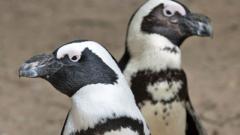
Namibia is currently betting its entire economic future on a molecule. By 2030, the government aims to produce two million tonnes of green hydrogen annually, transforming a desert nation into a global energy titan. But this $10 billion gamble—centered largely in the Tsau //Khaeb National Park—is colliding head-on with a fragile ecosystem that predates the industrial age. While the world cheers for carbon-neutral fuel, the reality on the ground is a high-stakes trade-off where the survival of the endangered African penguin is being weighed against the thirst of European industry.
To understand the friction, you have to look at the geography. The proposed sites for massive desalination plants and ammonia export hubs sit directly adjacent to the Mercury and Ichaboe Islands. These rocky outcrops are the last strongholds for the African penguin, a species whose population has plummeted by 90% in the last century. When we talk about green energy, we usually talk about atmospheric carbon. We rarely talk about the physical displacement of the wild.
The Engineering Logic vs the Biological Reality
Green hydrogen isn't pulled from the ground; it is manufactured. The process requires three things in abundance: wind, sun, and seawater. Namibia’s coastline has all three in spades. The plan involves using massive wind farms to power electrolyzers that split water into hydrogen and oxygen. That hydrogen is then chilled or converted into ammonia for shipping to ports like Rotterdam or Hamburg.
On paper, it is a closed-loop miracle. In practice, the infrastructure required is gargantuan. We are talking about industrializing a coastline that has remained largely untouched since the diamond rushes of the early 20th century. The African penguin relies on these specific coastal waters for foraging. They are not highly mobile travelers; they are specialized hunters that need predictable schools of sardines and anchovies within a specific radius of their nesting grounds.
Industrial noise is the first silent killer. Penguins and other marine life depend on acoustic clarity for communication and navigation. Constructing deep-water berths and operating high-capacity desalination plants creates a constant sub-aquatic hum. This isn't just an annoyance. It is a barrier. It disrupts the "acoustic landscape" that these birds have navigated for millennia. When you add the risk of ammonia leaks—a substance far more toxic to marine life than crude oil—the "green" label starts to look like a marketing coat of paint.
The German Connection and the Debt Trap
Follow the money and you will find Berlin. Germany is the primary driver behind Namibia’s hydrogen ambitions, looking for a way to decarbonize its heavy industry without relying on Russian gas or erratic local solar. Through various memorandums of understanding, German capital is flowing into Namibian infrastructure.
There is a cynical irony here. Europe is effectively outsourcing its environmental impact. By moving the energy production to the Global South, Germany can claim a "net-zero" victory while the physical scars of that transition—the brine discharge from desalination and the loss of biodiversity—remain in the Sperrgebiet.
Desalination is often pitched as a win-win for a water-scarce nation. But the byproduct is hypersaline brine, usually laced with anti-scaling chemicals. If pumped back into the shallow bays where penguins feed, it sinks to the bottom, suffocating the microorganisms that form the base of the food chain. No microorganisms means no fish. No fish means no penguins. It is a linear progression toward extinction.
The Economic Mirage of Job Creation
The Namibian government justifies this risk by pointing to the "Green Industrialization" promise. They speak of thousands of jobs and a GDP explosion. Yet, green hydrogen is an incredibly capital-intensive industry, not a labor-intensive one.
Once the wind turbines are bolted down and the pipes are laid, the actual operation of these plants requires a handful of highly specialized engineers. Most of that talent will likely be imported from Europe or South Africa in the short term. The local population might see a temporary construction boom, but the long-term "wealth" often evaporates into the pockets of international consortiums. We have seen this script before in the oil and gas sector across Africa. The infrastructure is built, the resource is exported, and the local ecology is left holding the bill.
The African penguin is an "indicator species." Their health reflects the health of the entire Benguela Current Large Marine Ecosystem. If the penguins disappear, it signals a systemic collapse of the fisheries that actually do provide thousands of sustainable jobs for Namibians. Sacrificing a renewable food source for a temporary energy export is a fiscal move that many analysts find increasingly difficult to defend.
The Problem with "Green" Labels
We have entered an era where "green" is used as a shield against scrutiny. If a project reduces CO2, it is often treated as beyond reproach. But true sustainability is three-dimensional. It must account for local ecology and social equity.
- Biodiversity Loss: Once a species like the African penguin hits a certain tipping point, recovery is biologically impossible.
- Chemical Pollution: Ammonia transport is fraught with risk; a single spill near a colony would be catastrophic.
- Resource Sovereignty: Who owns the water? In a drought-prone country, prioritizing industrial hydrogen over local agriculture is a dangerous gamble.
The False Choice
The narrative is often framed as "Penguins vs. Progress." This is a lie. Progress does not require the destruction of an apex predator. There are alternative sites for these plants—areas further away from critical nesting colonies—but they are slightly more expensive to develop. The current plan chooses the most profitable path, not the most sustainable one.
We are watching a repeat of the 20th-century extraction model, just with a different color scheme. If Namibia and its European partners don't pivot their infrastructure layout, they will succeed in cooling the planet only to find they have emptied the ocean.
The wind will still blow across the Namib, and the turbines will still spin, but the islands will be silent. A green future built on a graveyard of biodiversity isn't a transition; it’s just another form of conquest.
Investors must demand a moratorium on coastal construction within 50 kilometers of identified "Important Bird and Biodiversity Areas" before the first pylon is driven into the seabed.