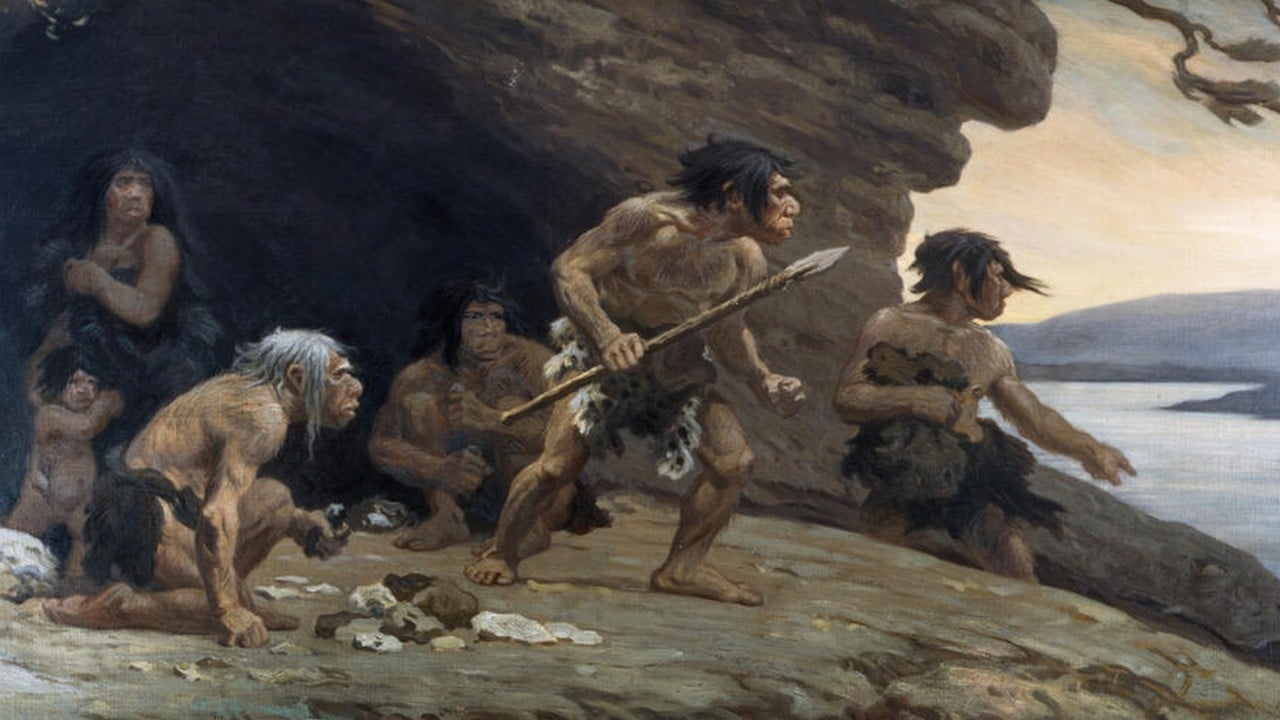
For decades, mainstream anthropology clung to a comfortable narrative. It suggested that our ancestors stumbled into creativity because they had it easy. The old theory goes that warm, bountiful environments gave early humans the leisure time to invent new tools, art, and complex social structures. But recent archaeological data and evolutionary modeling from Chinese research teams flip this cozy assumption on its head. The evidence shows that human innovation did not flourish during times of plenty. It was forged in the freezing, hyper-arid crucibles of extreme environmental stress.
When survival is guaranteed, behavior stagnates. Early hominins did not expend precious metabolic energy inventing complex technologies when a simple sharpened stone and a bush full of berries sufficed. The true catalyst for the rapid acceleration of human cognitive flexibility was the sheer terror of resource collapse.
The Failure of the Eden Hypothesis
The traditional model of human development often looks like an ideological projection rather than hard science. Anthropologists frequently assumed that regions with high biodiversity and stable, warm climates acted as incubators for cultural breakthroughs. They called it the Eden Hypothesis.
The math simply does not support it.
In a stable ecosystem, the evolutionary pressure to innovate is remarkably low. If a hominin group can secure sufficient calories using a primitive Acheulean handaxe for half a million years, they will keep using that handaxe. Innovation carries massive risk. Trying a new tool-making technique means wasting scarce materials. It means risking injury. It means deviating from a proven survival strategy.
New analytical frameworks led by teams at the Chinese Academy of Sciences demonstrate a striking correlation. The most significant leaps in lithic technology—the transition from heavy, inefficient stone cores to highly specialized, efficient micro-blades—align precisely with periods of intense climatic volatility and severe habitat degradation.
Our ancestors did not invent because they were comfortable. They invented because the alternative was extinction.
How Desperation Drives the Brain
To understand why harsh settings trigger creativity, you have to look at the energetic cost of the human brain. The brain is an absolute metabolic resource hog. It consumes roughly 20% of our resting energy while making up only 2% of our body weight.
Evolution does not tolerate that kind of expensive hardware unless it pays a massive dividend.
[Severe Environmental Shift]
       │
       ▼
[Resource Scarcity / Traditional Strategies Fail]
       │
       ▼
[High Behavioral Flexibility Triggered (Cognitive Load)]
       │
       ▼
[Technological Innovation / Adaptation or Extinction]
When the East Asian monsoon patterns shifted drastically during the Middle to Late Pleistocene, regions that were once predictable turned into unforgiving, arid steppes. The predictable herds of game vanished. The edible plants withered.
This is where the cognitive dividend paid off. Under intense environmental pressure, human groups that relied purely on instinct died out. The populations that survived were those capable of behavioral flexibility. This is the clinical term for creativity.
The Microblade Revolution
Take the emergence of microblade technology in Northern China and Siberia. These are tiny, razor-sharp stone flakes inserted into bone or wooden handles. They represent a massive leap in efficiency.
- Raw Material Conservation: A single chunk of high-quality flint can yield dozens of microblades, whereas traditional methods wasted most of the stone.
- Lethality: Composite weapons allowed for hunting from a safer distance, essential when large game became scarce and erratic.
- Portability: Highly mobile bands of hunters could carry a toolkit of microblades across hundreds of miles without being weighed down.
This technological shift did not happen gradually over a warm, sunny weekend. It exploded across the archaeological record precisely during the Last Glacial Maximum, a period of biting cold and environmental hostility. The harsh climate forced a logistical overhaul.
The Geographical Proof
The data coming out of sites across the Nihewan Basin and the Loess Plateau provides a granular look at this survival dynamic. For a long time, Western Eurocentric models dominated the conversation, focusing heavily on cave sites in France and Spain. But the vast, ecologically sensitive zones of Northern and Eastern Asia offer a much clearer laboratory for studying climate stress.
| Period | Environmental Condition | Technological Response |
|---|---|---|
| Middle Pleistocene | Stable, moderate warmth | Stagnant, heavy stone tool kits (Acheulean-like) |
| Late Pleistocene (Glacial Peaks) | Extreme aridity, dust storms, freezing temperatures | Rapid emergence of microblades, bone needles, tailored clothing |
| Holocene Transition | Stabilizing warmth | Shift toward sedentary tools, early cultivation experiments |
When you analyze the soil strata at these sites, the correlation is undeniable. Layers containing heavy wind-blown dust and markers of extreme cold match up with the highest densities of innovative artifacts.
Conversely, when the climate warmed up and resources became abundant again, the rate of technological change flattened. People went back to what was easy.
The Social Glue of Hard Times
Creativity is not just about carving a sharper rock. It is about restructuring how humans interact with one another. Harsh environments demanded a complete rewrite of social contracts.
In a bountiful landscape, a small family unit can isolate itself and survive comfortably. There is no need to cooperate with the neighbors over the hill. But when a multi-year drought hits, or when a glacial advance locks down traditional hunting grounds, isolation is a death sentence.
Obligate Collaborative Foraging
Extreme settings forced the development of what anthropologists call obligate collaborative foraging. It forced separate, sometimes hostile groups to establish regional networks. They had to share information about where water holes remained or where a lone herd of mammoths had migrated.
"The true measure of early human intelligence was not individual genius, but the capacity to store and transmit complex survival data across generations and group boundaries during crises."
This required communication tools. It drove the expansion of symbolic language, ritual sharing, and body ornamentation used to signal identity and alliance from a distance. The complex social networks that define modern humanity were constructed as a safety net against starvation.
The Counter-Argument: The Resource Trap
A counter-theory often raised by critics suggests that if an environment becomes too harsh, it crushes the capacity to innovate entirely. They argue that a population spending 100% of its time looking for water has zero time to sit down and experiment with new tool designs.
This objection misses the mechanics of how human innovation actually occurs.
It assumes that innovation requires a laboratory setting and structured leisure time. In reality, prehistoric innovation happened on the fly. It occurred during the hunt, during the desperate search for shelter, and out of the immediate need to fix a broken dynamic.
If an environment is so utterly barren that it kills off a population within a generation, then yes, culture dies with them. But the sweet spot for creativity is the unpredictable margin. It is the boundary zone where resources are scarce enough to threaten survival, but variable enough that a clever adaptation can yield a massive reward.
The populations living in the absolute harshest zones of Pleistocene Asia were not stupidly grinding their lives away. They were running highly sophisticated risk-management strategies.
Moving Beyond Environmental Determinism
It is easy to fall into the trap of environmental determinism, the idea that climate dictates human history entirely. That is an oversimplification. Climate did not build the tools; human minds did.
The environment acted as a filter. It eliminated the complacent. The groups that relied on rigid, unchanging traditions were wiped clean from the fossil record when the weather shifted. The groups that possessed a genetic or cultural predisposition toward flexibility were the ones that passed on their lineage.
This realization fundamentally changes how we view our own species. We are not the children of a lush African Eden who wandered out into the world looking for adventure. We are the bruised, hardened survivors of successive global climate disasters. Our finest attributes—our capacity for deep cooperation, our abstract thought, our relentless drive to engineer our way out of problems—were built to fight back against a world that was actively trying to freeze and starve us to death.
The current narrative needs to shift away from looking for the easiest places where humans could have lived, and start looking deeper at the hardest places they managed to survive. That is where the story of modern human capability truly begins.