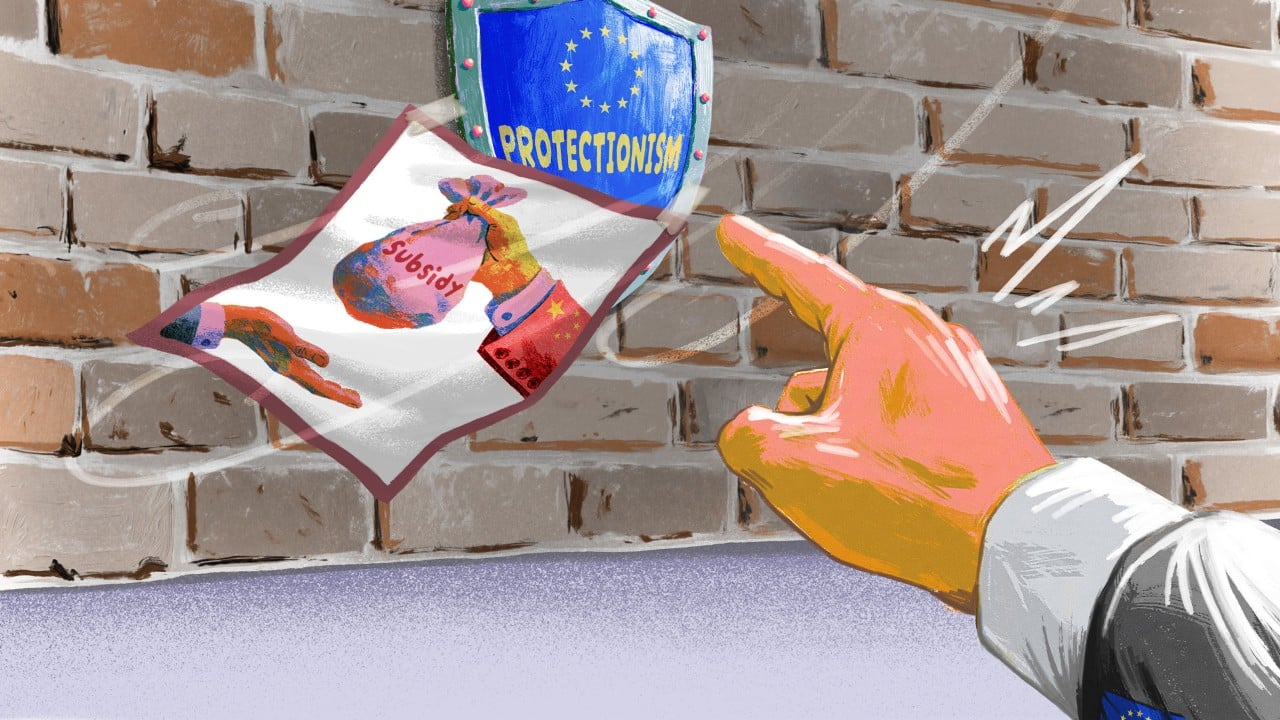
Every armchair economist in Frankfurt and London loves the same smug diagnosis. Europe is whining about Chinese state subsidies because European industry is bloated, over-regulated, and allergic to productivity. Fix your labor laws, slash red tape, let the free market breathe, and stop blaming Beijing for eating your lunch.
That take sounds tough. It flatters free-market orthodoxy. And it completely misunderstands how modern industrial power actually works.
The lazy consensus says Europe’s obsession with Chinese subsidies is a smokescreen for domestic stagnation. Both things are true at the same time—and treating them as mutually exclusive is how European manufacturing gets wiped off the map by 2030. Brussels does have a severe structural competitiveness problem. Energy costs remain brutal, capital markets are fragmented across twenty-seven jurisdictions, and permitting delays turn five-year factory builds into decade-long bureaucratic hostage situations.
None of that changes the arithmetic of state-backed overcapacity. You cannot deregulate your way out of competing against an adversary whose capital carries a near-zero cost of failure.
The False Choice Between Reform and Protection
Watch how pundits frame the EU-China trade fight. They present a binary choice: either Europe fixes its internal structural rot, or it hides behind tariffs on Chinese electric vehicles, solar wafers, and wind turbines.
That framing is a trap. I have sat in boardrooms with European Tier-1 automotive suppliers watching their order books evaporate in real time. These are not lazy, state-coddled dinosaurs. Many are lean, family-owned German Mittelstand engineering firms that spent thirty years perfecting precision tolerances and lean manufacturing. When a competitor walks into a tender offering battery housings or power electronics at 35 percent below the global cost of raw materials, no amount of domestic labor reform closes that gap.
Here is why the "just fix your own house" crowd misses the mechanics of Chinese industrial policy:
- Non-market capital allocation: In a normal market economy, sustained losses force capacity exits. In China’s strategic sectors, provincial governments, state-owned banks, and state-backed guidance funds absorb losses for years to capture global market share.
- Upstream choke points: Beijing did not just subsidize final assembly. It subsidized lithium refining, polysilicon production, rare-earth processing, and anode manufacturing until Western rivals went bankrupt and exited the supply chain entirely.
- Exporting deflation: When domestic Chinese demand slows—as it has sharply since the property crisis—excess factory output has to go somewhere. Europe’s open single market is the largest, wealthiest dumping ground on earth because Washington already slammed its doors shut with Section 301 tariffs.
If Brussels waits until it achieves perfect structural reform before defending its industrial base, there will be no industrial base left to reform. You do not tell a boxer to work on his cardio while his opponent is hitting him with brass knuckles. You stop the illegal blows first, then you fix the footwork.
What Mario Draghi Actually Said Versus What Critics Heard
When Mario Draghi delivered his landmark report on European competitiveness, free-market purists cherry-picked the sections on regulatory burden and capital markets union while quietly ignoring his core conclusion. Draghi explicitly warned that Europe is the only major economic bloc still pretending the rules-based, laissez-faire trade order of the 1990s still exists.
Washington abandoned that order years ago through the Inflation Reduction Act and aggressive tariff walls. Beijing never joined it in the first place.
Europe’s real failure is not that it noticed Chinese subsidies too late. Its real failure is believing that defensive trade measures—like countervailing duties on Chinese EVs—are a substitute for an actual European industrial strategy.
Tariffs buy time. Nothing more. If you slap a 35 percent duty on imported electric vehicles without fixing why electricity in Germany costs twice what it does in the United States, or why European pension funds refuse to fund high-risk scale-ups, you have merely built an expensive greenhouse for uncompetitive firms.
The Structural Rot Nobody Wants to Touch
Attacking the "anti-tariff" purists does not let Brussels off the hook. European policymakers love talking about strategic autonomy because drafting white papers is easier than dismantling the self-inflicted wounds strangling European growth.
Look at the actual structural bottlenecks holding the continent back:
- The Energy Self-Sabotage: Heavy manufacturing is converted energy. By shutting down nuclear capacity prematurely while failing to build cross-border grid interconnectors fast enough, Europe locked itself into structurally higher industrial power prices. No subsidy can permanently offset a double-digit structural disadvantage in baseload electricity.
- Fragmented Capital Markets: Europe does not lack savings. European households save at roughly double the rate of American households. Yet roughly €300 billion of European savings flows across the Atlantic every year because Europe lacks a unified Capital Markets Union. A European clean-tech startup has to navigate twenty-seven different insolvency regimes, tax codes, and securities rules just to scale across its own home continent.
- The Precautionary Principle Gone Rogue: Europe regulates technologies before they even reach commercial scale. From AI compliance frameworks to chemical restrictions and supply-chain due diligence mandates, Brussels treats regulatory volume as a measure of global influence. Companies spend millions on compliance officers instead of R&D engineers.
Notice the pattern here. Chinese subsidies and European stagnation are not competing explanations for Europe’s decline. They are a pincer movement. Beijing compresses European margins from the outside with state-subsidized overcapacity, while Brussels crushes European return on invested capital from the inside with energy costs and regulatory friction.
Why Classic Free-Trade Economics Breaks Down Here
Traditional trade theory—dating back to David Ricardo’s comparative advantage—assumes that if a foreign government wants to subsidize your consumers with cheap goods, you should send them a thank-you note. Let Chinese taxpayers fund cheap solar panels and cheap EVs for European drivers, and reallocate European capital to higher-value industries.
That logic works wonderfully when you are buying cheap t-shirts or plastic toys. It fails catastrophically when the subsidized goods are the foundational technologies of the twenty-first century.
When a single state uses non-market subsidies to establish a near-monopoly over clean energy hardware, batteries, and electric mobility, comparative advantage turns into strategic dependency. Once domestic competitors are wiped out and tooling capacity disappears, the low prices vanish—or worse, supply chains become weapons of geopolitical coercion. Europe already learned this lesson the hard way with Russian pipeline gas. Repeating the exact same mistake with Chinese clean-tech hardware is not free-market wisdom. It is institutional amnesia.
The Uncomfortable Questions People Keep Getting Wrong
Are EU tariffs on Chinese EVs just protectionism for lazy automakers?
No—and anyone claiming otherwise has not read the European Commission’s anti-subsidy investigation dossier. Countervailing duties under World Trade Organization rules are specifically designed to offset proven, market-distorting state subsidies, not to shield inefficient firms from fair competition. The real problem with the EU’s EV tariffs is not that they exist, but that they are too timid to stop subsidized imports from taking market share while failing to force European automakers to restructure their legacy cost bases.
Can Europe ever match China’s manufacturing scale?
Not across every sector, and trying to copy Beijing’s state-capitalist model euro-for-euro would bankrupt Brussels. China’s industrial machine relies on massive domestic scale, suppressed household consumption, and state-directed credit. Europe’s edge has never been brute-force commodity volume; it has been high-precision machinery, industrial software, specialty chemicals, and deep engineering. Europe does not need to out-subsidize China on commodity battery cells. It needs to protect its high-value manufacturing ecosystems while securing diversified upstream supply chains with allies.
Will fixing EU regulations automatically make European firms competitive against China?
Never. Deregulation removes self-inflicted drag, which is urgent and overdue, but a friction-free private company still cannot outlast a state-backed competitor willing to lose money for a decade to capture a market. Structural reform is a necessary condition for European survival, not a sufficient one.
The Downside of My Own Argument
Let’s be brutally honest about the risk of aggressive trade defense paired with industrial policy: governments are terrible at picking winners, and corporate lobbyists are brilliant at turning temporary shields into permanent entitlements.
If Brussels uses trade barriers against China as an excuse to funnel billions in no-strings-attached grants to legacy incumbents, Europe will end up with the worst of both worlds—higher prices for consumers, zero innovation from protected champions, and retaliatory tariffs from Beijing hitting European luxury goods, cognac, and aerospace. Every euro of public support and every tariff point must come with brutal, non-negotiable performance metrics: export targets, R&D spending floors, and strict sunset clauses.
What Brussels Must Actually Do Instead
Stop treating trade defense and structural reform as rival ideologies. Execute both simultaneously, or stop pretending Europe is a serious geopolitical actor.
- Tie every tariff to a countdown clock. Countervailing duties on subsidized imports should last five years maximum, paired with mandatory domestic milestones on grid buildout, permitting speed, and industrial power pricing. If member states fail to cut permitting timelines and energy costs within that window, the protection expires.
- Weaponize public procurement. Europe spends roughly €2 trillion a year—around 14 percent of its GDP—on public procurement. Stop awarding municipal bus contracts, grid infrastructure tenders, and public clean-energy projects solely to the lowest subsidized bidder. Mandate strict resilience, cybersecurity, and local-content criteria, just as Washington and Beijing already do.
- Force through a real Capital Markets Union. Stop debating harmonization in working groups. Create a single "28th regime" corporate charter across the EU with unified tax, labor, and insolvency rules for high-growth companies so innovators can scale across 450 million consumers without hiring armies of local lawyers.
- Fix industrial baseload power immediately. Halt premature closures of zero-carbon nuclear generation, streamline cross-border electricity interconnectors, and decouple industrial electricity pricing from marginal gas prices where possible.
The pundits telling Europe to ignore Chinese subsidies and focus solely on internal reform are fighting the last war with an outdated textbook. The politicians in Brussels who think tariffs alone will save European factories are selling an illusion.
Europe does not have a choice between fixing its house or defending its borders. If you leave the front door wide open while renovating the kitchen, someone else will move in and own the building before the paint dries.