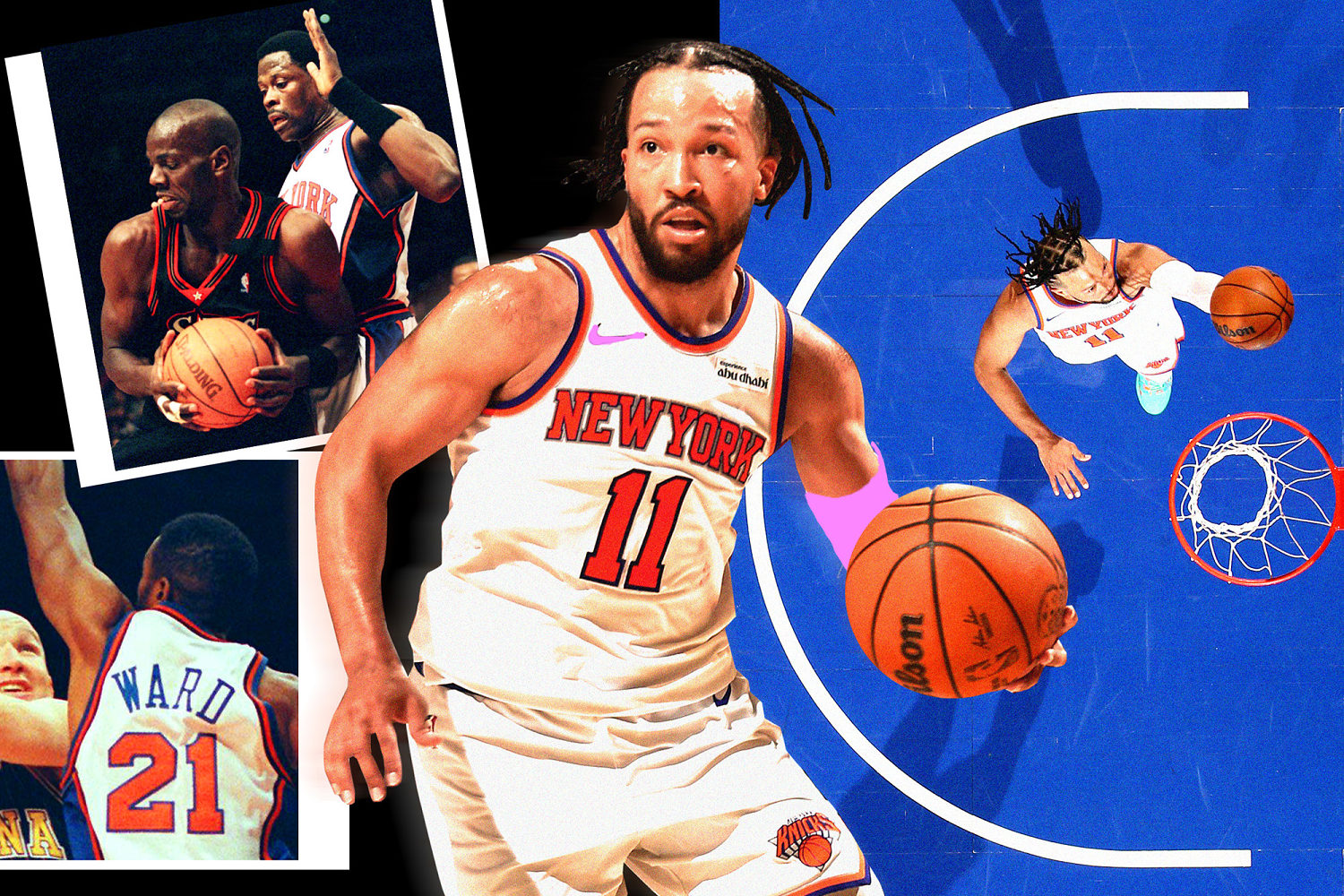
The modern National Basketball Association punishes teams anchored by sub-6-foot-2 guards who lack elite vertical athleticism. For a franchise to achieve sustainable postseason contention, the traditional roster architecture demands either a high-usage wing creator or a hyper-efficient, playmaking big man. The New York Knicks have inverted this paradigm. By building around Jalen Brunson—a player whose physical profile aligns closer to an early-2000s floor general than a 2026 positionless engine—the organization has executed a masterclass in idiosyncratic roster optimization.
Understanding the Knicks’ current competitive window requires moving past the narrative of legacy and nostalgia. The fact that Brunson’s father, Rick Brunson, was a reserve on the 1999 Knicks Finals team is a marketing coincidence. The mechanical reality is that Brunson’s production is the result of highly specific spatial optimization, elite footwork mechanics, and a front-office strategy designed to mitigate his defensive structural limitations while maximizing his elite isolation efficiency.
The Three Pillars of Brunson’s Offensive Efficiency
Brunson’s value proposition rests on his ability to generate high-efficiency looks without relying on elite top-end speed or verticality. His offensive output can be categorized into three distinct operational pillars.
                  [Brunson's Offensive Engine]
                               |
        -----------------------------------------------
       |                       |                       |
[Deceleration Profile] [Shot-Volume Inversion] [Decoupled Playmaking]
1. Deceleration Profile and Eccentric Force Application
Most NBA guards create advantages through explosive acceleration ($+\Delta v$). Brunson creates advantages through elite deceleration ($-\Delta v$). When driving into the paint, his ability to come to an instantaneous stop forces longer defenders to overrun their contest angles due to forward momentum.
This mechanical advantage relies on a high volume of lower-body eccentric strength. By utilizing jump stops, stride stops, and head fakes, Brunson consistently resets his pivot foot, forcing the defender to play in a state of constant recovery. He converts low-probability, contested paint touches into high-probability short mid-range attempts by utilizing his lower center of gravity to establish leverage against interior rim protectors.
2. Shot-Volume Inversion in the Mid-Range
Analytical roster construction over the past decade has deprioritized the mid-range jumper in favor of restricted-area finishes and above-the-break three-pointers. Brunson’s shot chart explicitly defies this trend.
He operates heavily within the 8-to-16-foot zone. Because he lacks the vertical explosion to routinely finish over elite drop-coverage rim protectors, he utilizes floaters, push shots, and short pull-ups before reaching the restricted area. This shot selection functions as an analytical counter-strategy: it exploits the deep drop coverages designed to take away layups, turning an analytically discouraged shot into a highly efficient weapon.
3. Decoupled Playmaking and Low-Turnover Usage
High-usage point guards typically display a strong correlation between assist volume and turnover rate. Brunson breaks this linear relationship. His playmaking is decoupled from high-risk passing windows. Instead of executing high-velocity cross-court skips, he leverages his scoring threat to force defensive collapses, utilizing simple, short-pocket passes to stationary shooters or baseline cutters.
This minimizes live-ball turnovers, which serves a dual purpose: it maximizes the Knicks' offensive possession efficiency and prevents opponents from generating high-efficiency transition opportunities.
Roster Architecture and the Defensive Structural Deficit
A point guard with a limited wingspan and a 6-foot-2 frame introduces an inherent defensive bottleneck. In isolation or switch-heavy defensive schemes, opposing offenses will hunting the weakest physical link. The Knicks’ front office, led by Leon Rose, neutralized this structural deficit not by attempting to transform Brunson into a lockdown defender, but by surrounding him with highly specific defensive archetypes.
The Compensatory Frontcourt Model
To sustain Brunson's high offensive usage, the defense must operate with a margin for error. The Knicks achieved this by prioritizing two specific player profiles:
- Hyper-Elastic Rim Protectors: Personnel capable of playing deep drop coverage to absorb perimeter blow-bys, ensuring that when Brunson is beaten on the perimeter, the interior shot contest is immediate.
- Switchable, Long-Wing Navigators: Players possessing the lateral quickness and length to fight through screens and pre-switch actions. This prevents opposing offenses from easily hunting Brunson via hunt-the-picker pick-and-roll schemes.
This defensive ecosystem transforms Brunson's role from a defensive liability into a neutral system actor. He is tasked primarily with low-rotation corner positioning and drawing offensive fouls through physical positioning, while the length behind him absorbs the primary driving lanes.
The Cost Function of High-Usage Postseason Systems
The primary vulnerability in the Knicks' operational framework is the physical toll dictated by Brunson's specific style of play. Unlike perimeter stars who generate clean looks via catch-and-shoot opportunities or elite elevation over contests, every possession handled by Brunson requires heavy physical friction. He initiates contact to create separation, absorbs hits in the paint, and logs high-mileage games under a demanding defensive system.
This creates a clear bottleneck as the postseason progresses. The efficiency of a deceleration-based offense drops if lower-body fatigue compromises the player's ability to halt momentum instantly. When the eccentric braking power diminishes, the defender's contest closes faster, converting high-efficiency short mid-range attempts into highly contested, low-efficiency blocks or altered misses.
[Increased Postseason Minutes]
       --> [Lower-Body Fatigue]
       --> [Reduced Deceleration Force (-Δv)]
       --> [Slower Separation Generation]
       --> [Contested/Altered Mid-Range Attempts]
Furthermore, an offense overly dependent on a single point of structural breakdown becomes predictable in a seven-game series. Teams with elite defensive coaching staffs will implement "blitz and recover" schemes designed to force the ball out of Brunson's hands before he can establish his preferred operating zones in the middle of the floor, testing the secondary playmaking capacity of the remaining roster.
Tactical Recommendation for Roster Optimization
To elevate this structural framework from a high-floor regular-season engine to an unbannable championship configuration, the organization must address the secondary creation deficit. The current system relies too heavily on Brunson generating advantages from a dead stop.
The strategic play requires acquiring or developing an off-ball, secondary connective playmaker capable of attacking advantages after Brunson has shifted the defense. This individual does not need to be a high-volume isolation scorer. Instead, they must excel at quick-decision second-side operations—attacking a closing defense, executing rapid extra passes, and hit contested catch-and-shoot opportunities at a high clip.
By offloading the initial creation burden across multiple possessions per quarter, the coaching staff can preserve Brunson’s lower-body eccentric strength for high-leverage leverage situations in the fourth quarter. This adjustment shifts the offensive ecosystem from a linear, single-point dependency into a dynamic, multi-layered threat profile capable of surviving elite postseason defensive adjustments.