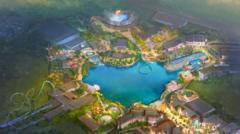
The industry cheerleaders are salivating over the projected figures for the UK’s latest theme park endeavor. They talk about visitor capacity, job creation, and the magic of regional investment. They are selling you a fairy tale built on outdated economics and a fundamental misunderstanding of the British consumer.
The math is easy to inflate, but reality is a brutal auditor. Every time a developer announces a multi-billion-pound attraction in the UK, the local press prints the brochure specs as if they were gospel. They cite the million-plus annual visitors, the "economic footprint," and the promise of a revitalized tourism sector.
I have watched companies burn nine-figure budgets on these "destinations" only to realize, three years into operations, that the UK climate and the British leisure habit do not support the American model of a mega-park.
The Seasonal Trap
The primary flaw in the "big numbers" argument is the obsession with peak capacity. Planners treat the year as a series of evenly distributed weeks. They ignore the brutal reality of the British shoulder season.
A theme park in Florida functions because it has a year-round weather engine that keeps the turnstiles clicking. A park in the UK, regardless of how many millions you sink into indoor attractions or climate-controlled queue lines, is fundamentally shackled to the school holiday calendar.
When you build a massive, capital-intensive facility, your fixed costs do not go on vacation in November. They sit there, bleeding cash, waiting for the February half-term. The "big numbers" presented in initial planning stages conveniently soften these troughs, assuming a mythical "staycation" trend will bridge the gap. It never does.
The Myth of Regional Revitalization
Local governments love these projects because they look great on a balance sheet before a single brick is laid. They promise thousands of jobs. Let us be precise about those jobs.
The service industry in the UK is suffering from a structural labor deficit. You cannot staff a sprawling, isolated theme park with a dedicated, expert workforce when you are competing with urban retail and hospitality centers that offer better transport links and more reliable hours. You end up relying on seasonal labor, which increases training costs and drives down the quality of the guest experience.
When the experience dips, the repeat visitor rate—the lifeblood of any attraction—evaporates. You are left with a park that requires constant, aggressive marketing spend just to fill the gates with first-time, one-and-done tourists. It is a treadmill that only moves in one direction: toward insolvency.
Why Investors Love the Wrong Questions
If you look at the "People Also Ask" queries regarding these developments, the focus is always on: "How many jobs will it create?" or "Will this boost local tourism?"
These are the wrong questions.
The right question is: "What is the lifetime value of a customer at this specific location, given the cost of acquisition and the extreme seasonality of the region?"
If you run that calculation, the answer is rarely positive. But investors do not want to hear that. They want a Ribbon-Cutting Event. They want a headline in a trade journal. They want to offload the asset to an institutional buyer before the first major capital refurbishment cycle hits at the five-year mark.
I have seen it happen repeatedly. Private equity buys in, pushes the growth narrative to the public, hits the exit, and leaves the operational shell to struggle with the maintenance backlog.
The Demographic Delusion
The UK population is not getting younger, and their leisure budget is not expanding to accommodate another high-ticket theme park. The middle-class wallet is under pressure from rising housing costs and stagnant wage growth. When families tighten their belts, the first item slashed is the weekend trip to a park that costs three hundred pounds for a family of four before they even buy a burger or a parking ticket.
You are not competing against other theme parks. You are competing against the sofa. Streaming services, high-end home gaming, and cheaper, more flexible leisure options are winning the war for the British weekend.
A Different Path
If you want to move the needle in the UK leisure space, stop building sprawling, land-hungry outdoor attractions. The future is compact, hyper-localized, and tech-integrated.
Imagine a scenario where developers stopped looking for massive plots of green belt land and instead focused on repurposing failing retail spaces in dense urban hubs. Instead of a park that requires a three-hour drive, build high-intensity, high-throughput experiences that people can access via public transit.
We need to stop trying to emulate the American "day out" culture. It does not fit. The British market craves high-quality, short-burst entertainment that integrates with existing social habits.
The Reality of Scale
Scale is not a virtue when your operating costs are tied to massive, static infrastructure. Scale is a liability.
Investors hide behind vanity metrics because they mask the lack of a sustainable product. They point to the "total addressable market" of the entire UK population, ignoring the fact that a theme park is a geographically limited product. Unless you are situated in a major transit artery with proximity to a massive metropolitan population, your effective catchment area is laughably small.
The industry ignores these truths because they are inconvenient. They disrupt the pitch. But as a participant in this sector, I can tell you that the next wave of theme park liquidations is already being written into the architectural blueprints of these "exciting new projects."
Look past the glossy renders and the impressive-sounding capacity stats. When you see a project claiming to defy the laws of British weather, geography, and consumer behavior, you are not looking at a business venture. You are looking at a monument to hubris.
The industry does not need more steel in the ground. It needs a reality check.