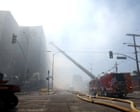
A standard warehouse fire usually wraps up in about twenty-four hours. Firefighters roll up, punch holes in the roof to vent the smoke, blast the flames with water, and go home. But the massive blaze at the Lineage cold-storage facility in Boyle Heights has been pumping noxious, gray smoke into the Los Angeles skyline for nearly a week.
If you live anywhere near East LA or the San Gabriel Valley, you’re likely breathing in the acrid fallout right now. Governor Gavin Newsom and Mayor Karen Bass both declared a state of emergency over the weekend. Yet, the building keeps smoldering.
The delay isn't due to a lack of effort. Over a hundred firefighters have been on the scene around the clock. The real issue is that this 500,000-square-foot facility wasn't built like a normal warehouse. It's basically a giant, reinforced thermos, and that design makes it almost impossible to extinguish from the outside.
Inside the Structural Thermos
To understand why this fire is dragging on, you have to look at how modern industrial freezers are built. The facility, known locally as the Big Bear warehouse, is constructed with thick corrugated steel walls. Those walls sandwich dense foam insulation, wrapped tightly with reinforced interior steel panels.
When a fire gets trapped inside a structure like this, the insulation does exactly what it was designed to do: it traps heat. Instead of letting the thermal energy escape, the building acts like an oven, keeping the core temperatures dangerously high.
Standard firefighting tactics don't work here. Normally, crews cut ventilation holes in a roof to release hot gases and restore visibility inside. But this roof was covered in a massive commercial solar panel array. Subcontractors were servicing those solar panels last Wednesday afternoon when the fire broke out. The heavily insulated roof and the twisted wreckage of the solar grid blocked crews from venting the building early on.
Without ventilation, the interior became a pitch-black maze of toxic smoke. The fire department had to pull crews out just fifteen minutes into the fight due to zero visibility and an immediate, terrifying secondary threat.
The Chemistry Problem
Industrial cold-storage units require massive refrigeration systems, and most of them rely on anhydrous ammonia. It's incredibly efficient for keeping millions of pounds of food frozen, but it's also highly toxic and flammable.
During the initial breakout on Wednesday, an ammonia line ruptured inside the facility. That changed everything. Firefighters couldn't safely enter a chemical cloud to chase down the flames. They had to retreat, shifting to a defensive posture to contain the fire from a distance.
[Initial Fire Outbreak] -> [Ammonia Line Ruptures] -> [Immediate Firefighter Retreat] -> [Defensive Operations from Distance]
Hazardous materials teams eventually stabilized the chemical threat by pumping the remaining ammonia out of the system and transporting it offsite. Air monitoring teams confirmed that no dangerous levels of ammonia escaped into the surrounding residential neighborhoods. But clearing the chemicals didn't solve the structural nightmare.
The weight of the collapsed roof flattened down onto floor-to-ceiling, heavy-duty steel rack shelving. This created a giant jumble of metal and debris. Because the structural integrity of the outer walls is now failing under the sheer weight of millions of gallons of water, sending firefighters inside is a suicide mission. Instead, crews are using heavy excavators to literally rip off the exterior steel siding, section by section, just so water cannons can reach the deep pockets of fire still burning within the insulation.
The 85-Million-Pound Biohazard
Even when the final embers are doused, the crisis won't be over. The facility holds roughly 85 million pounds of frozen food, including beef, poultry, pork, seafood, and bread, destined for grocery stores and restaurants across the West Coast.
With the power grid fried and the building compromised, that food is no longer frozen. It's rotting.
Los Angeles Fire Department Chief Jaime Moore noted that handling the decomposing food is the next major hurdle. Dealing with 85 million pounds of spoiled meat and dairy is a massive biohazard operation. If the smoke doesn't force neighbors to keep their windows shut, the impending smell of millions of pounds of rotting protein certainly will.
The South Coast Air Quality Management District has kept a strict air quality warning in place for Boyle Heights and surrounding areas. The smoke is loaded with PM2.5—microscopic particulate matter that travels deep into your lungs and bloodstream.
Surviving the Smoke
If you’re downwind of the plume, stop waiting for the fire to simply go away. Fire officials estimate the smoke will persist for at least another two to three days as crews open up concealed wall spaces. You need to protect your lungs right now.
- Seal your living space: Keep every window, door, and doggy door shut tightly.
- Adjust your HVAC: Set your air conditioner to "recirculate" so you aren't pulling the outdoor haze inside. If your system doesn't have this option, turn it off entirely.
- Upgrade your mask: If you have to step outside, a standard cloth or surgical mask won't cut it against PM2.5. Dust off an N95 or a P100 respirator.
- Utilize local relief centers: If your home is getting smoky or you don't have functional AC, move to one of the smoke relief centers opened by Los Angeles city and county officials.
This isn't a quick-fix situation. The very engineering that kept your food cold for years is what's keeping this fire alive, and it's going to take days of grueling, methodical demolition to finally put it out. Stay indoors, mask up when you can't, and keep your air filters running.