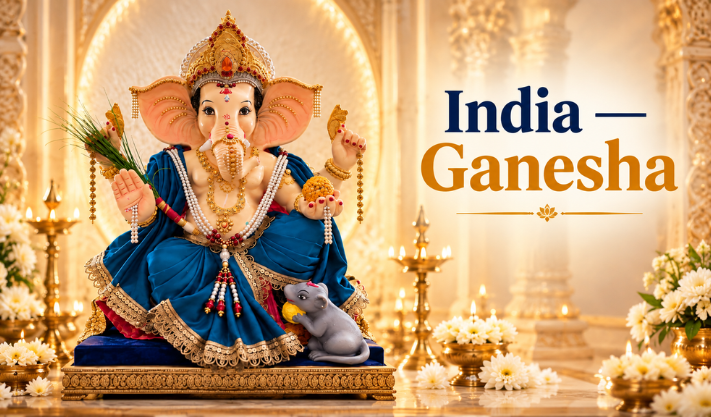
Lord Ganesha, the elephant-headed deity of wisdom, beginnings, and the removal of obstacles, commands one of the most remarkable geographical expansions in religious history. While orthodox Vedic texts once restricted ritual boundaries, maritime trade, royal politics, and migration carried his iconography far beyond the river valleys of the Indian subcontinent. Travelers often expect to find Ganesha solely within the incense-heavy shrines of Mumbai or Varanasi. Instead, they encounter him carved into cave walls in Southeast Asia, cast in bronze across European museums, and honored in private domestic altars in North America.
Understanding how a regional Hindu deity became a transcontinental fixture requires looking past simple geography. The spread of Ganesha reveals centuries of merchant routes, diplomatic alliances between ancient empires, and the fluid nature of syncretic worship. Don't miss our previous post on this related article.
Long before modern tourism connected continents, ancient traders crossed the Bay of Bengal laden with spices, textiles, and sacred texts. Indian merchants established trade outposts across Southeast Asia, bringing their administrative systems, art styles, and religious traditions with them. Local rulers in what are now Indonesia, Cambodia, Thailand, and Vietnam adopted Hindu statecraft to legitimize their rule, framing themselves as earthly reflections of cosmic order.
Ganesha occupied a vital role in this expansion because of his specific theological function. As the Lord of Beginnings and the Remover of Obstacles, he was the logical deity to invoke before embarking on dangerous ocean voyages or launching administrative projects. Port cities and maritime trade hubs erected shrines to ensure safe passage and commercial success. To read more about the context of this, Travel + Leisure provides an informative summary.
In Java and Bali, Indonesian artisans developed distinct interpretations of the deity. At temples like Candi Prambanan and archaeological sites across East Java, Ganesha appears seated with his legs crossed in the lalitasana posture, often adorned with regional skull-cap crowns and intricate floral motifs. The Javanese representation frequently emphasizes asceticism, depicting Ganesha with the third eye of wisdom and attributes associated with spiritual liberation. This integration shows that local populations did not merely copy Indian templates. They reinterpreted the deity through their own aesthetic and philosophical frameworks.
Further north in the Khmer Empire, which spanned parts of modern Cambodia, Thailand, and Laos, Ganesha held a prominent place in royal temple architecture. Khmer sculptors carved him into the sandstone walls of Angkorian monuments, sometimes endowing him with regional facial features and distinct ornamentation. While the dominant state religion shifted between Shaivism, Vaishnavism, and Buddhism over the centuries, Ganesha retained his utility as a mediator of barriers. He guarded the thresholds of temples and palaces, ensuring that structural and spiritual transitions remained unhindered.
As maritime networks extended toward East Asia, the deity underwent an even more profound transformation. In China, Ganesha arrived via Esoteric Buddhism, traveling along the Silk Road and maritime trade routes. Chinese Buddhist texts translated him as Daishō Shōten or Kangiten, depicting him either as a single elephant-headed figure or as a dual embrace form symbolizing the union of complementary cosmic forces.
Japan absorbed these esoteric traditions during the Nara and early Heian periods through monks who traveled to China for study. In Japanese esoteric lineages of Tendai and Shingon Buddhism, Kangiten assumed a complex role. Depicted privately rather than for public worship, the deity became associated with wealth, marital harmony, and the overcoming of inner demons. Japanese shrines dedicated to Kangiten remain restricted or private, preserving a lineage of ritual practice that diverged sharply from contemporary Hindu worship in India while retaining the core iconography of the elephant head.
The contemporary global presence of Ganesha operates through a different mechanism: diaspora migration and the establishment of transnational Hindu communities. Over the past century, migration waves from South Asia to the United Kingdom, Canada, the United States, South Africa, and the Caribbean transformed Ganesha into a visible symbol of cultural identity.
In these destination countries, public festivals like Ganeshotsav evolved from localized community events in Maharashtra into massive international celebrations. In Toronto, London, and Edison, New Jersey, public processions draw thousands of participants, bringing temporary traffic disruptions and vibrant displays of cultural pride to Western urban centers. These celebrations serve a double purpose for immigrant communities. They maintain continuity with ancestral traditions while asserting cultural visibility in multicultural societies.
At the same time, the iconography of Ganesha has detached itself from strict religious observance in global consumer markets. Yoga studios, boutique hotels, and interior design shops frequently display images or statues of the deity as a general motif for mindfulness, peace, and auspicious energy. This widespread adoption creates a distinct tension. For devout practitioners, treating the deity as mere decorative art trivializes sacred ritual. For cultural analysts, this diffusion demonstrates the extreme adaptability of Hindu symbols in a secularized global marketplace.
The trajectory of Lord Ganesha across nations and centuries illustrates that religious traditions are never static monuments. They are dynamic systems shaped by trade, political ambition, migration, and adaptation. By crossing physical and cultural borders, Ganesha transcended his origins as a regional deity to become a universal archetype for navigating change and confronting the unknown.