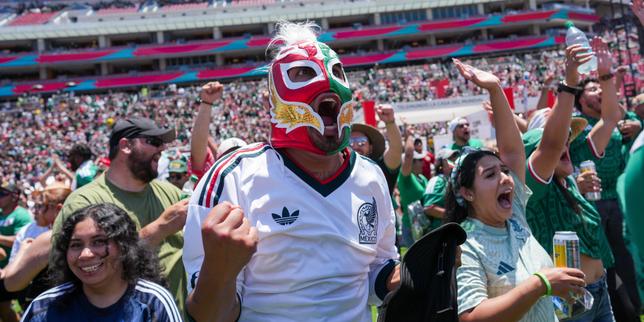
The stadium lights of a World Cup do not care about passports. When the whistle blows, forty thousand people scream for a ball crossing a white line, and for ninety minutes, the messy, fractured geography of our world is supposed to melt away. We are told sports are the ultimate equalizer. We are told the pitch is neutral ground.
But the grass does not grow in a vacuum.
Long before a ball is kicked, before the jerseys are printed or the tactics drawn on a whiteboard, there is the bureaucracy of movement. For some, a tournament begins not with a training camp, but with a visa application. And sometimes, the match is lost before anyone even steps onto the plane.
Jibril Rajoub, the head of the Palestinian Football Association, spent weeks preparing for a journey to the United States. He was not going to play. He is a bureaucrat, a political figure, a man whose job is to navigate the complex, often suffocating intersection of international athletics and Middle Eastern geopolitics. He was scheduled to attend a series of high-level meetings, to sit in the air-conditioned rooms where the future of global soccer is negotiated, and to represent a team that has spent decades fighting simply to be recognized on the global stage.
He never made it past the consulate.
The United States government denied his visa application. No grand explanation was offered. No dramatic press conference was held. Just a standard, cold piece of paper that effectively closed the border to a man recognized by FIFA, the world’s governing soccer body, as the legitimate voice of Palestinian sport.
To understand why this matters, you have to look past the political headlines and look at the dirt.
The Weight of the Passport
Imagine waking up every morning knowing that your ability to do your job depends entirely on the mood of a foreign embassy clerk. For athletes and sports officials from developing or politically turbulent regions, this is not a hypothetical anxiety. It is the baseline reality of their careers.
Consider the logistics of a modern national soccer team. You need training camps. You need international friendlies. You need to scout talent across continents. Now, add a layer of friction to every single step. A defender cannot make a match in Europe because his appointment at the embassy was delayed. A coach cannot join the team because his background check is taking six months. The federation’s president is barred from attending the very congresses where funding and infrastructure are allocated.
It is death by a thousand administrative cuts.
When the news broke that Rajoub was denied entry, the reaction followed a predictable, weary script. Critics pointed to his past political statements and his history within the Palestinian leadership, arguing that sports and politics cannot be separated when the official in question carries so much political baggage. Supporters called it a targeted attempt to silence a prominent voice and isolate Palestinian sports from the global community.
But the debate itself misses the deeper, more unsettling truth about modern sports.
We love the myth of the meritocracy. We want to believe that the eleven best players on any given day will win, regardless of where they were born or what language they speak. We watch documentaries about the triumphs of underdogs who overcame poverty and hardship to lift trophies. But we rarely talk about the gatekeepers who control the gates before the stadium even opens.
The denial of a visa is not just a personal inconvenience for one man. It is a reminder of the invisible borders that dictate who gets to participate in the global culture.
The Hidden Friction of the Beautiful Game
The international sports system operates on a fragile consensus. FIFA recognizes nations that the United Nations does not. It grants a form of sporting sovereignty to territories that are otherwise occupied, disputed, or unrecognized on a standard political map. For a few weeks every four years, the World Cup creates an alternate reality where every culture has a seat at the table.
Except when they do not.
The reality of international travel is deeply unequal. A passport from Germany, Japan, or the United States is a golden ticket, granting visa-free access to the vast majority of the planet. A passport from Palestine, Iraq, or Somalia is a barrier, requiring mountains of paperwork, thousands of dollars in fees, and a high probability of ultimate rejection.
This inequality shapes the very nature of competition. When a wealthy federation wants to organize a warm-up match, they book a flight and show up. When a marginalized federation wants to do the same, they must engage in a diplomatic campaign just to get their luggage through customs.
The system is rigged not by the referee on the field, but by the consulate in the city.
This is the friction that rarely makes the highlight reels. It is the story of the Olympic sprinter who trains on a dirt track because her federation cannot access international grants, or the young soccer prodigy who misses a trial with a Premier League club because his visa was denied three times. It is a quiet, administrative erasure that happens away from the cameras.
The Myth of the Neutral Pitch
We are living in an era where sports are increasingly weaponized as tools of soft power. Governments invest billions to host tournaments, buy historic clubs, and plaster their names across the chests of superstar athletes. They do this because they know that sport is the most powerful narrative engine on earth. It can reshape a country's image faster than any diplomatic mission.
But if sport is a tool of power, then the denial of access is an exercise of that power.
By refusing to allow the head of a recognized football association into the country, the host nation sends a message that transcends the rulebook of the game. It asserts that national security and foreign policy priorities will always trump the idealized neutrality of the sporting world.
Perhaps that is inevitable. Perhaps it is naive to think that a soccer tournament can exist in a vacuum, insulated from the brutal realities of global conflict and geopolitical alliances. The world is bleeding, and it is foolish to expect the stadium walls to keep the blood out.
Yet, there is something profoundly tragic about the capitulation to this reality.
If we accept that the pitch is just another battlefield, that the passport is more important than the performance, then we lose the very thing that makes sports worth watching in the first place. We lose the possibility of the unexpected. We lose the moments where an underdog, against all odds, forces the world to look at them not as a geopolitical problem, but as equals.
The Palestinian national team has continued to play, despite the travel restrictions, the canceled training camps, and the absence of their federation's leader at international meetings. They play on neutral ground in the Middle East, thousands of miles from home, in empty stadiums where the only sound is the echo of the ball hitting the net.
They keep playing because the alternative is disappearance.
The stadium in the United States will still be full. The lights will still turn on. The fans will still sing, and the goals will still be celebrated. The tournament will move forward, a massive, unstoppable machine of commerce and entertainment. But in the quiet corners of the press box and the executive suites, the empty seat reserved for the Palestinian delegation remains a silent testament to a different game.
One where the lines are drawn in ink, not chalk.