The court does not care about your grand plans. It does not care about the hours you spent sweating in empty gyms or the dreams you whispered into the dark when nobody was watching. When the afternoon heat bakes the turf until it turns slick and unpredictable, the game strips away everything until only two things remain. Raw will. Raw survival.
Arthur Fery stood on the baseline, the weight of a thousand expectations resting heavily on his young shoulders. Across the net stood Zizou Bergs, a competitor who moves with the terrifying efficiency of a machine designed solely to break an opponent's spirit. This was not just a match. It was a crucible.
Tennis at this level is often described in beautiful, sanitized terms. Analysts talk about baseline strategy, spin rates, and unforced errors. They treat the sport like a chess game played with yellow felt balls. But when you are down in the dirt, breathing in the scent of crushed grass and your own sweat, chess disappears. It becomes a street fight.
The Breaking Point
The pressure builds slowly at first. It starts in the calves, a dull ache that grows with every sudden change of direction. Then it moves to the lungs, making every breath feel like inhaling hot glass. Fery felt it early. The crowd was a wall of sound, a shifting mass of voices pushing him forward, but inside the white lines, he was entirely alone.
Bergs was relentless. Every return came back faster, lower, heavier. The first few sets vanished in a blur of blinding speed and tactical warfare, leaving both men pushed to the absolute edge of their physical capabilities.
Then came the blood.
It started as a metallic taste in the back of the throat. A sharp, unmistakable warmth that ruins your concentration. Suddenly, Fery was fighting two opponents at once: the man across the net and his own body. A nosebleed during a high-stakes, five-set epic is not just an inconvenience. It is a timer. Every stoppage breaks your rhythm, every drip reminds you that your physical engine is running on fumes.
Imagine trying to track a ball moving at well over a hundred miles per hour while your vision blurs and your breathing is constricted by cotton plugs stuffed hastily into your nostrils. It forces a choice. You can let the chaos overwhelm you, or you can accept the mess. Fery chose the mess.
The Geometry of Pain
To understand what it takes to survive a fifth set, you have to understand the sheer loneliness of the sport. There are no substitutions. No timeouts to talk to a coach. Your support box can yell until their throats are raw, but they cannot hit a single backhand for you.
Consider the physical reality of the fifth hour. Your muscles are no longer responding with the crisp precision of the opening minutes. The mind begins to play tricks. It tells you that dropping one point does not matter, that resting for just one game is acceptable. Yielding to that voice is how matches are lost.
Fery refused to yield.
With blood staining his shirt and the physical toll written clearly across his face, he dug his sneakers into the worn turf. He stopped trying to play perfectly. Perfection is a luxury for the early rounds, for sunny days when everything goes according to script. This script had been torn up hours ago. Instead of perfection, he relied on pure grit. He chased down balls that seemed entirely out of reach, sliding across the baseline with an desperation that electrified the stands.
Bergs looked across the net and saw something terrifying: an opponent who refused to acknowledge his own breaking point. When a competitor realizes that pain will not stop you, the psychological balance shifts. The hunter becomes the hunted.
The Final Accord
The closing games of a five-set match do not belong to the most skilled athlete. They belong to the person who can tolerate the highest level of discomfort.
Fery began to dictate the pace again, his movements jagged but incredibly purposeful. Every successful shot felt like a small miracle, a triumph of human spirit over a failing physical frame. The crowd sensed the shift. The atmosphere transformed from standard sporting spectatorship into something deeply communal, a collective push to drag the young Brit over the finish line.
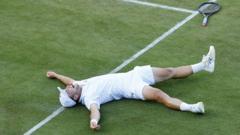
When the final point landed, the explosion of noise was almost deafening. Fery did not celebrate with a polished, practiced routine. He dropped to his knees, completely spent, the red stains on his gear a testament to the sheer cost of victory. He had fought off a formidable opponent, his own physical limitations, and the crushing weight of the moment.
We look for meaning in sports because they offer a rare glimpse of clear, unadulterated human truth. There are no shortcuts on the grass. You cannot fake your way through a five-set war when your body is actively giving out. You either have the depth of character to stand your ground, or you break. On this day, under the blazing sun, Arthur Fery proved exactly what he was made of.