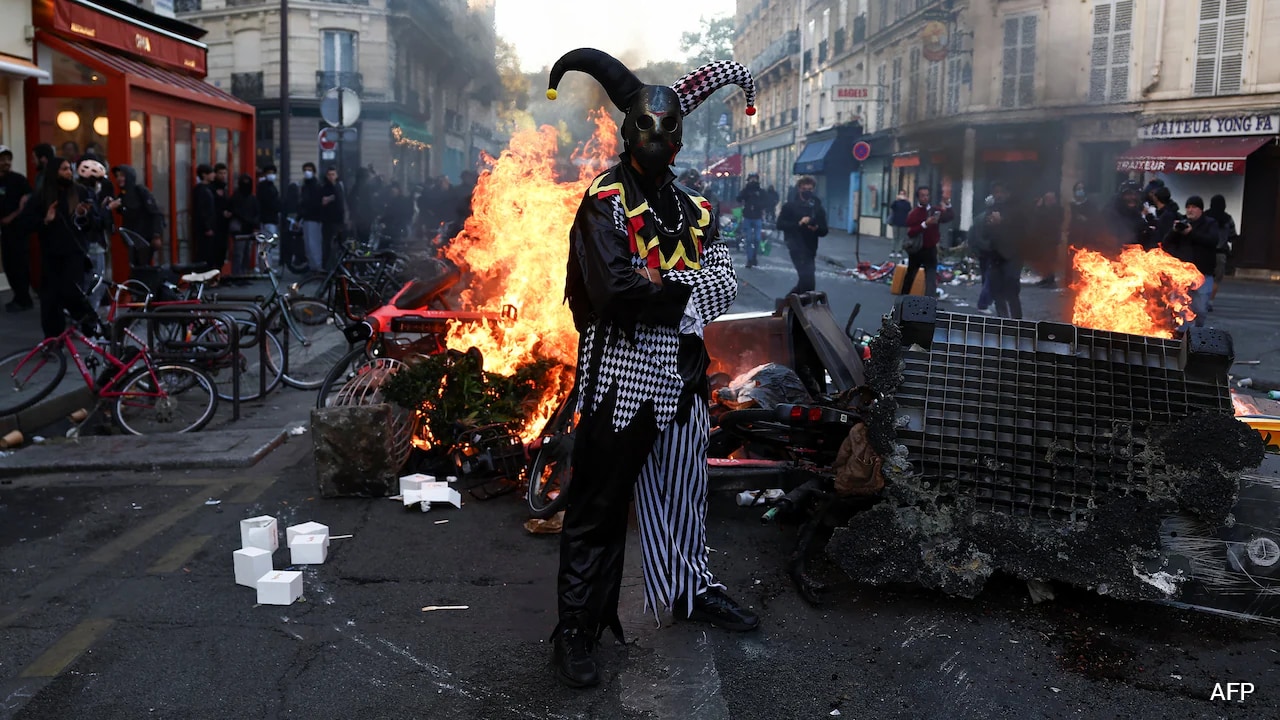
Online misinformation did not ignite the streets of France. It just showed up with a megaphone after the matches were already struck.
Whenever civil unrest flares across French cities—whether over pension overhauls, fuel taxes, policing, or agricultural mandates—a predictable media reflex kicks in. The "real story," we get told, is being buried beneath a tidal wave of viral fabrications, recycled footage from older riots, and coordinated bot campaigns. Fact-checkers sprint to debunk fake clips. Columnists warn that social feeds are poisoning public reason.
That framing is comfortable. It is also backward.
Treating disinformation as the root cause of French unrest lets entrenched institutions off the hook. It turns deep structural rot into a content-moderation problem. Worse, it assumes that if every misleading post vanished overnight, the underlying grievances—stagnant real wages, housing bottlenecks, municipal fiscal strain, and a widening gulf between Paris ministries and provincial or suburban realities—would quietly evaporate. They will not. Misinformation spreads in France not because people suddenly lost the ability to tell fact from fiction, but because institutional trust was already starved of oxygen.
The "Storm Of Lies" Narrative Misses How Unrest Actually Starts
Walk into any newsroom or policy briefing during a major French protest cycle and you will hear the same refrain: algorithms are radicalizing the public. Show a five-year-old burning car or a misattributed clip from another country, and commentators treat the viral post as the spark that set the neighborhood ablaze.
That gets the causal arrow backwards. Viral distortion is an accelerant and a mirror, not a primary ignition source.
Social platforms reward high-arousal material—outrage, panic, spectacle, and moral certainty. During fast-moving street clashes, information moves faster than verification on every side. Local residents film chaotic fragments from balconies. Activists push framing that highlights state force. Authorities release statements that sometimes lag behind events or get revised once video surfaces. Out of that fog come recycled images, exaggerated casualty claims, and outright hoaxes.
Calling that a "storm of lies" that obscures the "real story" treats public perception like a fragile glass bowl that would stay intact if only bad actors stopped throwing stones at it. Real-world unrest has a much heavier inertia. People do not risk tear gas, arrest, or property damage over a fake video unless they already feel cornered by concrete pressures in their daily lives. A manipulated clip can inflame a specific flashpoint for forty-eight hours; it cannot manufacture years of commuting strain, unaffordable rents, or a feeling that ballots barely shift policy.
In political communication research, media scholars like Pippa Norris and Ronald Inglehart have long documented how institutional trust shapes how citizens process information. When trust in government and legacy media is high, rumors get checked and dismissed quickly. When trust is already low, official denials often backfire—not because citizens are stupid, but because they suspect spin. Treating the information environment as an isolated pathology confuses the thermometer with the fever.
Why People Ask The Wrong Questions About French Protests
When protests erupt in France, coverage almost immediately funnels into narrow, repetitive questions. People type them into search bars every time sirens start wailing: Are foreign bots fueling the riots? Why are French people always protesting? Is social media destroying French democracy?
Each of those questions smuggles in a flawed premise.
"Are foreign bots fueling the riots?"
Even when state-linked accounts or opportunistic networks amplify divisive content during crises, blaming external manipulation for domestic combustion is a convenient alibi for local failure. Foreign actors rarely invent grievances from scratch; they spot existing fault lines and pour gasoline where dry timber already sits. If a society has high social cohesion, affordable housing, and responsive institutions, outside agitators look like background noise. When a society already feels brittle, even clumsy amplification hits a nerve. Obsessing over shadowy accounts distracts from fixing the brittle beams.
"Why are French people always protesting?"
This question rests on a caricature—the idea that France has a quirky national hobby of taking to the streets whenever life gets slightly inconvenient. Anyone who has spent real time studying French labor politics, municipal budgeting, or central-state administration knows better. French street politics is a pressure-release valve inside a system that often feels top-down between elections. When compromise feels blocked behind closed doors in ministries or executive decrees, the street becomes a negotiation table. Calling it a cultural quirk dismisses real friction as theater.
"Is social media destroying French democracy?"
Social media has certainly flattened editorial gatekeeping, accelerated outrage loops, and made crowd mobilization faster. Yet blaming platforms for democratic strain ignores decades of slower shifts: declining union density in many sectors, hollowing out of local civic intermediaries, suburban segregation around major metros, and recurring budgetary standoffs in the National Assembly. Platforms are amplifiers of existing incentives, not the sole architects of political gridlock.
Misinformation Isn't The Disease—It's The Symptom Of Broken Trust
To understand why false or misleading claims gain traction during French unrest, you have to look at epistemic trust—the degree to which ordinary people believe institutions are both competent and honest with them.
When epistemic trust erodes, information ecosystems fragment into competing counter-archives. One person trusts a national broadcaster; another trusts a local Telegram group or an activist livestream; a third assumes every official briefing is sanitized PR. In that environment, "the real story" is no longer a single authoritative bulletin handed down from above. It becomes a contested terrain where different groups bring competing receipts.
I have watched organizations and public-affairs teams burn millions of dollars trying to fight a trust deficit with better slide decks, glossier explainer videos, and louder fact-check threads. I have seen campaigns pour huge budgets into "myth-busting" hubs only to watch engagement stall because the audience doubted the messenger's motives before reading a single word. You cannot out-message a credibility gap with sheer volume. If people suspect an institution hides uncomfortable trade-offs behind technocratic jargon, correcting a viral clip without addressing the underlying grievance feels like a lawyer winning a technicality while the client's house burns down.
Consider a thought experiment. Imagine a scenario where every single misleading post, doctored video, and coordinated rumor about a major protest wave is scrubbed from the internet within ten minutes of appearing. Every claim is cleanly labeled, every timestamp is verified, and every bot network is shut down. Would the protests end? Only if the underlying dispute—say, a pension rule, a policing practice, a farm income squeeze, or a local tax burden—was actually resolved. Clean feeds do not pay higher rents or lower fuel costs.
What Analysts And Operators Miss On The Ground
There is a wide gap between watching unrest from a screen in Paris, London, or New York and reading the mechanics up close.
From afar, protests often look monolithic: France is burning, youth are revolting, populism is surging. Up close, unrest is rarely one single movement. A spark in one neighborhood or sector can draw in very different groups with overlapping—or even conflicting—motives. Local youths with longstanding grievances against police, workers defending specific protections, small business owners hit by disruptions or costs, and political opportunists trying to ride the wave can all share the same headlines without sharing the same playbook.
Standard commentary flattens that complexity into neat moral binaries. Either the protesters are heroic defenders of justice, or they are lawless vandals manipulated by bad actors and online falsehoods. Both caricatures are lazy. Real politics is messier. A protest can involve genuine, justifiable anger over economic pressure or heavy-handed policing and real destruction, looting, or dangerous falsehoods at the same time. Holding both truths at once is harder than picking a side, which is why pundits rarely do it.
Political sociologists like Charles Tilly and Sidney Tarrow spent careers mapping how contentious politics works in modern states. Their core insight holds up stubbornly: mobilization rises and falls with political opportunities, threat perception, and organizational networks—not merely because a clever meme went viral. A viral rumor can speed up coordination during a flare-up, yet without real grievances and social ties on the ground, online outrage stays mostly on the screen.
How To Actually Read Unrest Without Getting Played
If you want to understand what is happening during French unrest—whether you are an analyst, an investor, a policy observer, or a reader trying to cut through noise—stop treating viral falsehoods as the main plot. Treat them as a diagnostic signal.
1. Track the material friction first, the viral clip second
Before debating whether a video was misdated, ask what concrete pressure was already building before the camera rolled. Look at purchasing power, housing costs, municipal debt, agricultural margins, policing disputes, or legislative bottlenecks. Those pressures set the floor for how far unrest can spread.
2. Treat every viral clip as a claim, not proof—and ask why it spread
When a dramatic video circulates, do not just ask Is this real? Ask Why did thousands of people want this to be true right now? A fake or misattributed clip that goes viral usually touches a raw nerve—fear of escalation, anger at perceived double standards, or frustration with official silence. The lie is the vehicle; the nerve is the destination.
3. Separate street disorder from policy legitimacy
Conflating every broken window with the entirety of a protest movement is a classic analytical trap; so is pretending property damage and violent clashes do not matter. Watch how different actors—unions, local mayors, national ministers, neighborhood groups, and political parties—distance themselves from or lean into escalation. That tells you where real leverage sits.
4. Watch local municipalities, not just national soundbites
National speeches make great television, yet local mayors, prefects, transit operators, and neighborhood associations often feel the operational shock first. Shifts in local order, public transport disruption, and municipal response usually reveal trajectory earlier than cable-news panels.
Where This Contrarian View Can Go Wrong
Pushing back against the "online lies ruined the real story" narrative has real blind spots, and pretending otherwise would be dishonest.
First, downplaying disinformation can slide into underestimating how fast false narratives can trigger real-world harm. Rumors about police conduct, attacks, or imminent crackdowns can pull crowds into dangerous confrontations in real time, even when the underlying premise is false. A lie does not need to invent a grievance to turn a tense standoff violent.
Second, dismissing platform dynamics too far misses how modern algorithms compress reaction cycles. When a clip spreads across messaging apps and short-form feeds in minutes, officials and journalists often react to distorted framing before verified facts catch up—and sometimes the initial misperception hardens into political reality even after a correction appears.
Third, focusing heavily on structural grievances can make an observer sound overly deterministic, as if human agency, leadership choices, and bad tactical decisions on both sides of the barricade do not matter. They do. A poorly phrased ministry statement, a heavy-handed perimeter tactic, or a reckless call to escalate can turn a manageable standoff into a multi-week crisis.
Still, none of those risks changes the core hierarchy. Grievances and institutional strain create the tinder. Distrust makes people vulnerable to manipulation. Online falsehoods blow on the embers.
If you want to find the real story of unrest in France, stop blaming the wind and start inspecting the dry wood.


