Ink smells different when it is meant to outlive you.
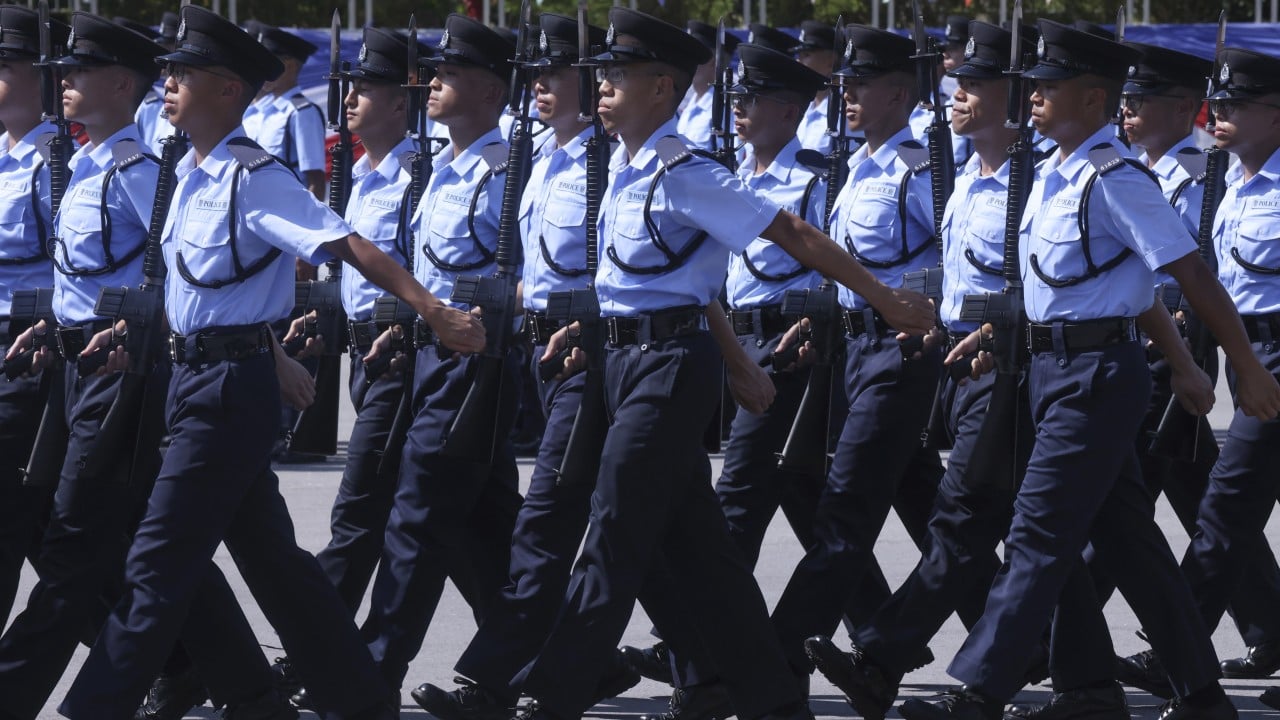
Consider the weight of a holster. For decades, the leather has carried the quiet friction of split-second choices made in the damp neon alleys of Kowloon or the packed, vibrating carriages of the MTR. When an officer draws a weapon, or lowers one, the physical action takes a fraction of a second. But the architecture of that decision—the years of conditioning, the cultural muscle memory, the subtle shifting expectations of a restless public—takes decades to build.
Now, look at a textbook.
They do not usually sit next to each other in the popular imagination. We prefer our security forces neat, sharp-edged, and unambiguous. We like to think of order as something enforced rather than something studied. Yet, inside a quiet room overlooking the harbor, a transformation is underway that refuses to fit into the old, cinematic stereotypes of police work. Hong Kong is building an academy. Not just a drill square with freshly painted white lines, and not just a firing range where paper targets flutter in the exhaust fans.
This is a degree-granting institution.
Picture Officer Chan. He is thirty-two years old, built like a middle-distance runner who spends too much time sitting behind a desk filing incident reports about digital fraud. His uniform is ironed crisp, but his eyes carry the heavy, distinct fatigue of a man who spent his Tuesday night talking down a distraught teenager on a pedestrian overpass while three dozen smartphones recorded the scene from different angles, capturing every micro-expression for an audience that had already decided how the story ended before it began.
Chan does not need another lecture on baton retention. He needs to understand why a twenty-year-old economics dropouts salary can vanish into a decentralized crypto-tumbler in three clicks. He needs to understand the strange, fractured psychology of a city where people live closer together than almost anywhere else on Earth yet often experience absolute, terrifying isolation.
This is the invisible crisis facing modern policing everywhere, though few admit it out loud. The streets have outgrown the manual.
For generations, the training was practical, physical, and insular. You learned the penal code like a catechism. You learned how to march, how to arrest, how to maintain a stoic silence when the crowd began to press in close with cameras raised like shields. It was a trade, passed down from sergeant to constable like an old carpentry secret.
But a trade is no longer enough when the battlefield is algorithmic.
When financial scams cross four borders before the victim has even hung up the phone, a street-level constable is no longer just a peace officer; they are an amateur forensic accountant, a crisis counselor, a diplomat, and a digital investigator all before lunch. The old model—relying on intuition and street smarts—is like trying to navigate a supersonic jet with a compass and a hand-drawn map.
That is why the announcement of the new international police academy and its specialized degree programs is not merely an institutional update. It is a quiet admission of vulnerability. It is the establishment looking at the complexity of the twenty-first-century city and realizing that raw authority has an expiration date.
Authority must now be literate.
Think about what it takes to sit in a lecture hall after eight hours of patrolling a humid wet market where the language of survival is fast, slang-heavy, and deeply skeptical of anyone wearing a badge. You are tired. Your boots still smell faintly of salt water and diesel. And the professor at the front of the room is talking about comparative criminal justice frameworks, transnational money laundering vectors, and the ethical philosophy of public trust.
It is dry work. It is demanding. There are no sirens.
Yet, this is where the real work of modern security happens. It happens in the slow, grinding process of learning how human beings behave under pressure, how criminal networks adapt to new surveillance technologies, and how a police force can maintain legitimacy in a world where every misstep is broadcast instantly to millions.
Critics will look at this and see mission creep. They will ask why cops need degrees in strategic leadership or cyber criminology when their primary job is to walk the beat and keep the peace. It is a fair question, born of a nostalgia for simpler times—times that, if we are being completely honest, probably never existed quite the way we remember them.
The reality is that complexity cannot be fought with simplicity.
Imagine a cybercrime syndicate operating out of an unmarked office park in Tsuen Wan, funneling millions through shell companies in three different time zones. The detective tracking them cannot simply kick the door down on a hunch. They have to trace digital breadcrumbs across jurisdictions, decode encrypted chat logs, and understand the intricate legal hurdles of international evidence sharing. If our protectors are not as intellectually agile as those who seek to exploit the system, the system collapses. Not with a dramatic explosion, but with the quiet, devastating erosion of public safety.
This new degree program is an attempt to bridge that gap. It borrows from the rigor of top-tier universities while keeping its boots planted firmly in the mud of real-world operational challenges. It treats policing not as an occupation of muscle, but as a profession of intellect.
There is something inherently humbling about watching a seasoned veteran open a textbook on behavioral psychology. You can see the initial resistance—the instinctive distrust of academic theory by someone who has spent ten years breaking up street fights. But then comes the moment of recognition. A case study is discussed, a pattern is revealed, and the officer realizes that what felt like chaos on the street actually follows a predictable, understandable human rhythm.
That is the moment the badge changes meaning.
It stops being just a symbol of state power and becomes a tool of profound comprehension. It acknowledges that to protect a society, you must first understand its fractures, its fears, and its frantic desire for safety.
As the academy prepares to open its doors, the physical buildings will get the headlines. The ribbon cuttings, the glossy brochures, the architecture renderings showing glass facades reflecting the Victoria Harbour skyline—these will dominate the press releases. But the real architecture is happening elsewhere.
It is happening in the minds of men and women who are learning to read the city not just as a grid of streets to be patrolled, but as a living, breathing text that requires deep, sustained attention.
The night shift will still end in exhaustion. The radio will still crackle with distress calls that defy easy categorization. But when the sun comes up over the harbor, painting the concrete towers in a pale, amber light, the officer walking down the steps of the station will carry something new in their pocket alongside the radio and the cuffs.
They will carry the quiet confidence of someone who has learned to think as fast as the world is changing.