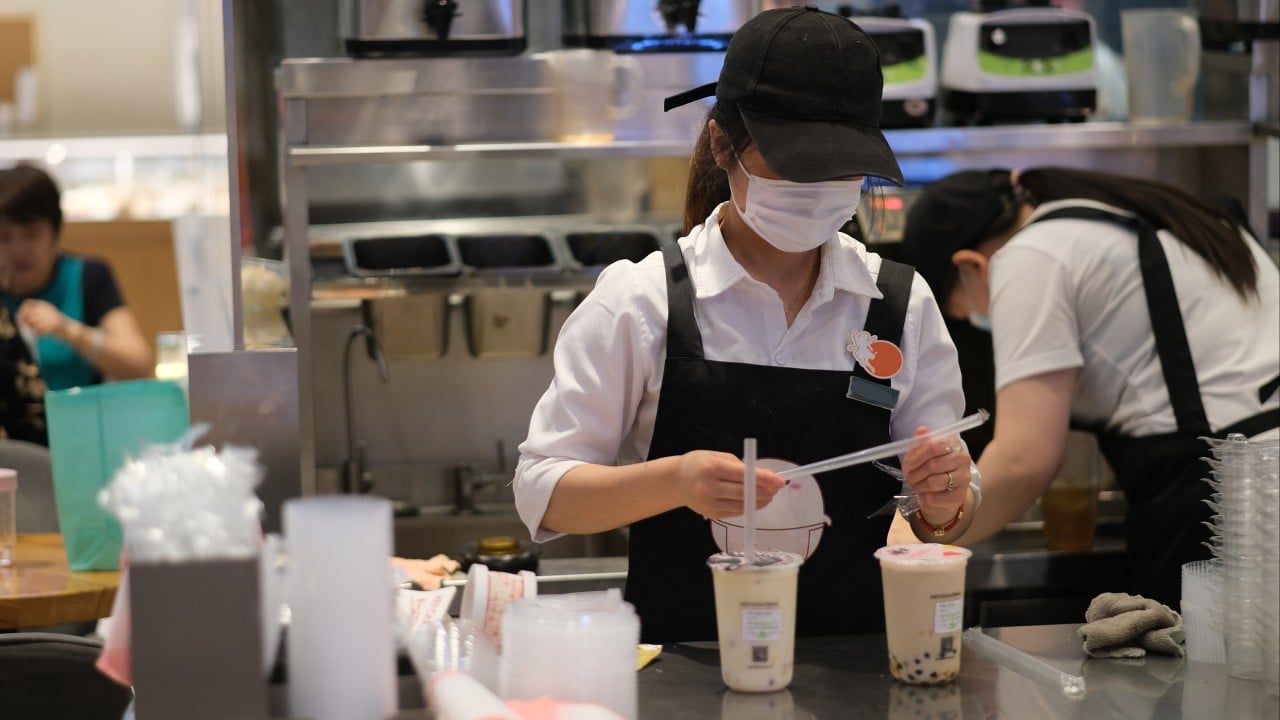
Wang Wei stands behind a counter of polished stainless steel, his hands moving with the practiced, robotic rhythm of a man who has made four hundred cups of the same drink since sunrise. The smell is cloying—a mix of artificial taro, scalded milk, and the ozone of a high-speed sealing machine. Outside his shop in a mid-sized city in Zhejiang, a delivery driver waits impatiently, tapping a helmet against a thigh.
A year ago, this drink cost eighteen yuan. Today, a neon sticker on the glass screams a different story: 9.9 yuan.
Wei isn’t celebrating the high volume of orders. Every time that machine clicks and heat-seals a plastic lid, he is losing more than just a few cents in margin. He is watching the collapse of an aspiration. He is a foot soldier in a scorched-earth price war that is currently cannibalizing China’s massive tea-drink industry.
The Race to the Floor
For a decade, the "New Style Tea" movement was the darling of Chinese venture capital. It was supposed to be the sophisticated, healthier successor to the powdered creamers of the nineties. Brands like HeyTea and Nayuki Tea built glass-walled cathedrals in high-end shopping malls, charging thirty yuan ($4.15) for a cheese-topped grape infusion. It wasn't just tea. It was social currency.
Then the economy shifted.
The swagger of the middle class cooled. Suddenly, paying the price of a full lunch for a single cup of jasmine tea felt less like a lifestyle choice and more like a lapse in judgment. The response from the giants was swift and brutal. They stopped selling luxury and started selling proximity to zero.
Mixue Bingcheng, the king of the low-end market with its ubiquitous "Snow King" mascot, already had the bottom floor locked down with four-yuan lemonades. To compete, the premium brands had to descend. They stripped away the fresh fruit, replaced expensive organic milk with cheaper alternatives, and slashed prices into the single digits.
The consumer won, or so it seemed. But in the backrooms of franchises across the country, the math has stopped making sense.
A Thousand Cuts
Consider the anatomy of a ten-yuan cup of milk tea.
The raw ingredients—tea leaves, milk or creamer, sugar, pearls—take up a chunk. The plastic cup, the straw, and the branded carry-bag take another bite. Then there is the platform fee for delivery apps, which can swallow twenty to thirty percent of the total price. Add in the rent for a high-traffic storefront and the electricity to run industrial chillers.
What remains for Wei is a sliver.
"If I sell five hundred cups a day, I can pay the rent and my two staff members," Wei says, rubbing a wrist sore from shaking canisters. "If I sell four hundred, I am paying for the privilege of standing here."
The industry is now a volume game where the only way to survive is to be massive. This has triggered a frantic expansion. Brands are no longer looking for the best street corners; they are looking for every street corner. In some neighborhoods in Chengdu or Shanghai, you can find five different tea shops within a two-minute walk of each other.
This density creates a paradox. To lure customers away from the shop next door, brands launch "Buy One Get One" promotions or deep-discount coupons on Douyin. This drives traffic, but it also trains the customer never to pay full price again. The moment the promotion ends, the crowd vanishes, migrating to the next shop offering a nine-yuan deal. It is a nomadic loyalty, anchored only to the lowest number on a screen.
The Invisible Toll on Quality
When profit margins are squeezed until they bleed, something has to give. Usually, it is the one thing that made the industry special in the first place: the product.
In the early days of the boom, you could see staff hand-peeling fresh grapes or mashing real strawberries. Today, that labor is too expensive. The "New Style" is reverting to the old style. Pre-mixed syrups, shelf-stable concentrates, and powdered additives have returned to the supply chain. They are easier to store, faster to pour, and cheaper to buy in bulk.
We are witnessing the "instant-ification" of a premium product.
This isn't just about taste. It's about a betrayal of the brand promise. If a luxury brand sells a budget version of itself, it risks erasing the reason it existed. When a premium tea shop starts tasting like a convenience store fridge, the brand equity evaporates. But the giants are trapped. If they don't lower prices, they lose market share. If they do, they lose their soul.
The Franchise Trap
The most tragic figures in this narrative aren't the CEOs in Beijing or the billionaire founders of Mixue. They are the individual franchise owners—the middle-class families who poured their life savings into a "proven" business model.
In China, franchising is often sold as a shortcut to the American—or Chinese—dream. You pay a fee, you get the equipment, and you get the brand name. But in a price war, the franchisor often wins while the franchisee drowns.
Large corporations make money on the supply chain. They sell the ingredients and the cups to the shop owners. Even if the shop owner is barely breaking even on a 9.9 yuan promotion, the corporate headquarters is still profiting from the sheer volume of sugar and plastic they are moving. They have shifted the risk downward.
The shop owner is the one who has to deal with the rising cost of labor. They are the ones who face the landlord when the rent goes up. They are the ones who stay awake at night wondering if the new tea shop opening across the street will be the final blow.
The Bubble and the Pin
Economists often talk about "involution"—a term that has become a viral buzzword in China. It describes a process where intense competition leads to no progress, only exhaustion. It is a treadmill where everyone is running faster just to stay in the same place.
The tea industry is the poster child for involution.
Brands are now experimenting with coffee, snacks, and even perfume to diversify their income. They are expanding into Southeast Asia, hoping to find "blue ocean" markets where the price wars haven't yet turned the water red. They are pouring money into automated tea-making robots to eliminate the need for human staff entirely.
But technology can’t solve a fundamental lack of demand. China’s youth, the primary consumers of these drinks, are facing a tough job market. They are "lying flat" or "letting it rot," rejecting the high-pressure lifestyle of their parents. A nine-yuan milk tea is a small, affordable luxury—a "poverty-friendly" dopamine hit.
Yet, even that small joy is becoming mechanized.
The Ghost in the Machine
Back in Zhejiang, Wei’s shop gets an order for ten cups of Oolong Milk Tea. It’s an office order. He begins the dance again.
He doesn't look at the tea. He looks at the timer. The timer is his master. The delivery app tracks his "preparation time" to the second. If he's too slow, his ranking drops. If his ranking drops, he gets fewer orders. If he gets fewer orders, he dies.
There is a hollow feeling in his chest. He used to like tea. He used to enjoy the way the leaves uncurled in hot water. Now, tea is just a chemical component in a logistics puzzle.
The industry’s "thirst for profits" isn't a sign of greed. It’s a sign of desperation. When everyone is fighting for the last scrap of food, nobody stops to ask if the meal is actually worth eating.
Wei finishes the order and bags it. He hands it to the driver, who is already halfway out the door before the bag handle is fully extended. The shop is quiet for exactly four seconds before the printer chimes again. Another order. Another 9.9 yuan. Another step toward a horizon that never seems to get any closer.
He reaches for a fresh cup. The plastic is thin, cold, and entirely disposable.