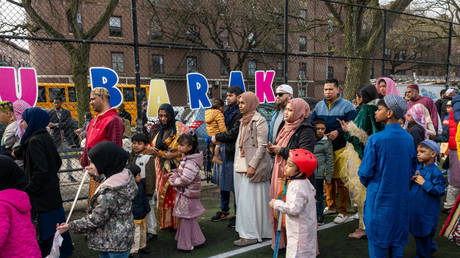
When California joined Washington to officially recognize Eid al-Fitr and Eid al-Adha as state-acknowledged holidays, headlines treated the event as a routine victory for pluralism. Public schools gained mechanisms to accommodate student absences, and state workers secured paths toward holiday credits. Yet beneath the celebratory press conferences lies a much harder administrative and social reality. Official recognition is not the destination. It is the starting gun for an institutional machinery that has spent over two centuries operating on a strictly Judeo-Christian rhythm.
To understand why this shift matters—and why its implementation is bound to expose deep friction—we have to look past the symbolic value of a pen stroke. Government calendars are not neutral tools. They dictate economic productivity, municipal resource allocation, testing schedules, and traffic patterns. When a state housing over one million Muslims formally integrates Eid into its structural framework, the state is forced into an uncomfortable collision with its own logistical inertia. Recently making headlines recently: Inside Iran's Winter Energy Crisis and the Strategic Fallout of Facility Strikes.
The Mechanics of Structural Integration
Public policy changes rarely happen in a vacuum. Washington set an early precedent, and California’s recent adoption under Assembly Bill 2017 formalized a long-overdue accommodation. But school districts and public agencies are now grappling with the mechanics. Unlike fixed-date holidays like the Fourth of July, Islamic holidays follow the lunar calendar. They shift backward by approximately eleven days every Gregorian year.
This variability creates a permanent headache for institutional planning. School boards that schedule standardized testing blocks months in advance must now build administrative flexibility into academic calendars that were never designed to fluctuate. Human resources departments in state agencies face parallel headaches. Managing floating holidays or compensatory time off for major religious observances requires tracking systems that can handle shifting lunar computations without breaking labor agreements. Additional insights regarding the matter are explored by Associated Press.
Consider a hypothetical school district in central California attempting to manage teacher absenteeism, substitute teacher shortages, and synchronized state testing during a spring semester when Eid al-Fitr coincides with a peak evaluation window. The law permits school closures through local procedures, but implementation is decentralized. Wealthy districts with robust administrative buffers will adapt smoothly. Underfunded districts will struggle, turning what is meant to be an inclusive civic accommodation into a localized logistical scramble.
The Private Sector Disconnect
State recognition applies strictly to public institutions. Private employers face zero legal mandates to provide paid time off or operational closures for Eid, creating a stark two-tier reality for American workers.
For the millions of Muslim Americans working in tech, healthcare, logistics, and corporate finance, state-level validation of Eid does not automatically translate into a day off. They must still navigate the delicate dance of requesting vacation days, often burning annual leave for holy days that their Christian colleagues receive automatically through standard Christmas and Easter closures.
This gap exposes the limits of government-led cultural shifts. While state endorsement provides a powerful rhetorical shield against workplace discrimination, it leaves the burden of accommodation squarely on the individual employee. Corporations talk endlessly about belonging and inclusivity initiatives, yet very few have restructured their floating holiday policies to automatically absorb non-Western religious calendars. Until Fortune 500 companies follow the lead of state legislatures, the lived experience of religious minority workers will remain defined by negotiation rather than right.
Navigating the Political Backlash
Every institutional shift generates resistance, and the formalization of Islamic holidays is no exception. While governors in Washington and California framed these bills around civic inclusion, the legislative battles revealed a persistent undercurrent of anxiety regarding cultural change. Critics routinely frame such measures through the lens of exceptionalism, questioning why state machinery should adapt to non-traditional calendars.
This pushback misses the fundamental demographic trajectory of the United States. The Muslim population in the country has more than doubled over the last two decades, transforming transient immigrant communities into deeply rooted multi-generational constituencies. State recognition is not an imposition of foreign tradition; it is an administrative adjustment to domestic reality. When a state’s tax base, civic leadership, and labor force diversify, public institutions must eventually reflect that baseline.
Yet, acknowledging this reality requires intellectual honesty about the friction involved. Inclusion is messy. It disrupts standard operating procedures, forces difficult conversations about secularism and religion in public space, and demands that institutions abandon the lazy comfort of a monolithic calendar.
The real test of these new laws will not occur in the celebratory atmosphere of a bill-signing ceremony. It will happen in the quiet administrative offices where school calendars are drafted, in the corporate boardrooms where PTO policies are written, and in the everyday interactions of workplaces trying to figure out what it actually means to function as a pluralistic society. State recognition has opened the door. What happens next depends entirely on whether institutions have the structural grit to walk through it.
California designates two Muslim holy days as state holidays, excusing student absences
This video provides an overview of how California's legislative shift affects local public schools and student attendance policies.