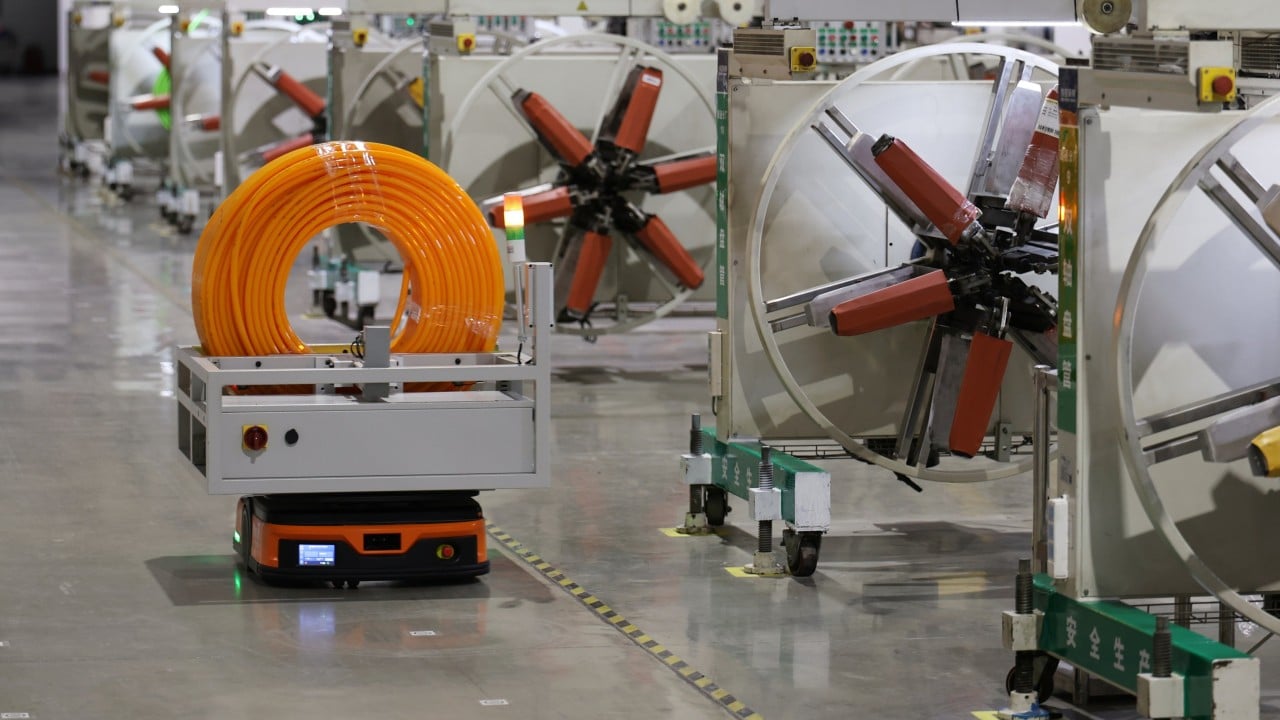
Every western financial commentator is currently hyperventilating over Beijing's latest hardware push. The standard narrative runs on pure autopilot. President Xi bets big on artificial intelligence, advanced semiconductors, and hyper-automated smart factories, transforming the nation into an unstoppable manufacturing juggernaut that leaves Silicon Valley in the dust.
It sounds terrifying if you live in Detroit or Stuttgart. It is also fundamentally wrong.
I have spent the past decade auditing industrial supply chains from Shenzhen to Shandong. I have watched billions of dollars in state-backed capital vanish into concrete shells filled with idle multi-axis CNC machines and ghost server racks. The conventional wisdom treats factory automation and artificial intelligence as a magic wand. If you add enough robots, productivity shoots up, costs plummet, and global dominance follows.
That theory ignores the brutal math of demographics, domestic consumption, and the law of diminishing returns on capital misallocation. Beijing is not engineering a technological breakout. It is executing the most expensive supply-side distraction in modern economic history, doubling down on hardware capacity while the demand side of the global economy quietly rots.
Let us dismantle the three core myths driving this industrial panic.
The Myth of Infinite Demand for Industrial Hardware
The dominant panic assumes that if China builds ten thousand automated smart factories, the world will happily absorb the output. This view belongs in 2010.
We are living through a historic transition where industrial capacity far outstrips global purchasing power. You can strap the most sophisticated neural network onto an injection molding machine, but if the middle classes in the west are squeezed by housing costs and inflation, and domestic consumers at home are nursing a multi-trillion-dollar real estate hangover, those smart factories are just printing unpayable debt.
I watched a provincial governor proudly show off a lights-out facility producing EV components. It was a marvel of modern engineering. Zero human workers on the floor. Autonomous guided vehicles ferrying magnesium frames across polished epoxy floors. When I asked about utilization rates, the local managers squirmed. The plant was running at thirty-five percent capacity because export markets were slapping on tariffs and local buyers could not afford the end product.
Throwing artificial intelligence at a structural overcapacity crisis is like installing a V8 engine in a car with no wheels. You are burning energy to go nowhere faster.
Silicon Nationalism Meets the Laws of Physics
Then there is the semiconductor obsession. The narrative states that export controls and sanctions have forced Beijing into an indigenous innovation miracle, spawning domestic chip champions that will soon render foreign silicon obsolete.
Let us look at the data instead of the state media press releases. Advanced lithography is not a software problem you can solve by holding hackathons or throwing subsidies at state-owned enterprises. It is a material science and precision engineering nightmare. The supply chain for extreme ultraviolet tools spans optics from Carl Zeiss in Germany, laser sources from Cymer in San Diego, and specialized chemicals from dozens of small Japanese firms.
When domestic designers try to spin up domestic alternatives without these interlocking dependencies, yields suffer. Low yields mean astronomical unit costs. You can mandate that every state-backed server farm buy homegrown accelerators, but you are effectively taxing your own domestic tech sector to keep inefficient semiconductor foundries alive. That is not industrial policy; that is a wealth transfer mechanism designed to mask systemic vulnerability with vanity projects.
True technological leadership comes from market-driven feedback loops where failure means bankruptcy, not from administrative edicts backed by endless central bank credit.
The Demographic Wall No Robot Can Scale
The most glaring blind spot in the industrial power play thesis is the labor force itself. The rationale for this automated pivot is simple: the population is aging, the workforce is shrinking, and machines must replace human hands.
Here is the catch. Robots do not buy washing machines. Robots do not purchase automobiles, book holiday travel, or upgrade their smartphones every two years. By shifting capital away from household income support and directly into heavy capital expenditure for industrial hardware, policymakers are accelerating the very imbalance threatening their economic model.
For thirty years, the global growth engine relied on Chinese households suppressing consumption to build industrial infrastructure. That model worked during a period of rapid urbanization and catch-up growth. It breaks down completely when you reach the frontier. You cannot export your way out of a domestic consumption deficit when the entire developed world is pushing back against trade imbalances.
The state pours trillions into silicon and steel while household disposable income hovers at a fraction of gross domestic product compared to western economies. Building more lights-out factories does nothing to solve a balance sheet recession driven by a collapsed property sector and an anemic social safety net.
What Real Industrial Resilience Looks Like
If you want to understand where genuine technological leverage lies, stop looking at government-mandated smart factory indices. Look at where capital flows organically when bureaucrats are not holding the leash.
The most competitive enterprises in the region are not the massive state-owned heavy industries bragging about their five-gigawatt data centers. They are the nimble, specialized component makers in the Pearl River Delta who figured out how to iterate product designs in days rather than months, purely through flexible modular software integration and decentralized supply networks.
They did not achieve this by following a top-down master plan from a ministry in the capital. They did it by operating in the messy, chaotic, highly competitive free market that Beijing's current planners are actively trying to sanitize and control.
State direction can mobilize resources to build a dam or lay high-speed rail tracks. It is utterly incompetent at discovering the next paradigm-shifting technology because discovery requires decentralization, heresy, and the freedom to fail spectacularly.
When you prioritize ideological compliance and quantitative output targets over market-tested viability, you do not build an innovation superpower.
You build very expensive museums for yesterday's technology.