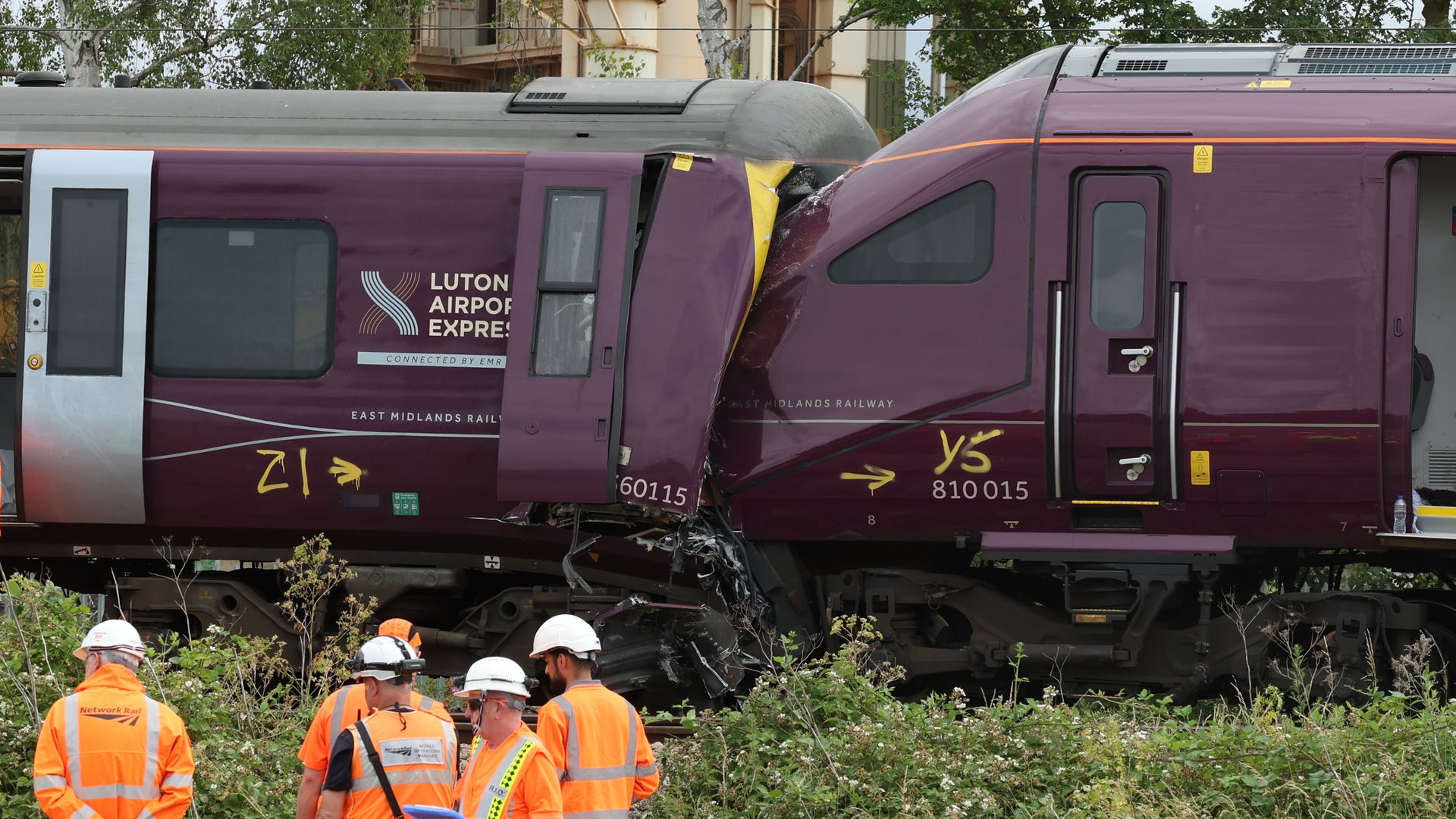
The interim findings from the Rail Accident Investigation Branch regarding the fatal Bedford train crash point to a chilling mechanical and human sequence. According to investigators, the Corby-to-London express driven by 60-year-old Shaun Burton passed a red signal at speed, continuing to accelerate up to 76 mph even after the onboard Automatic Warning System acknowledged the danger aspect. Moments later, the train collided with a stationary service stalled on the line near Elstow, resulting in a tragedy that injured over 160 people and claimed the driver's life.
Yet, reducing a catastrophic railway collision to a simple narrative of a driver speeding past a stop light ignores the vast, systemic architecture of modern rail transit. Decades of heavy transit analysis show that accidents rarely occur in a vacuum of individual negligence. Instead, they serve as the violent intersection of infrastructure blind spots, signal placement anomalies, and the heavy cognitive load placed upon human operators who must trust systems that occasionally fail them.
The Anatomy of a Modern Signal Failure
To understand how a train accelerates past a danger aspect, one must look closely at how signaling protocols operate on high-density commuter lines. When a preceding train halts unexpectedly due to onboard equipment faults—as the stationary East Midlands Railway service did—the signaling block behind it drops to red.
Drivers are trained to respond to sequential warnings, moving from green to yellow, and finally preparing to stop at red. However, track geometry plays an unforgiving role. Investigators noted that the final stretch of track leading up to the stationary train featured a notable curve, severely restricting line-of-sight visibility. By the time the obstruction appeared around the bend, the physics of a heavy passenger train traveling at seventy-plus miles per hour made a complete stop mathematically impossible within the remaining distance.
The data recorders show that full service brakes were applied roughly ten seconds before impact, followed by emergency brakes two seconds later. The train dropped from 76 mph to roughly 49 mph by the time of the collision, a desperate deceleration that underscores active driver engagement right up to the final seconds. Pinning the blame entirely on an acceleration phase ignores why the warning context failed to trigger a preemptive, automated brake intervention far earlier down the line.
The Dangerous Illusion of Total Automation
Rail operators often market modern signaling and warning systems as fail-safe shields against human error. Systems like the Automatic Warning System (AWS) provide audible chimes and horns to alert operators, requiring manual acknowledgement via a driver's foot pedal or attention button. If ignored, the emergency brakes engage automatically.
Yet, this creates a dangerous psychological feedback loop known in safety science as automation complacency. When an operator operates thousands of miles of track where signals routinely clear or yellow aspects precede open lines, the act of acknowledging an alert can become habitual. If track magnets or track-circuit equipment sit outside precise physical tolerances—as investigators noted regarding equipment positioning near the Bedford site—the margin for human miscalculation narrows to zero.
Relying on a driver to correctly interpret a restrictive signal while managing dense schedules, restrictive line curves, and potential equipment degradation is an outdated safety model. True modernization requires positive train control systems that take active-braking control out of the operator's hands the moment a stop signal is breached, rather than relying on human reaction times in high-velocity environments.
Beyond the Interim Report
As the full inquiry presses forward, the focus must shift away from an isolated search for scapegoats. Transport authorities and rail companies face intense pressure to evaluate whether existing infrastructure can safely support legacy signaling alongside growing passenger demands.
When infrastructure permits a high-speed commuter service to bear down on a stationary train with virtually zero automated intervention until the final hundred meters, the system itself requires an overhaul. Safety improvements cannot wait for another public inquiry or another community to mourn a lost worker. The hard truth of modern rail is that humanity cannot out-react a poorly engineered safety margin.