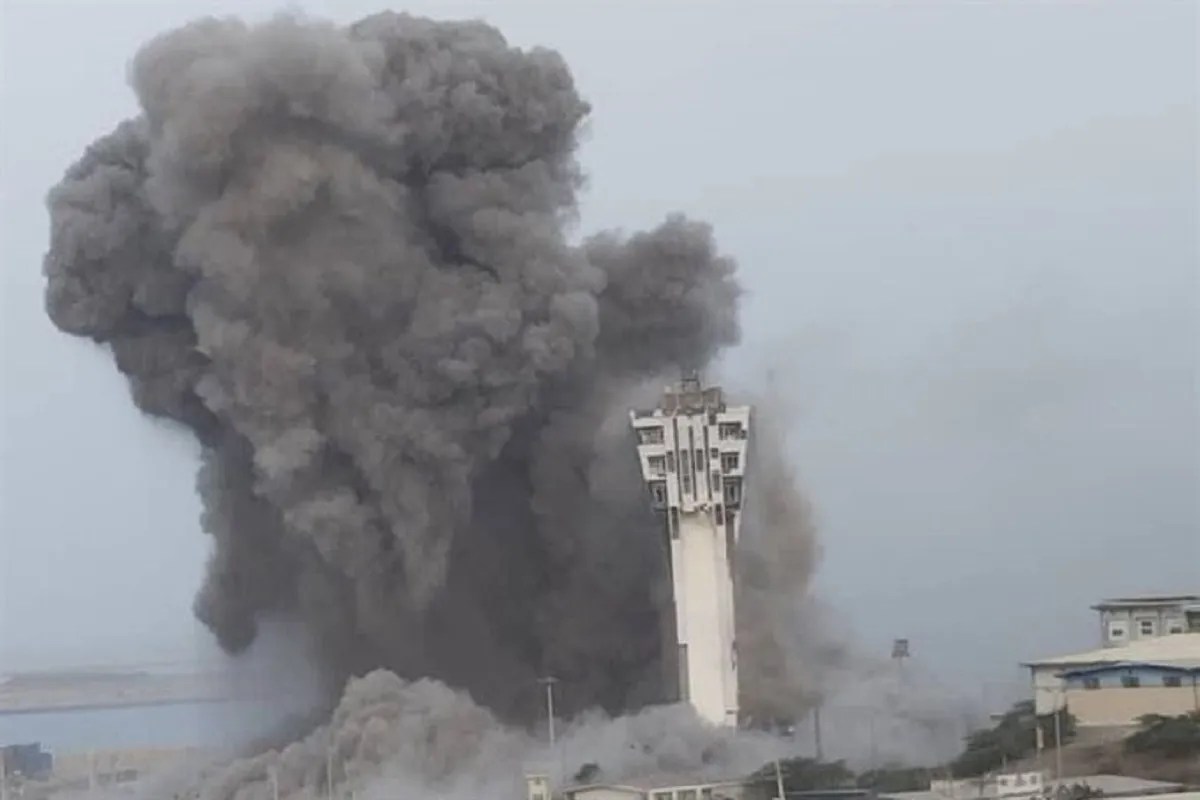
Targeting civilian maritime infrastructure is the fastest way to cripple a nation's economic lifeline without deploying boots on the ground. When military action disables a marine control tower, such as the critical installations at Iran's Chabahar Port, it does not just shatter concrete and glass. It blindfolds the entire harbor. By taking out the sensory organs of a port, an adversary halts maritime traffic, freezes international shipping insurance, and forces regional trade partners to instantly reassess their alliances. This is not collateral damage. It is a highly calculated, surgically executed strategy of economic strangulation designed to isolate Iran from the global market.
Chabahar Port is the crown jewel of Iran’s eastern maritime strategy. Located in the Sistan and Baluchestan province, it represents Tehran’s only direct access to the Indian Ocean, positioned safely outside the volatile and easily choked Strait of Hormuz. For years, Iranian planners believed this geographic buffer offered safety from Western blockades. That assumption was wrong. You might also find this connected story insightful: The Expensive Illusion of Presidential Diplomacy in Eastern Europe.
The Illusion of Purely Civilian Infrastructure
Modern warfare has erased the line between commercial utility and military capability. In public, Chabahar is marketed as a regional transit hub, a peaceful gateway linking India, Iran, and Afghanistan to the vast markets of Central Asia. In private, military strategists view the port through a vastly different lens.
The marine control tower of any major port houses the Vessel Traffic Management System. This array of radar, radio transmitters, and electro-optical sensors coordinates the movement of heavy container ships. However, these same systems track the movement of foreign naval assets in the Gulf of Oman. The Islamic Revolutionary Guard Corps Navy operates extensively in these waters, frequently utilizing civilian port data to coordinate its patrol boats and monitor Western warships. As discussed in recent coverage by Reuters, the effects are significant.
Under international humanitarian law, civilian objects are protected from direct attack. Yet, the legal framework contains a massive loophole. If an asset offers an effective contribution to military action, and its destruction offers a definite military advantage, it loses its protected status.
An adversary targeting the Chabahar marine control tower does so under the justification of neutralizing a hostile surveillance outpost. The physical destruction of the tower immediately suspends all commercial operations. No civilian vessel will enter a harbor where the control tower has been destroyed. International maritime underwriters, particularly those operating out of London, will immediately withdraw hull and cargo insurance for any vessel attempting to dock in a war zone. Without insurance, the flow of goods stops instantly.
The Indian Dilemma and the Eurasian Corridor
To understand the full impact of an attack on Chabahar, one must look beyond Tehran. The true diplomatic fallout of such a strike lands squarely in New Delhi.
India has invested hundreds of millions of dollars in developing the Shahid Beheshti terminal at Chabahar Port. For India, this harbor is a geopolitical necessity. It provides a trade route to landlocked Afghanistan and Central Asia that completely bypasses Pakistan, India’s historic rival. By striking this specific port, an adversary sends a chilling message to New Delhi.
                  [ Central Asia ]
                         |
                         | (Transit Route)
                         v
[ India ] --------> [ Chabahar Port ] <-------- [ Iran ]
                         ^
                         | (Targeted Infrastructure)
                  [ Gulf of Oman ]
India’s strategic planners now face a brutal reality. They must decide whether to continue backing a maritime project that sits directly in the crosshairs of Western military power. While India has secured sanctions waivers from Washington in the past to operate Chabahar, those waivers offer zero protection against physical missiles or cyber attacks.
The destruction of port infrastructure also serves as a warning to China. Beijing has spent over sixty billion dollars developing the deep-water port of Gwadar in Pakistan, located a mere one hundred and seventy kilometers east of Chabahar. While Gwadar is part of the China-Pakistan Economic Corridor, any active conflict near Chabahar destabilizes the entire Gulf of Oman. The militarization of these waters threatens Beijing's energy supply lines, proving that no economic corridor in the region is safe from geopolitical friction.
The Mechanics of Port Paralysis
Disable a control tower, and you disable the entire logistical chain. The physical destruction of a control tower is an act of undeniable kinetic violence, but the operational consequences are administrative and systemic.
- The Loss of Vessel Tracking: Without active radar and transponder monitoring, large container ships risk collisions in narrow shipping channels.
- The Flight of Maritime Labor: Harbor pilots, tugboat operators, and crane drivers will refuse to work under the threat of incoming strikes.
- The Insurance Blacklist: Maritime insurance premiums spike to prohibitive levels, effectively placing a financial blockade on the targeted country.
- Supply Chain Diversion: Shipping lines reroute their vessels to safer regional hubs, permanently shifting trade dynamics away from the targeted nation.
A physical strike on a control tower is often preceded by electronic warfare. Cyber operations can spoof GPS signals, disable port management software, and knock out communication arrays. When these digital measures fail to achieve long-term paralysis, physical intervention becomes the preferred option for military commanders. A single precision-guided munition targeting the top floor of a control tower achieves in seconds what months of economic sanctions fail to do. It brings all commercial shipping to a dead stop.
The Escalation Ladder and the Threat of Asymmetric Retaliation
Iran is not a passive actor on the global stage. If its sole oceanic port is neutralized, the leadership in Tehran will not simply sue for peace. They will climb the escalation ladder.
The Iranian navy and the Revolutionary Guard Corps have spent decades preparing for asymmetric maritime warfare. If Chabahar is closed, Iran can retaliate by making the neighboring shipping lanes unusable for the rest of the world. The Strait of Hormuz, through which a fifth of the world's oil passes daily, would become the primary target.
Tehran’s retaliatory playbook relies on cost-effective, highly disruptive tactics. Drone swarms, fast-attack craft armed with anti-ship missiles, and sea mines can easily choke the narrow strait. The goal is to drive global energy prices to unsustainable levels, forcing Western nations to halt their military campaigns due to domestic economic pressure.
This creates a dangerous feedback loop. The targeting of Iranian civilian infrastructure leads to the destruction of global energy infrastructure. The battle for a single port in southeastern Iran has the potential to trigger a worldwide economic shockwave, demonstrating that in modern conflict, there is no such thing as a localized strike.
The Gray Zone of Modern Port Security
The vulnerability of Chabahar highlights a larger trend in global conflict. Ports are no longer just logistics hubs; they are frontline military targets masquerading as commercial enterprises.
As long as states use civilian trade infrastructure to project military power and bypass international sanctions, those facilities will remain high-value targets. The destruction of the Chabahar marine control tower is a stark reminder that in the event of an open conflict, the rules of commercial shipping no longer apply. The physical assets that connect nations to the global economy are often the very first things to burn.