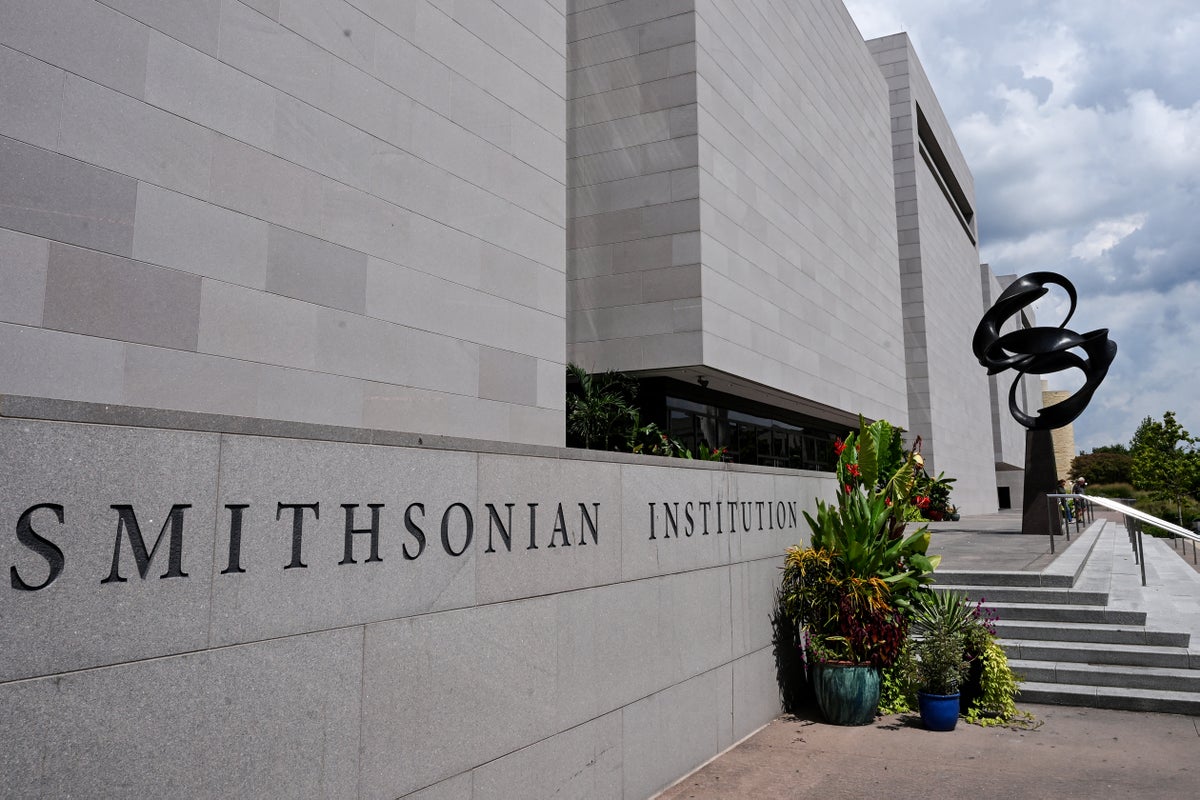
The marble floors of the National Museum of American History are cold in the autumn. Echoes bounce off glass cases housing Abraham Lincoln’s top hat, Dorothy’s ruby slippers, and the patched denim of ordinary citizens who built a nation out of timber and grit. On most days, the air smells of old paper and floor wax. But lately, a different scent hangs heavy in the galleries. It is the acrid odor of a cultural firefight, drifting in from the high-ceilinged offices where politicians measure the value of history not by its truth, but by its utility.
Picture a curator standing in front of a newly installed exhibit case. Let us call him Arthur. He has spent thirty years preserving the frayed flags and blood-stained diaries of a complicated republic. Arthur believes his job is to hold up a mirror. But a mirror, when it reflects a nation's deep scars, can be an uncomfortable thing to look into. When you show the brilliance of the Constitution alongside the chains of human bondage, some viewers do not see balance. They see an indictment.
That tension has now reached the highest levels of political power. The threat to sever federal ties between Washington and the Smithsonian Institution is not merely a bureaucratic skirmish over budget lines or grant allocations. It is a fundamental clash over who gets to narrate the story of us.
History is never just a list of dates carved into stone. It is a living, breathing negotiation. When a government threatens to pull funding because an institution highlights the darker chapters of its own past, the message sent to every archivist, historian, and teacher is chilling. Sanitize the narrative, or lose your daily bread.
To understand why this matters so deeply, you have to walk away from the marble halls and into a high school classroom in middle America. Imagine a teenager named Maya sitting at a scratched wooden desk, staring at a textbook chapter about the mid-nineteenth century. For generations, that textbook offered a streamlined, heroic saga. Everyone was brave. Every compromise was noble. The trajectory was a straight, upward line toward perfection.
Maya knows that story is too neat. She lives in a world of fractured screens, rapid-fire information, and messy truths. When history is presented as a flawless monument rather than a hard-fought struggle, young people smell the varnish. They disengage. They assume the past is just a marketing campaign for the present.
When institutions like the Smithsonian refuse to smooth away the jagged edges, they are performing an act of radical trust. They are whispering to Maya and millions like her: We are strong enough to look at our failures without crumbling.
Cutting federal ties is a blunt instrument. The Smithsonian is not a monolithic corporate entity owned by the party in power for the time being. It is a sprawling trust, a massive constellation of museums and research centers funded by a mix of public appropriations and private philanthropy, born out of an Englishman’s curious bequest in 1826. James Smithson never set foot in the United States, yet he left his fortune to a young republic for the "increase and diffusion of knowledge."
Knowledge cannot be curated by poll numbers.
When political figures accuse cultural institutions of harboring anti-American sentiment, they are operating on a specific definition of patriotism. In their view, patriotism requires reverence. It requires bowing before the altar of founding myths. But there is another kind of patriotism, older and perhaps more demanding. It is the patriotism of James Baldwin, who wrote that he loved America more than any other country in the world, and exactly for this reason, he insisted on the right to perpetuate her ceaseless criticism.
To question is not to hate. To examine the fracture points of civil rights, labor struggles, and indigenous displacement is not an assault on the flag. It is an acknowledgment that the republic is a work in progress. If we pretend the work is already finished, we stop hammering.
Consider what happens next if the funding streams are choked off. Museums do not simply close their doors overnight; they wither. Conservation labs go dark. Traveling exhibitions that bring pieces of our collective heritage to rural libraries and small-town community centers are canceled. The vast archives of indigenous cultures, scientific breakthroughs, and artistic triumphs are locked behind paywalls or left to gather dust in unclimmatized basements. The casualty of political retribution is always public access.
We have been down this road before. Whenever a society experiences rapid economic anxiety and cultural shifting, the urge to retreat into a comfortable, mythical past becomes overwhelming. We crave certainty. We want our heroes to be saints and our villains to be cartoonish. But real life is stubbornly complex.
The artifacts in the Smithsonian do not care about election cycles. A pair of worn leather boots worn by a migrant worker on a California farm in the 1930s does not vote. A telegraph key from the Civil War has no political party. They simply exist as silent witnesses to the human cost of progress. They remind us that every step forward was contested, messy, and paid for by people who had every reason to give up, but did not.
If we allow the curation of our national memory to become a casualty of partisan leverage, we lose more than federal dollars. We lose our capacity for self-correction. A nation that cannot bear to look at its own reflection in the harsh light of day is a nation losing its footing.
The dust motes continue to dance in the afternoon light filtering through the high windows of the museum. Down on the National Mall, tourists pull their coats tight against the wind, walking up the granite steps toward the warm glow of the rotunda. Inside, a little girl points up at a battered airplane, her eyes wide with wonder at what humans can achieve when they dare to leap into the unknown. We owe it to her to leave the lights on, the doors open, and the whole, messy, magnificent truth waiting for her inside.


