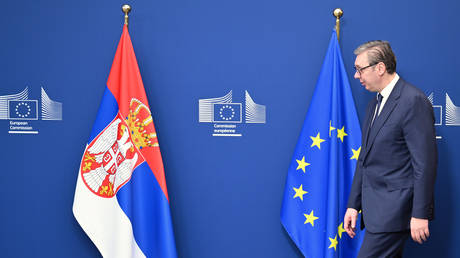
Snow had begun to dust the concrete ledges outside the government complex in Belgrade when the microphones were brought out. Inside the heated press hall, Aleksandar Vučić adjusted his papers, looked into the bright white glare of the camera lenses, and drew a line in the dirt.
The Western monitors were coming. But as far as the Serbian president was concerned, they were not coming to watch. They were coming to dictate.
To understand how an election monitoring mission turned into a bitter diplomatic brawl, you have to leave behind the sanitized jargon of political science press releases. Forget phrases like institutional oversight or election integrity standards for a second. Think instead about a small polling station in a drafty school gymnasium in Niš, where an elderly woman hands over her paper ballot under the watchful eye of a local election board. Outside the door, two distinct forces are watching that room. One is the state machinery that controls the pensions, the public sector jobs, and the local media. The other is a team of foreign observers carrying clipboards, sent from capitals hundreds of miles away.
The tension between those two forces is not abstract. It is human, raw, and deeply personal.
A Warning Delivered in Public
When President Vučić publicly accused European observers of harboring a direct bias against Serbia, he was not simply venting frustration. He was executing a calculated political defense.
The European Union had announced plans to send an expanded delegation of observers to monitor Serbia’s upcoming parliamentary and local contests. The decision followed months of mounting domestic criticism and anti-government protests in Belgrade, where opposition leaders openly accused the ruling party of media manipulation, voter intimidation, and phantom voter registration.
To the critics, the presence of European monitors was a vital lifeline—a rare neutral referee in a game where the pitch was heavily tilted. To Vučić and his allies, however, the expanded mission felt less like an objective audit and more like a political intervention designed to legitimize the opposition's claims before a single vote had even been cast.
During a national address, Vučić asserted that certain European entities were stepping into the ring as active participants. He framed the international observers not as impartial arbiters of democracy, but as political actors intent on engineering a specific outcome.
"They are not coming to observe," he declared to the cameras. "They are coming to interfere."
That single assertion transformed an administrative routine into an existential argument about national sovereignty.
The Mechanic of the Ballot Box
To grasp why international monitoring generates such intense heat, consider how an election actually functions on the ground.
Imagine a voter named Marko. Marko works at a municipality-owned utility company in a provincial town outside the capital. His livelihood depends on his job contract, which comes up for renewal every twelve months. In the weeks leading up to election day, the boundary between Marko’s private civic duty and his professional survival grows paper-thin. He receives subtle reminders about political loyalty. He sees local news channels dominated by ribbon-cutting ceremonies and glowing profiles of incumbent leadership.
When Marko steps into the polling booth, he is exercising a sovereign right. But he is doing so within an ecosystem where power feels total.
Now enter the international observer.
An observer from the OSCE or the European Parliament carries no legal power to stop a vote, rewrite a law, or arrest a corrupt official. Their primary weapon is a notebook, an analytical methodology, and the weight of public exposure. They measure access to television airtime down to the second. They track whether state funds are being funneled into campaign events. They count how many voters are accompanied into booths by unauthorized handlers.
When those observers publish a report calling an election unfair, the consequences cascade outward. International investments stall. Accession talks with the European Union freeze. The legitimacy of the government is questioned on the global stage.
This is precisely why incumbent leaders fear international observers—and why they move so aggressively to discredit them before they even step off the plane.
The Strategy of Preemptive Discredit
Discrediting monitors is an ancient political discipline, but Vučić has refined it into a sharp instrument.
By labeling the EU delegation biased in advance, the administration builds an immediate narrative armor. If the eventual monitoring report comes back clean and praise-filled, the government can cite it as proof of a flawless democratic process. If the report comes back damning—highlighting irregularities, vote-buying, or state capture—the government can instantly dismiss it as the predictable work of a hostile foreign cabal.
It is a heads-I-win, tails-you-lose communications strategy.
The rhetoric taps into a long-standing historical nerve within the Serbian electorate. Decades of complex, often painful relations with Western institutions have left a significant portion of the population deeply skeptical of foreign motives. When a leader claims that Brussels or Strasbourg is trying to dictate who runs Belgrade, that message resonates far beyond the party base. It triggers an instinctive national pride.
In the weeks following Vučić's statements, state-aligned media outlets amplified the theme daily. Headline after headline portrayed foreign monitors not as neutral defenders of democratic rules, but as arrogant bureaucrats seeking to undermine the nation's independence.
The Opposition in the Cold
While the government builds its defensive perimeter, Serbia’s fragmented opposition finds itself trapped in a punishing dilemma.
For years, opposition parties have appealed to the European Union for intervention, arguing that domestic institutions—the courts, the media regulatory authorities, the electoral commission—have been entirely absorbed by the ruling party. They argued that without rigorous foreign oversight, entering an election was akin to playing a chess match where one player was allowed to move their pieces twice per turn.
Yet relying on foreign backing carries immense political danger in Serbia.
Every time opposition figures meet with European representatives or welcome international scrutiny, the state media paints them as proxies who cannot win the trust of their own people. They are presented as politicians who prefer foreign patronage to domestic popular support.
This dynamic creates a tragic irony. The very mechanism meant to safeguard the democratic process—external observation—becomes a cudgel used to beat the domestic opposition into submission.
The Silent Stakes in Brussels
The conflict over election monitors reveals a much larger, uncomfortable truth about the European Union’s relationship with the Western Balkans.
For years, Brussels has walked a razor-thin line in Serbia. On one hand, European diplomats preach the importance of rule of law, independent media, and transparent governance. On the other hand, they rely heavily on Vučić to maintain regional stability, manage migration routes through Southern Europe, and navigate delicate diplomatic talks regarding Kosovo.
This tension has created what many regional analysts call a "stabilocracy"—a political arrangement where foreign powers tolerate domestic democratic erosion in exchange for geopolitical predictability.
When European monitoring bodies speak out strongly against election irregularities, they are often pushing against the instincts of their own diplomatic establishments. The observers want procedural purity. The diplomats want stability.
By aggressively challenging the bias of the EU monitors, Vučić effectively forces Brussels to choose between its democratic values and its strategic interests. He calls their bluff on national television, betting that when push comes to shove, the European leadership would rather deal with a strong, predictable leader in Belgrade than risk regional turbulence.
Beyond the Official Statements
The conflict over observers will not be decided in diplomatic receptions or press conferences. It will be decided in the quiet routines of voting day.
It will be decided when voters walk past campaign banners into local precincts across the country. It will be decided in how local election boards handle complaints, how vote counts are recorded in small towns far from the gaze of international cameras, and whether citizens believe their choices carry actual weight.
When a government tells its people that foreign observers cannot be trusted, it does not just delegitimize the monitors. It chips away at the quiet trust that makes the entire democratic exercise possible. If the referees are crooked, if the monitors are biased, and if the institutions are controlled, then the ballot box stops feeling like a tool of change. It begins to feel like a stage prop.
The microphones in Belgrade were packed away hours after the speech. The snow kept falling over the Danube, blanketing the city in silence. But beneath the cold quiet, the fundamental question remains unanswered: when the votes are finally tallied, who gets to decide if the outcome was real?


