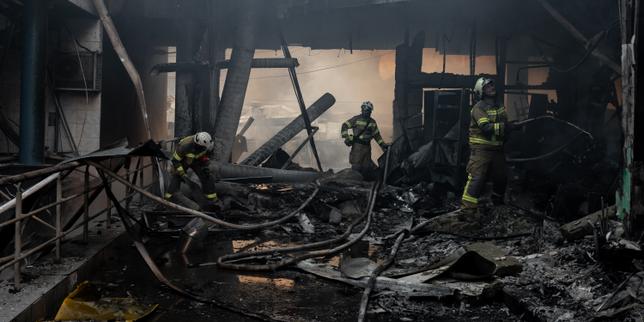
The deployment of intermediate-range ballistic missiles (IRBMs) against Ukrainian urban centers marks a transition from tactical attrition to high-threshold psychological warfare. When Russia confirms the use of a nuclear-capable system—specifically the "Oreshnik" or modified RS-26 variants—against targets in Dnipro or Kiev, the primary objective is not the kinetic destruction of the physical site. Rather, it is the execution of a cost-signaling maneuver intended to recalibrate Western risk assessments. This shift represents an evolution in the conflict’s "escalation ladder," moving from conventional volume-based strikes to high-velocity, low-interception probability demonstrations.
The Triple Architecture of Ballistic Intimidation
The use of an IRBM in a conventional theater functions across three distinct layers of strategic utility. Understanding these layers is necessary to differentiate between a change in military capability and a change in political signaling.
1. The Interception Deficit
Standard air defense systems, including the Patriot (PAC-3) and various European equivalents, are optimized for cruise missiles and short-range ballistic threats. An IRBM operates on a different flight profile. By utilizing a terminal velocity that exceeds Mach 10, these systems reduce the "decision window" for automated interceptors to a negligible margin. This creates a technical vacuum where the defender possesses the theoretical tools for defense but lacks the reaction time to deploy them effectively against Multiple Independently Targetable Reentry Vehicles (MIRVs).
2. The Nuclear-Conventional Ambiguity
The "Oreshnik" and its analogs are dual-capable. By firing a platform traditionally reserved for nuclear delivery, the Kremlin forces NATO intelligence to treat every launch as a potential existential threat until the moment of impact. This ambiguity creates "frictional delay" in Western response cycles. If a radar signature suggests an IRBM launch, the immediate protocols involve high-level nuclear command and control alerts, distracting from the immediate tactical needs of the Ukrainian front lines.
3. Economic Asymmetry of the Strike
There is a profound imbalance in the cost-exchange ratio of using an IRBM. The manufacturing cost of a single experimental or strategic-grade ballistic missile far outweighs the value of most conventional targets in Kiev. This indicates that the value of the strike is found entirely in its "deterrence yield" rather than its "tactical damage." Russia is spending strategic capital to purchase a psychological freeze in Western long-range missile supplies to Ukraine.
Structural Constraints of the Oreshnik Platform
While the shock value of the missile is high, its operational utility is governed by several hard bottlenecks. Analysts must distinguish between a system that is "combat ready" and one that is "strategically viable" for sustained use.
- Production Volume Scarcity: These systems are not mass-produced in the same manner as Shahed drones or Kalibr cruise missiles. Each launch represents a significant percentage of available developmental stock.
- Launch Infrastructure: IRBMs require specialized Transporter Erector Launchers (TELs) or silo-based infrastructure. Their signature is large and detectable by satellite overhead imagery, making "surprise" launches difficult to achieve against a peer intelligence network.
- The Law of Diminishing Returns: The psychological impact of an IRBM strike decays with repetition. The first strike triggers a global diplomatic crisis; the tenth strike becomes an expensive, inefficient method of delivering a conventional payload.
European Union Diplomatic Response Mechanics
The assessment by the EU’s High Representative characterizing the strike as "intimidation" is a formal classification that influences the Union's "Integrated Political Crisis Response" (IPCR). This categorization moves the event from a "local military escalation" to a "systemic security threat" to the European continent.
This classification triggers two primary counter-mechanisms:
- Hardened Defense Posture: High-velocity strikes necessitate the deployment of exo-atmospheric interceptors, such as the Aegis Ashore systems or the development of future European hypersonic interceptors.
- Sanction Elasticity: Intimidation tactics typically result in the removal of "red lines" regarding the types of weaponry the West is willing to provide. Historically, Russian escalations intended to deter Western involvement have instead acted as a catalyst for expanded military aid packages.
The Kinematics of Hyper-Sonic Reentry
To comprehend why the Oreshnik is causing such a high degree of concern in Kiev, one must look at the physics of its reentry. Unlike a cruise missile that maneuvers through the atmosphere at subsonic or low supersonic speeds, an IRBM enters from a high-arcing trajectory.
$$v = \sqrt{2gh}$$
The potential energy converted into kinetic energy during the descent phase results in speeds that create a plasma sheath around the reentry vehicle. This sheath interferes with traditional radar tracking, effectively making the missile "dark" during the most critical seconds of its flight path. When Russian officials highlight the "nuclear capability," they are referencing the hardened electronics and heat shielding required to survive these conditions—features that are redundant for simple conventional explosives but essential for the delivery of strategic payloads.
Signaling vs. Capability: A Strategic Divergence
A common misconception is that the use of this missile increases Russia’s ability to win the war on the ground. Data suggests the opposite. The front lines in the Donbas are decided by artillery volume, drone density, and manpower rotation. A ballistic missile hitting a command center or a symbolic target in Kiev does not alter the "force ratio" at the zero line.
Instead, the move is a response to the "ATACMS/Storm Shadow" factor. By hitting Kiev with a high-tier system, the Kremlin is attempting to establish a new "ceiling" for the conflict. They are communicating that for every Western-enabled deep strike into Russian territory, there will be a corresponding move up the technological ladder, eventually approaching the threshold of non-conventional warfare.
Bottlenecks in the Western Escalation Calculus
The West currently faces a "decision bottleneck" regarding how to counter high-velocity intimidation.
- The Interceptor Shortage: Production of PAC-3 MSE and SAMP/T interceptors is currently below the rate of global demand. Deploying more to Ukraine leaves holes in NATO’s own "Integrated Air and Missile Defense" (IAMD).
- Intelligence Latency: Early warning systems are robust, but "attribution latency"—the time it takes to confirm the missile’s payload (nuclear vs. conventional)—remains the most dangerous variable in the loop.
The Strategic Path Forward
The situation dictates a shift from "reactive defense" to "structural deterrence." To nullify the psychological impact of IRBM intimidation, the counter-strategy must focus on removing the ambiguity that Russia exploits. This involves three specific actions:
First, the deployment of permanent, high-altitude sensor platforms capable of tracking hyper-sonic signatures in real-time to eliminate the "radar darkness" phase. Second, a formal decoupling of nuclear signaling from conventional theater actions; by treating IRBMs as purely conventional threats in the absence of radioactive signatures, the West reduces the "terror premium" Russia seeks to extract. Third, the acceleration of "deep strike parity," ensuring that the cost to Russia for utilizing its strategic reserve outweighs the perceived diplomatic gains.
The conflict has moved beyond the era of territorial acquisition into an era of high-stakes technical signaling. The Oreshnik is not a "game-changing" weapon in terms of the map; it is a "protocol-changing" weapon in terms of international security. The objective is no longer just to win the battle of attrition, but to dominate the perception of risk.