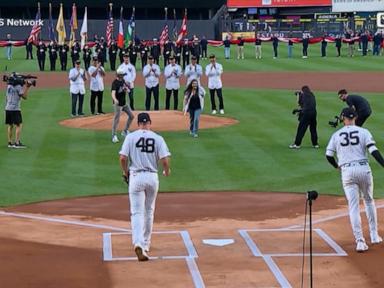
Twenty-five years after a Tuesday morning rearranged the geography of American life, the ritual has become as fixed as the smell of stale beer and garlic fries in the concourse. The New York Yankees and the New York Mets share a field, first responders wear their service caps, and a carefully curated pair steps to the mound to throw out the ceremonial first pitch. It is presented to the public as an unadulterated moment of national healing, a cinematic reconciliation of sport and sorrow. Yet beneath the broadcast packaging and the swell of orchestral strings lies a more complicated machinery—one where raw grief is continuously processed, packaged, and re-presented to a public that grows further removed from the actual event with every passing season.
To understand why these baseball commemorations persist with such unyielding gravity, one has to examine the unique weight New York sports assumed in the autumn of 2001. Major League Baseball did not return to the city immediately; fields went dark for a week while the smoke still drifted over lower Manhattan. When the games finally resumed, stadiums did not merely host athletic contests; they functioned as secular cathedrals where a stunned populace could gather in numbers large enough to feel visible again. Derek Jeter recalled staring out from the diamond, wondering why they were even playing a children’s game when the world was fracturing. The answer, arrived at through tears and shared trauma, was that predictability and routine are the primary narcotics of a traumatized society. Baseball offered a return to sequence—balls, strikes, innings, outs—in a reality that had suddenly become entirely unmoored.
Over a quarter of century, however, that spontaneous outpouring has mutated into a formalized liturgy. When Brielle Saracini and Sean McGuire walked to the mound at Yankee Stadium to throw out simultaneous first pitches, the narrative arc carried a staggering personal weight. Both had lost their fathers on Flight 175, both had met as children through support networks, and both had eventually married. With Derek Jeter standing just feet away—the same player who had hosted a grieving ten-year-old Brielle in the dugout weeks after the attacks—the tableau was an architect's dream of narrative closure. Love survived. Steel fell, but human bonds endured.
Yet, industry analysts and cultural critics must ask a harder question about how these moments function in the modern sports entertainment complex. There is an inherent friction when multi-billion-dollar franchises utilize generational trauma as a recurring emotional anchor for broadcast windows. The commercialization of grief is rarely malicious, but it is systemic. When the league mandates specific first responder caps or choreographs pre-game tributes, it taps into a deep reserve of collective memory that belongs to the victims' families and the survivors, converting private devastation into public spectacle.
Consider the logistical mechanics behind these ceremonies. Every participant is vetted, every story is scripted for the broadcast booth, and every camera angle is chosen to maximize the lump in the throat of the viewer at home. It provides an undeniable service to a city that still bears the structural and psychological scars of that day, offering a communal space for remembrance. But it also risks flattening a complex historical catastrophe into an easily digestible sports narrative—complete with a neat beginning, middle, and an emotional climax that resolves itself neatly before the top of the first inning.
The players themselves occupy a strange space in this dynamic. Modern rosters are populated by athletes who were either toddlers on September 11, 2001, or had not yet been born. For a twenty-year-old rookie standing on the baseline during the anniversary tribute, the event is not a memory of personal terror; it is history, no different than the moon landing or the fall of the Berlin Wall. Jeter noted the necessity of educating these incoming generations about why the world changed that day. This creates a pedagogical burden for the franchises: how to instill authentic reverence in athletes who view the tragedy through the lens of archival footage rather than lived reality.
Furthermore, the juxtaposition of high-stakes pennant race baseball with solemn national mourning creates an uncomfortable tonal whiplash. Within three hours of a deeply emotional remembrance involving orphaned children, military honor guards, and survivor testimonials, the same stadium is screaming for a blown call, booing a relief pitcher, or engaging in the petty tribalism intrinsic to a Subway Series rivalry. Sports demand a baseline of hostility toward the opponent to function, which sits uneasily alongside a liturgy built on national unity and shared grief.
This tension is precisely why the ceremonies endure. They force a momentary collision between the trivial and the monumental. Winning a baseball game does not pay rent, cure an illness, or bring back the thousands who vanished into the dust of the financial district. Yet by forcing modern entertainment venues to pause and acknowledge the fragility of civic life, these rituals act as an annual reality check. They remind a distracted public of what the city looked like when the lights went out, and how fragile the baseline of normalcy truly is.
As the decades march onward, the living witnesses of that autumn will inevitably fade, leaving behind only the archives, the plaques in the concourses, and the broadcast clips played on loop every September. The danger is that the event becomes hollowed out—reduced to a patriotic set piece devoid of its initial terror and confusion. Yet when individuals who lost their childhoods to a hijacked plane step onto the grass to throw a baseball, the synthetic packaging briefly cracks, exposing the raw human core underneath.
The game resumes. The crowd cheers. The machinery of professional sports grinds forward, leaving the ghosts behind until the calendar turns once more.