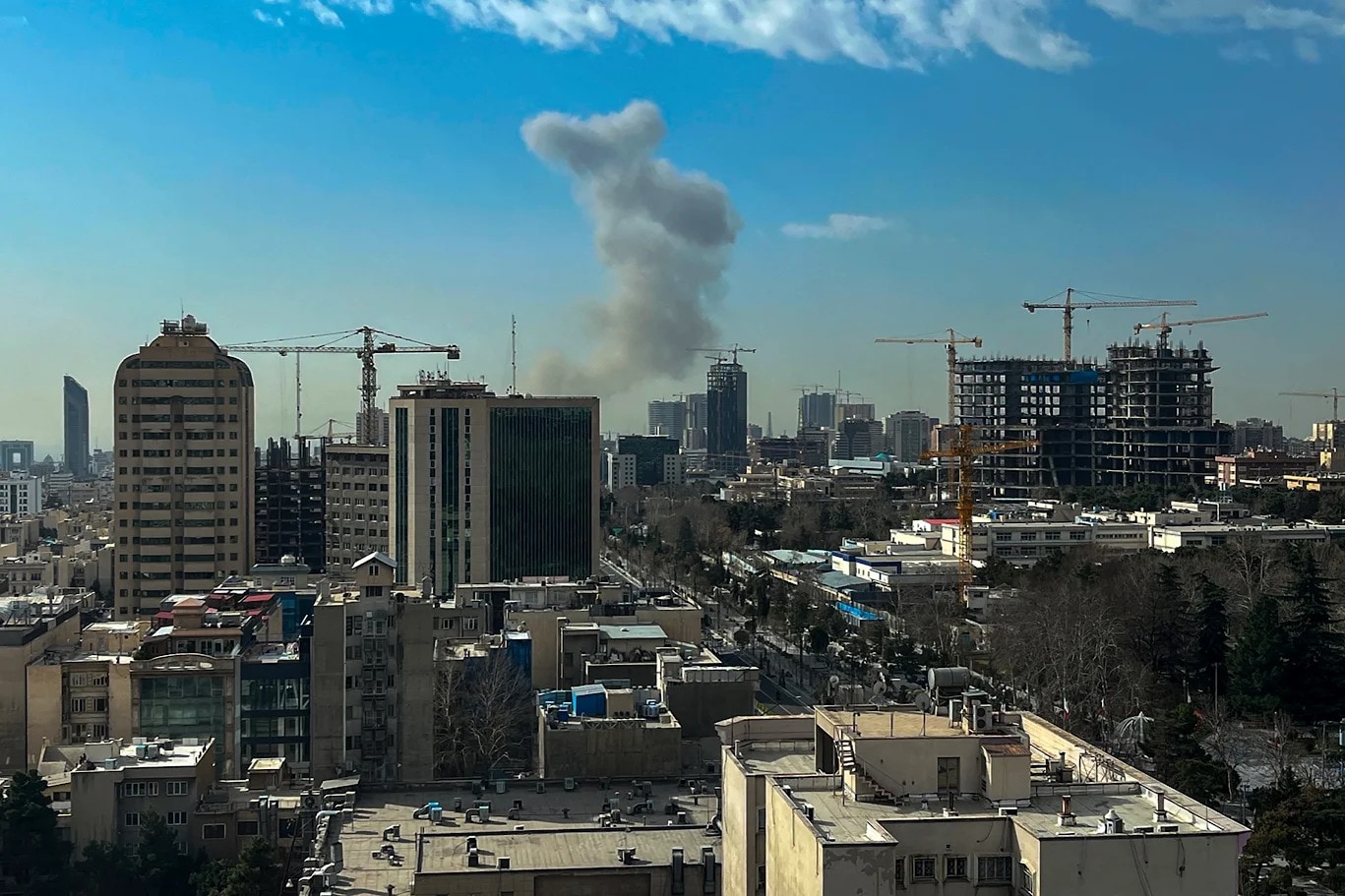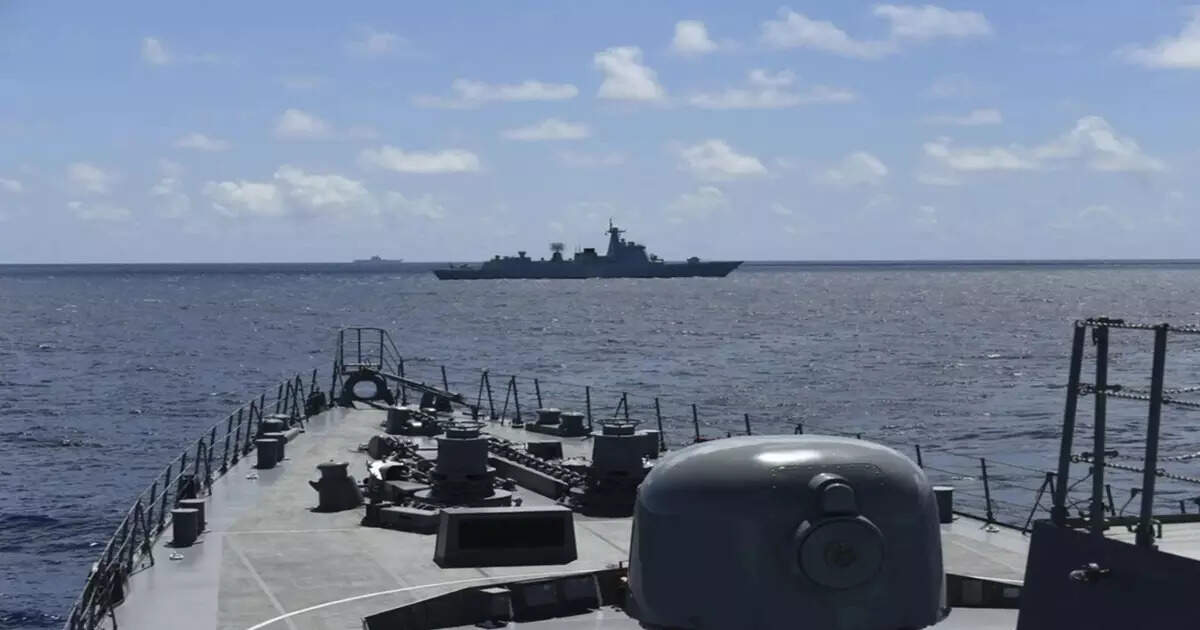
The headlines are screaming about a "spillover" in the Middle East because a few projectiles landed near a U.S. Navy facility in Bahrain. The consensus is panicking. Analysts are dusting off their 1980s Tanker War playbooks, claiming this is the beginning of a regional conflagration that will choke the global economy.
They are wrong. They are missing the math, the geography, and the brutal reality of 21st-century kinetic attrition.
What we are seeing isn't a "spillover." It is a structural exposure of an obsolete strategic posture. For decades, the U.S. Fifth Fleet in Manama has been treated as an untouchable fortress, a sovereign piece of American willpower parked in the Persian Gulf. But the recent strikes prove that Bahrain isn't a strategic asset anymore. It’s a multi-billion-dollar hostage.
The Myth of Presence as Power
The defense establishment loves the word "deterrence." They believe that if you park a massive gray hull in a harbor, the "bad guys" will rethink their life choices. I’ve sat in rooms with O-6s and GS-15s who genuinely believe that proximity equals control.
It doesn’t. In the age of $20,000 loitering munitions and $50,000 anti-ship missiles, proximity equals vulnerability.
The U.S. Navy’s presence in Bahrain is predicated on the idea that we can intercept anything thrown at us. We use the Aegis Combat System, the RIM-161 Standard Missile 3 (SM-3), and the Phalanx CIWS. On paper, it’s an impenetrable shield. In reality, it’s a math problem that the U.S. is losing.
If an adversary launches a swarm of twenty drones and five ballistic missiles, and we use a $2 million interceptor to take down a $20,000 drone, we aren't "winning" the engagement. We are being bled out. The "spillover" isn't a military failure; it's an accounting nightmare. Every time a missile hits a facility in Bahrain, it isn't just a hole in the ground. It's a signal that the cost of defending the Persian Gulf has finally exceeded the value of being there.
The Shallow Water Trap
The Persian Gulf is a bathtub. At its deepest, it’s about 90 meters. Most of it is significantly shallower. This is the worst possible environment for a modern blue-water navy.
The competitor articles talk about "escalation" as if the U.S. Navy can simply flex its muscles and end the threat. They ignore the fact that our most expensive assets—Carrier Strike Groups (CSGs)—are effectively useless inside the Strait of Hormuz. A carrier needs sea room to maneuver. It needs depth to hide from submarines.
In the Gulf, a carrier is a stationary target.
By basing the Fifth Fleet in Bahrain, we have committed ourselves to a "littoral defense" strategy with "blue water" tools. It’s like trying to defend a hallway with a long-range sniper rifle. You’re too close to use your best attributes, and you’re too big to miss. The strikes on Bahrain aren't a surprise to anyone who understands naval architecture. They are the inevitable result of parking a giant target in a small, crowded room.
The False Narrative of Global Oil Chokepoints
The "People Also Ask" sections of the internet are currently obsessed with one question: "Will the Bahrain strikes raise gas prices?"
The "lazy consensus" says yes. They claim that any instability near the Strait of Hormuz will send Brent Crude to $150 a barrel. This is 1970s thinking.
The global energy map has shifted. The U.S. is now a net exporter of crude and petroleum products. China is the one that should be sweating over Bahrain, not Washington. If the Persian Gulf shuts down, the primary victim is the manufacturing engine of East Asia, not the American consumer.
By staying in Bahrain and absorbing these hits, the U.S. is essentially providing a free security service for its primary global competitors. We are spending American blood and treasure to ensure that Iranian oil keeps flowing to Chinese ports so they can continue to build a navy designed to fight us in the Pacific.
This isn't "stability." It's a strategic subsidy for our rivals.
The "Iron Dome" Delusion
Whenever a facility gets hit, the immediate reaction from the armchair generals is: "Why didn't we shoot it down? We need more Iron Dome-style defenses."
The Iron Dome is for short-range rockets. It's a localized, tactical solution for a localized problem. Bahrain's problem is that it is a strategic hub that can be reached by everything from long-range ballistic missiles to low-flying suicide drones.
You cannot "out-defend" the geography of the Persian Gulf. If you increase the number of batteries, the adversary simply increases the volume of the swarm. The defender always pays more. This is the "cost-curve" of 21st-century warfare. We are playing a game where every "win" costs us $100 for every $1 the enemy spends. That's not a military strategy. That's a slow-motion bankruptcy.
Why We Should Leave (and Why We Won't)
The smart move is to pivot.
Stop pretending Bahrain is a frontline combat station. Treat it as a support hub, and move the heavy hitters—the carriers, the cruisers, the destroyers—out of the bathtub and into the Arabian Sea. Let the regional powers build their own security architecture. If they can't, let the nations that rely on that oil pay for the defense.
But we won't.
I’ve seen this before. Institutional inertia is more powerful than military logic. The Fifth Fleet is a massive bureaucratic machine. Thousands of sailors, hundreds of contractors, and billions in real estate. To admit that Bahrain is a liability would be to admit that thirty years of Middle East naval strategy has been built on a foundation of sand.
The "spillover" isn't a regional war. It’s a reality check. And right now, the U.S. Navy is bouncing that check.
Every missile that hits a facility in Manama isn't a call to arms. It's a bill. And if we keep paying it, we’re the ones being played.
Get out of the bathtub. The water is already boiling.