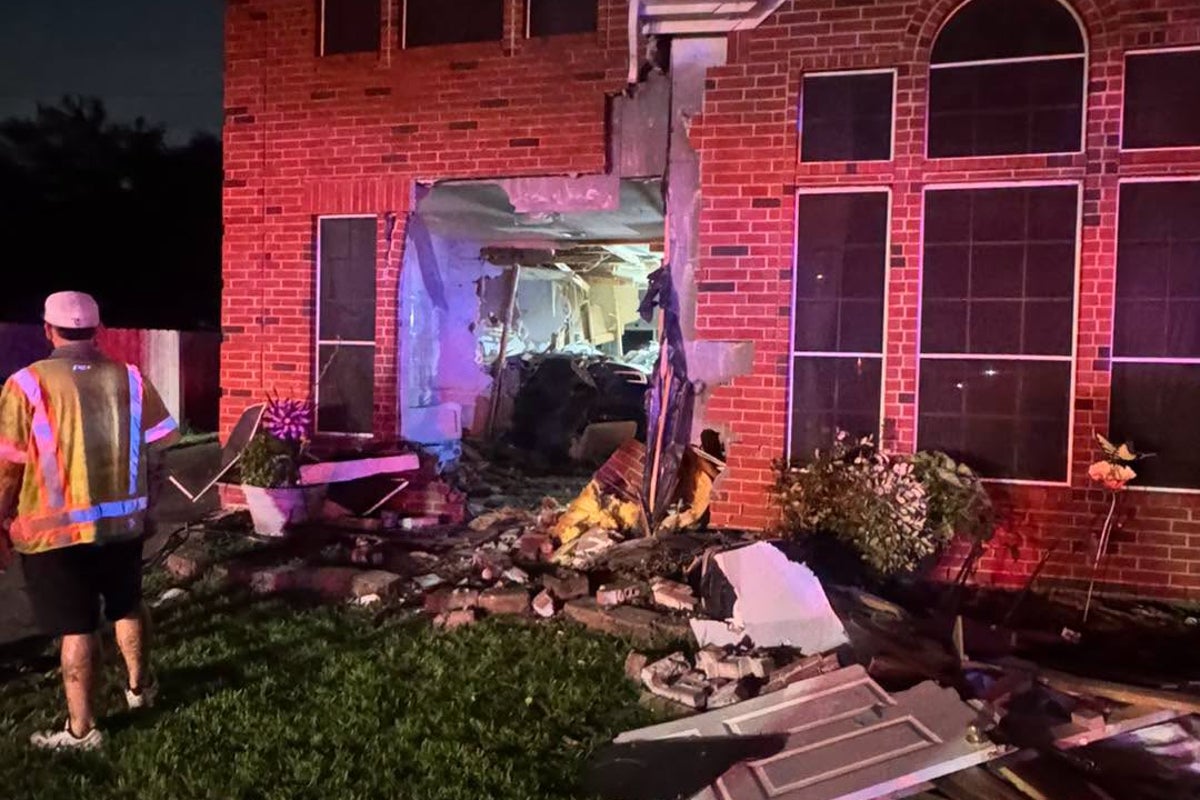
The fatal collision of a Tesla vehicle into a Texas residence highlights a critical vulnerability in the current deployment of Level 2 semi-autonomous driving systems: the systemic failure of the human-machine handover protocol. When a passenger vehicle breaches a residential structure at speed, the incident cannot be evaluated merely as an isolated driver error. It must be analyzed as a multi-variable failure occurring at the intersection of operational design domains, kinetic energy transfer, and cognitive decoupling.
To evaluate the strategic implications for automotive manufacturers, insurers, and regulatory bodies, the event must be deconstructed into three foundational vectors: the Operational Design Domain (ODD) mismatch, the mechanics of automated driver disengagement, and the structural realities of perimeter penetration.
The Operational Design Domain Mismatch
Semi-autonomous features, specifically Tesla’s Autopilot or Full Self-Driving (FSD) beta systems, operate within strict constraints defined by software engineering boundaries. These boundaries constitute the Operational Design Domain (ODD). The primary systemic failure in residential accidents involving automation is the execution of these systems outside their validated ODD.
Automated steering and traffic-aware cruise control systems are fundamentally architected for structured highway environments characterized by clear lane demarcations, predictable geometric curvature, and the absence of pedestrian or cross-traffic variables. Residential zones introduce high-frequency anomalies: unmapped driveways, non-standard curb heights, variable asphalt degradation, and unexpected spatial obstructions.
When a vehicle attempts to navigate a residential environment under automated control, the sensor suite—relying heavily on optical cameras—faces severe input degradation. The absence of high-definition radar or LiDAR mapping creates a reliance on neural networks to interpret three-dimensional space from two-dimensional pixel arrays. In a residential setting, complex shadows from trees, non-uniform building facades, and localized geometry frequently cause object classification errors within the perception stack. The system fails to classify a residential wall as an absolute trajectory barrier, treating it instead as a non-threatening visual artifact or an open roadway extension.
The Human-Machine Handover Bottleneck
The root cause of Level 2 automation fatalities is cognitive decoupling, a psychological state where the human operator, lulled by a false sense of system competency, completely disengages from situational awareness. This creates an insurmountable latency during a critical human-machine handover event.
In engineering terms, the handover protocol relies on a predictable sequence:
- System Anomaly Detection: The vehicle's perception stack identifies an unresolvable path planning conflict.
- Alert Issuance: The vehicle triggers auditory and visual alerts to command driver intervention.
- Driver Re-engagement: The driver transitions from cognitive disengagement to active situational reassessment.
- Physical Intervention: The driver applies mechanical brake pressure or steering torque to override the automation.
This sequence requires a minimum latency of 1.5 to 2.5 seconds under optimal conditions. In high-speed residential scenarios, this latency window exceeds the time-to-collision threshold.
The vehicle's data loggers invariably record a lack of braking or evasive steering input in the seconds preceding impact. This does not indicate intent; it indicates that the human operator was trapped in the cognitive bottleneck, unable to process the system's failure state before the kinetic trajectory became irreversible. The design paradox of Level 2 automation is that it demands the highest level of human vigilance precisely when the technology is engineered to minimize human effort.
Kinetic Energy Transfer and Structural Vulnerability
The severity of a residential penetration event is governed by Newtonian physics, specifically the exponential relationship between velocity and kinetic energy, expressed as:
$$E_k = \frac{1}{2}mv^2$$
A standard electric vehicle, heavily weighted by its lithium-ion battery pack, possesses a curb weight often exceeding 4,500 pounds (approximately 2,041 kilograms). When propelled at residential speeds or higher, the resulting kinetic energy upon impact completely outmatches the structural load-bearing capacity of standard American residential architecture.
Most residential homes utilize wood-frame construction (light-frame construction) with exterior finishes consisting of brick veneer, stucco, or siding. These materials are engineered to withstand vertical gravitational loads and lateral wind loads; they possess negligible resistance to concentrated, high-mass horizontal impacts.
Upon impact, the vehicle mass shears through the exterior envelope, destroying structural load-bearing studs and penetrating deep into the interior living spaces. The risk to occupants inside the structure is catastrophic because residential interior layouts are not designed with impact attenuation or crash barriers. The kinetic energy is transferred directly into interior partition walls and furniture, turning standard household items into lethal secondary projectiles.
Regulatory and Liability Realignment
The Texas residential fatality accelerates the inevitable shift in legal liability frameworks from the operator to the system architect. Historically, automotive manufacturers have successfully insulated themselves from liability by leveraging user agreements that mandate continuous driver attention. However, this legal defense faces diminishing returns as marketing narratives clash with structural engineering realities.
The National Highway Traffic Safety Administration (NHTSA) has steadily increased its scrutiny of automated systems, moving from passive data collection to active recall mandates targeting software logic. The core regulatory question is no longer whether the driver was paying attention, but whether the manufacturer deployed a system that predictably induces human error through its operational interface.
Insurer risk models must evolve to account for this shifting liability landscape. Traditional automotive insurance calculates premiums based on driver demographics and historical accident data. Autonomous risk modeling requires a granular evaluation of the vehicle's software version, sensor configuration, and the geographic boundaries of its operational deployment. Insurers will increasingly demand geofencing capabilities that programmatically disable Level 2 or Level 3 automation when a vehicle enters designated high-risk zones, such as school districts, high-density pedestrian centers, and residential developments.
Engineering Mandates for Autonomous Safety
To mitigate the recurrence of catastrophic residential penetrations, the automotive industry must abandon purely reactive safety measures and implement rigid architectural guardrails.
First, strict vision-based and GPS-enforced geofencing must be deployed. Automated driving features must undergo hard lockout protocols when the vehicle departs from verified arterial roadways and highways. The software should prohibit activation on undivided residential streets where the margin for error is razor-thin.
Second, driver monitoring systems must transition from passive torque sensors on the steering wheel to high-frequency infrared camera tracking of ocular orientation and cognitive focus. If the driver’s eyes leave the forward path of travel for more than a fraction of a second within non-highway environments, the system must initiate an immediate, controlled deceleration and vehicle immobilization sequence, rather than allowing the vehicle to maintain velocity blindly.
Finally, the perception stack must prioritize structural mass detection. If the visual data presents an ambiguity between an open path and a solid structure, the path planning algorithm must default to an immediate braking command. It is vastly preferable to execute an unnecessary stop on a misclassified shadow than to permit an unmitigated kinetic penetration into a residential structure. Manufacturers must design these systems under the absolute assumption that the human operator will fail to intervene, engineering the software to fail safely in isolation.

