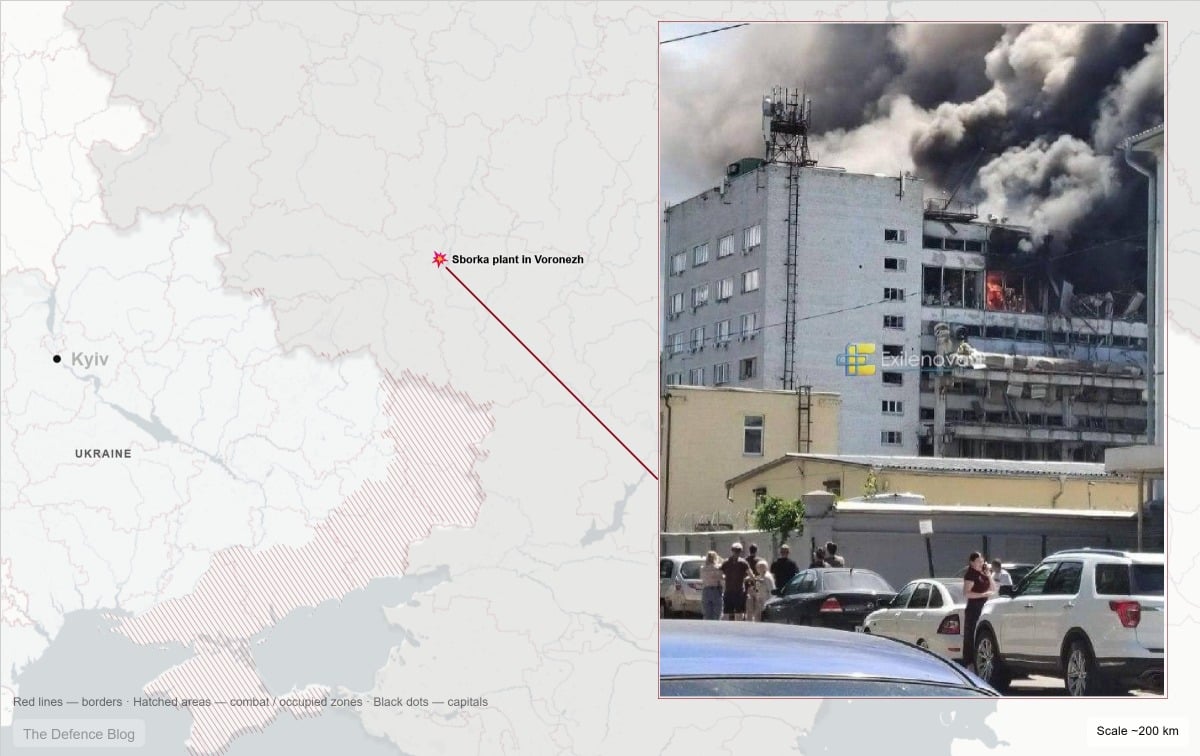
The headlines are practically celebrating. A drone strike hits a manufacturing plant deep inside Russian territory, smoke billows on social media feeds, and Western defense analysts immediately proclaim a turning point in the war. The consensus is set: hit the supply chain, choke off the components, and the missile strikes will stop.
It is a comforting narrative. It is also entirely wrong.
The belief that modern industrial warfare can be won by decapitating individual factory nodes is a hangover from World War II strategic bombing theories—theories that failed then and are failing now. In the era of decentralized manufacturing, global black markets, and asymmetrical defense economics, treating a missile factory like a singular, fragile bottleneck is a catastrophic misunderstanding of modern logistics.
Drones make great theater. They do not stop state-level industrial momentum.
The Bottleneck Myth: Why Supply Chains Do Not Break Like Glass
When a strike hits a facility rumored to produce guidance systems or solid-fuel rocket engines, the immediate analysis treats the target like a thread in a sweater. Pull it, and the whole apparatus unravels. This assumes a rigidity in military manufacturing that simply does not exist for a state operating on a total war footing.
Industrial redundancy is the first thing defense journalists ignore. State enterprises do not operate like a lean Silicon Valley startup running on just-in-time delivery. They hoard.
- Strategic Stockpiling: Major defense bureaus maintain deep reserves of raw materials, machine parts, and sub-assemblies. A strike on an assembly floor destroys the building; it rarely destroys the years of components cached in underground bunkers or alternative storage sites.
- Machine Tool Portability: Modern CNC (computer numerical control) milling machines and component manufacturing units are modular. If a factory floor is compromised, production is distributed across smaller, secondary facilities or civilian machine shops repurposed overnight.
- The Subcontractor Matrix: A missile is not built under one roof. It is an amalgamation of parts from dozens of obscure workshops. Flattening the final assembly point creates a temporary logistical headache, not a permanent halt.
Think of it this way: if you bomb a bakery, you do not stop the city from eating bread. You force them to bake it in kitchens across the province and truck it in through different routes.
The Microchip Delusion: Sanctions and the Black Market Reality
The secondary argument always leans on technology starvation. The narrative claims that because Western microelectronics are restricted, hitting the factories that integrate these parts will permanently dry up the arsenal.
This view misunderstands how globalized hardware works. The chips found in downed cruise missiles are rarely military-grade, custom-built silicon. They are ubiquitous, dual-use commercial components. They are the same microcontrollers found in washing machines, automotive engine control units, and agricultural equipment.
You cannot sanction a component that is manufactured by the hundreds of millions across Southeast Asia. The supply chain for transshipping these goods through front companies in Central Asia or the South Caucasus is incredibly agile. If a procurement network in one country gets burned by Western intelligence, three more open up in adjacent jurisdictions within a month.
When a factory is struck, the immediate bottleneck isn't the physical hardware or the silicon chips; it is the human capital. Yet, specialized defense engineers are rarely sitting in the specific warehouse that gets hit by a unidirectional attack drone at 3:00 AM. The intellectual property, the schematics, and the technical expertise remain intact. Buildings can be rebuilt; concrete cures quickly when a state budget prioritizes it above all else.
The Cost Asymmetry Trap
We need to talk about the brutal math of this attrition strategy.
Let us analyze a typical cross-border deep strike operation. A military utilizes a dozen long-range, indigenous strike drones. Each drone costs roughly $50,000 to manufacture, factoring in fiberglass fuselages, commercial GPS guidance, and low-yield explosives. The total cost of the attack run sits around $600,000.
On paper, this looks like an incredible return on investment if you damage a multi-million-dollar facility. But look at the defense ledger on the other side.
To protect that facility, the defending state deploys short-range air defense systems, electronic warfare jamming arrays, and point-defense guns. If they fire two surface-to-air missiles to intercept a single cheap drone, they are spending upwards of $1 million per intercept.
This looks like a victory for the attacker until the factory resumes partial operations three weeks later. The structural damage is cleared by conscript labor. The broken roof is patched with corrugated steel. The machinery, shielded by sandbags or heavy concrete barriers inside the structure, is wiped down and restarted.
The attacker spent finite, highly sophisticated drone assets to achieve a temporary pause in production. Meanwhile, the core industrial output capacity remains structurally viable because the underlying power grid, transport rail lines, and raw material inputs were left completely untouched.
What Actually Stops the Missiles?
If targeting the factory floor is an exercise in futility, how do you actually disrupt a state's ability to wage long-range industrial warfare? You have to stop asking how to break the machine, and start looking at what keeps the machine alive.
1. Target the Energy Inputs, Not the Assembly Lines
A precision electronics assembly plant or a heavy foundry cannot run on diesel generators for long. They require massive, stable inputs of industrial electricity and high-pressure natural gas.
Instead of blowing up a warehouse full of aluminum casings, the target must be the ultra-high-voltage transformers supplying the industrial park, or the specialized gas compression stations feeding the foundries. Machinery can be moved to a new building; a dedicated multi-gigawatt power sub-station cannot be improvised or easily replaced under sanctions.
2. Eviscerate the Financial Rails
Factories do not run on patriotism; they run on payroll and procurement capital. The weak point in the missile supply chain is almost never the physical factory inside the borders—it is the banking correspondence network outside of it.
If a defense firm cannot clear cross-border payments to buy high-end Swiss machine tools or German lubricants through third-party intermediaries, the assembly line grinds to a halt far more effectively than it would from a kinetic blast. The focus should shift entirely from physical sabotage to aggressive, secondary financial blockades targeting the specific regional banks facilitating these transactions.
3. Interdict the Raw Chemical Precursors
A missile needs propellant. Solid-fuel rockets require specialized chemical compounds: ammonium perchlorate, synthetic rubber binders, and high-purity aluminum powder.
These chemicals cannot be easily substituted with commercial alternatives, nor can they be easily smuggled in small quantities in the back of a civilian vehicle. The production facilities for these specific chemical precursors are highly centralized, massive, and volatile. Disrupting the chemical processing infrastructure creates a definitive, un-bypassable hard stop for missile assembly. Without propellant, a high-tech fuselage is just a incredibly expensive metal pipe.
The Harsh Reality of Industrial Resilience
The belief that air campaigns can cleanly decapitate an economy is a persistent myth because it satisfies our desire for quick, tech-driven solutions to grueling, long-term problems. It allows politicians to point to satellite photos of charred roofs and claim meaningful progress.
But history is a stubborn witness. During World War II, the Allied air forces dropped hundreds of thousands of tons of explosives on German ball-bearing plants in Schweinfurt. The goal was to freeze the entire Nazi military machine. The result? German aircraft production actually increased in the months following the deepest raids because the industry decentralized, adapted, and found workarounds.
Modern defense industrial complexes are even more resilient, more modular, and more capable of absorbing kinetic shocks. Celebrating the destruction of a single factory floor isn't just premature; it creates a false sense of security that diverts strategic focus away from the dull, difficult work of systemic economic and energetic strangulation.
Stop looking at the smoke plumes. Start looking at the power lines.