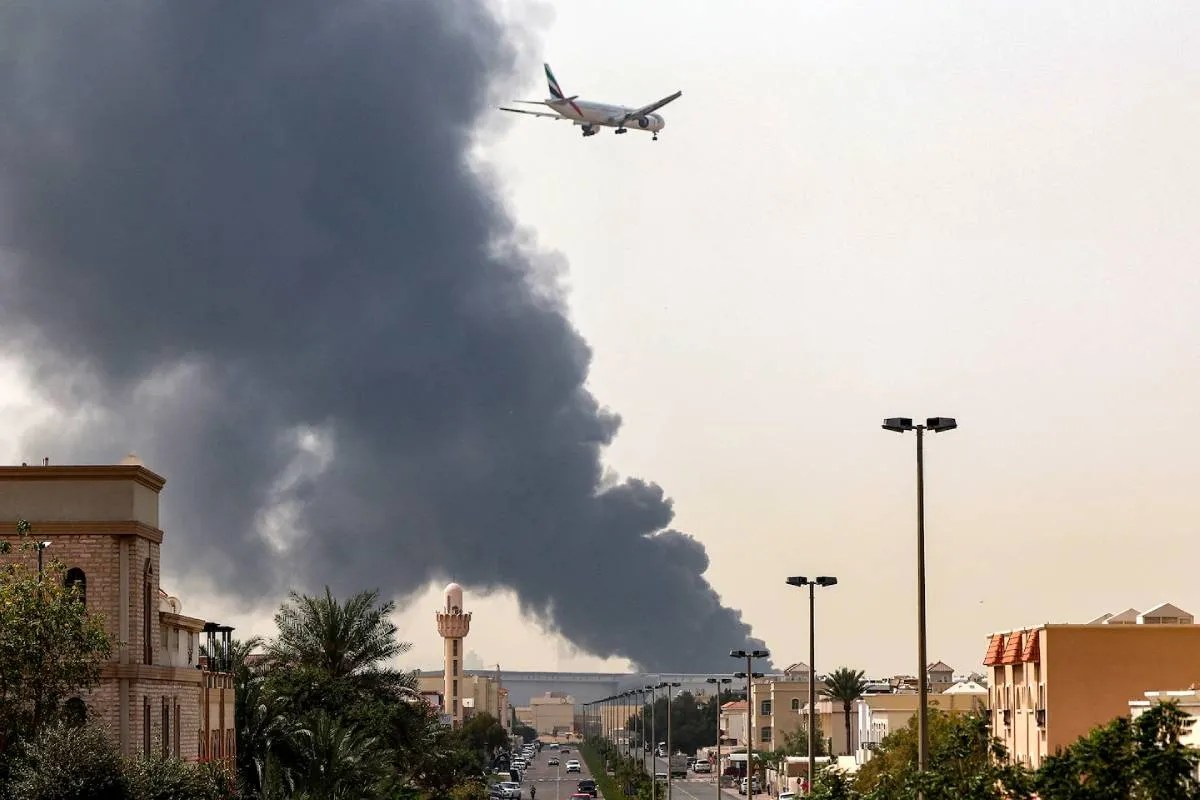
The recent kinetic activity involving rocket strikes on the U.S. Embassy in Baghdad and drone incursions near Dubai International Airport represents a calculated shift from proxy-led harassment to synchronized, high-impact regional signaling. While traditional media focuses on the "chaos" of the strikes, a structural analysis reveals a sophisticated application of the Cost-Imposition Strategy. This framework dictates that an actor does not need to achieve total military victory; they only need to make the maintenance of the status quo prohibitively expensive for their adversary—politically, economically, and logistically.
The Triad of Tactical Objectives
The synchronized nature of these attacks serves three distinct strategic functions that move beyond simple retaliation.
1. The Baghdad Vector: Political Sovereignty Erosion
The targeting of the Green Zone with rocket fire—specifically 107mm or 122mm variants—is a deliberate exercise in Institutional Degradation. By targeting the diplomatic core of a nation, the aggressor forces the host government (Iraq) into a binary crisis of legitimacy.
- Security Failure Perception: If the Iraqi security apparatus cannot protect the most fortified district in the country, its authority over peripheral provinces is naturally questioned.
- Diplomatic Attrition: Consistent pressure on the U.S. Embassy creates a "non-permissive environment," forcing the withdrawal of non-essential personnel and eventually shuttering diplomatic channels, which achieves the long-term goal of regional isolation of Western influence.
2. The Dubai Vector: Economic Sensitivity Mapping
The deployment of Unmanned Aerial Systems (UAS) near Dubai International Airport (DXB) is not a failed military strike, but a successful Economic Interdiction Test. Dubai’s economy functions as a global logistics and tourism hub; its primary commodity is "perceived stability."
- Market Volatility Trigger: Even a non-lethal drone sighting can ground flights for hours. The cost of fuel for circling aircraft, the disruption of global supply chains, and the spike in insurance premiums for regional transit create a massive financial multiplier effect from a low-cost asset.
- Infrastructure Vulnerability: Modern air defense systems (such as the Patriot or THAAD) are optimized for ballistic missiles, not low-altitude, slow-moving "Group 1" or "Group 2" drones. This creates a Capability Gap where the cost of the interceptor (multi-million dollar missiles) far exceeds the cost of the threat (thousand-dollar drones).
3. Regional Synchronization
The timing of these events indicates a Unified Command Structure. By striking Iraq and threatening the UAE simultaneously, the aggressor demonstrates a "Multi-Front Contingency" capability. This forces the United States and its allies to dilute their intelligence, surveillance, and reconnaissance (ISR) assets across a wider geographic spread, reducing the efficacy of their response.
Technical Analysis of the Asymmetric Arsenal
Understanding the threat requires a breakdown of the hardware utilized. These are not random "explosions" but specific tools chosen for their deniability and cost-to-effect ratio.
Rocket Artillery (MLRS)
In the Baghdad theater, the primary tool is the man-portable rocket.
- Mechanism: These are unguided, point-detonation weapons. Their lack of precision is a feature, not a bug; it allows for "area denial" and ensures that any collateral damage can be used in information operations to paint the defender as incompetent.
- Logistics: The small footprint of these launchers allows for rapid deployment and extraction (the "shoot and scoot" tactic), making counter-battery fire nearly impossible in dense urban environments without high civilian casualties.
Loitering Munitions and UAS
The drone activity near Dubai points to the use of "Loitering Munitions"—essentially kamikaze drones.
- Guidance Systems: These assets often use GPS-independent navigation (optical flow or pre-programmed waypoints) to circumvent electronic jamming.
- Signature: Their low Radar Cross-Section (RCS) and thermal output make them difficult for traditional pulse-doppler radars to track, often allowing them to reach the "inner ring" of a target's defense before detection.
The Deterrence Paradox
Western response mechanisms are currently trapped in a Symmetry Trap. Standard military doctrine suggests a proportional response to an attack. However, in asymmetric warfare, a proportional response is often what the aggressor wants.
- Response: The U.S. retaliates against a proxy warehouse.
- Result: The aggressor uses the footage to fuel recruitment and nationalist sentiment.
- Financial Reality: The cost of the U.S. operation (fuel, ordnance, satellite time) is $50 million. The cost of the destroyed warehouse is $50,000.
This Negative ROI of Conflict ensures that the larger power is slowly bled of resources while the smaller power maintains a sustainable "burn rate" of low-tech assets.
Civil-Military Impact and Infrastructure Resilience
The targeting of a civil aviation hub like Dubai signals a transition to Grey Zone Warfare, where the lines between military targets and civilian infrastructure are intentionally blurred.
- Psychological Operations (PSYOP): The goal is to induce "investor flight." If a regional power cannot guarantee the safety of its primary airport, foreign direct investment (FDI) becomes high-risk.
- The Insurance Bottleneck: In the event of sustained drone threats, Lloyd’s of London and other insurers may reclassify the region as a "war zone," effectively ending its status as a global transit hub overnight without a single shot being fired.
Strategic Forecast and Adaptive Defense
To counter this shift, regional security must move away from "Hard-Kill" kinetic defenses toward a Layered Resilience Model.
The first priority is the deployment of Directed Energy Weapons (DEW). High-energy lasers and high-power microwaves offer a "low cost-per-shot" solution to the drone problem, rectifying the economic imbalance of current missile-based defenses.
The second priority involves Information Decoupling. Governments must develop protocols to maintain economic operations during minor security breaches to deny the aggressor the "Economic Multiplier" they seek. If an airport can neutralize a drone threat without a total shutdown of the airspace, the strategic value of the drone attack evaporates.
The third priority is the Deniability Threshold. International pressure must be shifted from "retaliation" to "attribution." By utilizing advanced forensic analysis of recovered debris to definitively link hardware to its source, the political cost of "deniable" attacks is raised to the point of strategic failure.
The current trajectory suggests that these "pinprick" attacks are precursors to a larger-scale Saturation Strike attempt. The goal will be to overwhelm existing Aegis or Patriot batteries with a high volume of low-cost targets, creating a window for a single high-value ballistic asset to penetrate the defense. Preparation for this scenario requires an immediate shift toward automated, AI-driven sensor fusion capable of tracking thousands of small-scale contacts in real-time.
The strategic play is no longer about winning a battle in the air; it is about winning the battle of the balance sheet. The actor that can maintain security at the lowest marginal cost will dictate the future of the Middle Eastern security architecture.