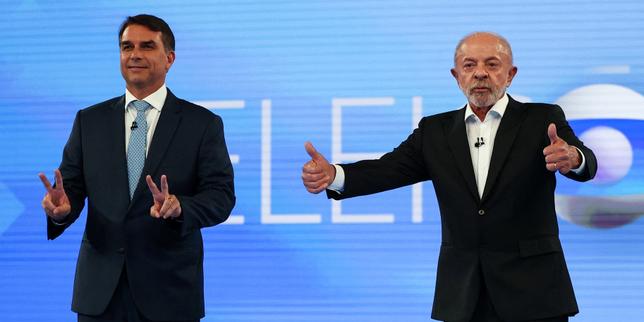
Political debates in polarized runoff elections operate as risk-transfer mechanisms rather than persuasion exercises. When an incumbent faces a dynastic challenger carrying heavy brand baggage, the structural incentives invert: the challenger must manufacture moderation to capture undecided centrist voters, while the incumbent must weaponize retrospective accountability to prevent the challenger from shedding historical liabilities. The second debate in the Brazilian presidential cycle featuring Flávio Bolsonaro and Luiz Inácio Lula da Silva demonstrated this exact mechanical divergence. By adopting a restrained, institutional posture, Flávio Bolsonaro attempted to lower the perceived volatility of a Bolsonarista return to power, while Lula da Silva deployed aggressive offensive framing to lock the electorate into a referendum on the 2019–2022 administration.
Understanding this confrontation requires stripping away surface-level stylistic commentary—labels like "polished" or "aggressive"—and examining the underlying game theory governing candidate positioning. In a binary race, voter utility is calculated by comparing the expected variance of a challenger against the known baseline of an incumbent. You might also find this related coverage insightful: Asymmetric Deterrence and US Force Posture Why Intelligence Alerts Trigger.
The Asymmetry of Risk Management
Every televised debate forces candidates to solve an optimization problem constrained by their existing coalition. Neither candidate can win solely by energizing their base; both must alter the calculus of the median voter in swing states such as Minas Gerais and São Paulo.
The Challenger’s Volatility Discount
Flávio Bolsonaro entered the debate facing a severe structural handicap: high rejection rates tied directly to his surname and the rhetorical excesses of his father’s presidency. In political marketing, this functions as a volatility discount. Undecided voters—particularly moderate conservatives, urban professionals, and market-oriented centrists—frequently align with right-leaning fiscal policies but balk at institutional instability. As highlighted in detailed coverage by Al Jazeera, the implications are widespread.
To neutralize this discount, Flávio executed a deliberate Reputational Decoupling Strategy:
- Tonal Moderation: Maintaining steady vocal pacing, avoiding personal insults, and declining to take bait on cultural wedge issues.
- Institutional Framing: Anchoring economic and security proposals within standard legislative procedures rather than executive confrontation.
- Selective Distance: Implicitly signaling competence and predictability without alienating the core evangelical and hard-right base that provides his electoral floor.
The operational logic behind this approach is straightforward. If the challenger appears calm, technocratic, and governed by impulse control, the incumbent’s primary attack line—that a return of the Bolsonaro movement equals institutional chaos—loses visual credibility on screen. The viewer sees a controlled senator rather than a populist agitator.
The Incumbent’s Incumbency Trap
Incumbents seeking re-election cannot run as agents of change; they must defend a tangible record while projecting forward momentum. When economic growth faces headwinds, inflation pressures household budgets, or fiscal deficits draw scrutiny, defending the status quo becomes a losing proposition.
Lula da Silva circumvented this trap through Offensive Agenda Control. Rather than allowing the debate to become a retrospective audit of his own recent administration, he shifted the focal point outward and backward. By maintaining high offensive pressure, an incumbent forces the challenger onto a defensive footing, consuming the challenger's allotted speaking time with rebuttals rather than policy exposition.
This offensive posture rested on three tactical pillars:
- Historical Anchoring: Tying Flávio Bolsonaro’s candidacy directly to the pandemic response, environmental deregulation, and democratic friction of the previous administration.
- Moral and Ethical Contrast: Highlighting judicial investigations, family political networks, and governance controversies to erode the challenger’s polished exterior.
- Social Policy Ownership: Framing state-led welfare programs, minimum wage adjustments, and public investment as existential protections that a right-wing government would dismantle.
The Mechanics of Political Rebranding
A candidate’s attempt to appear "more polished" is rarely a spontaneous shift in temperament. It is the output of rigorous media training designed to exploit cognitive biases in low-information voters.
Signaling Theory in Televised Confrontations
Under signaling theory, when a political actor incurs a visible behavioral cost—such as suppressing natural combative instincts under direct provocation—observers interpret the behavior as credible evidence of a broader trait. By absorbing Lula’s attacks without erupting, Flávio Bolsonaro attempted to send a costly signal of emotional discipline.
The effectiveness of this signal depends entirely on audience segmentation:
- For the Core Base: Restraint is tolerated so long as it is perceived as tactical superiority—making the opponent look desperate or unhinged by comparison.
- For Swing Voters: Restraint lowers the psychological barrier to defecting from the incumbent, making a vote for the challenger feel safe rather than radical.
- For the Opposition: Restraint is dismissed as performative deception, a temporary mask worn solely for broadcast cameras.
The limitation of rebranding through debate demeanor is structural fragility. A single broadcast cannot erase years of public record, legislative voting history, or family association. If a challenger’s calm demeanor appears overly scripted or detached from genuine conviction, voters categorize it as artifice rather than evolution.
The Cost Function of Offensive Pressure
Conversely, an incumbent’s decision to go on the offensive carries its own risk curve. Aggression projects vitality, dominance, and command of the arena—critical attributes for an older leader seeking to dispel narratives of fatigue or declining political capital. By dictating the tempo of exchanges, Lula demonstrated stamina and rhetorical sharpness.
However, sustained aggression introduces diminishing returns:
- Over-prosecution: Attacking an opponent who refuses to fight back can trigger a sympathy effect among undecided viewers, making the aggressor appear bullying or defensive.
- Policy Crowding-Out: Every minute spent relitigating past scandals is a minute not spent articulating a credible macroeconomic plan for the next four years.
- Validation of the Challenger: Engaging intensely with a challenger elevates their stature, treating them as an equal peer rather than dismissing them as unready for executive office.
Issue Ownership and Rhetorical Leverage
Debate performance is ultimately mediated by which candidate successfully locks the conversation onto terrain where their party holds structural trust. Political scientists refer to this as issue ownership—the long-term association between a political brand and competence in solving specific societal problems.
Fiscal Discipline vs. Social Protection
In Brazilian presidential politics, the ideological divide maps cleanly onto competing economic anxieties. The right claims ownership over fiscal restraint, private-sector deregulation, agribusiness protection, and public security. The left claims ownership over poverty reduction, labor protections, public healthcare, and industrial policy.
During the second debate, the tactical friction occurred precisely at the boundary of these two domains:
- Flávio’s Objective: Frame the government’s fiscal expansion as reckless spending that drives up interest rates, stifles private investment, and erodes purchasing power through subtle inflation. By keeping his tone measured, he sought to sound like a rational economist diagnosing a balance-sheet failure.
- Lula’s Objective: Frame fiscal austerity as a euphemism for cutting social safety nets, starving public universities, and abandoning the working class to market volatility. By pressing aggressively, he framed his administration’s spending as moral necessity and economic stimulus.
When an incumbent attacks aggressively on social outcomes while a challenger responds calmly with macroeconomic warnings, the viewer is forced to choose between two distinct mental models of governance: empathetic state intervention versus technocratic market discipline.
Public Security as an Asymmetric Wedge
Public security remains the single most potent vulnerability for center-left incumbents across Latin America. High crime rates, organized criminal networks, and urban insecurity create immediate, visceral voter anxiety that macroeconomic statistics cannot soothe.
Flávio Bolsonaro leveraged his background in Rio de Janeiro politics to press this advantage, utilizing a composed delivery to present hardline policing and penal reform as common-sense administrative necessities rather than extremist impulses. Lula’s offensive counter-strategy required reframing security away from purely punitive measures toward federal intelligence coordination, financial tracking of criminal organizations, and social prevention—an argument that is logically coherent over the long term but harder to compress into ninety-second broadcast soundbites.
Structural Constraints on Debate Impact
Evaluating the strategic success of either posture requires accounting for the realities of modern media consumption. Televised debates no longer function as unified national broadcasts; they operate as raw material factories for fragmented digital ecosystems.
The Clip Economy and Algorithmic Filtering
Fewer voters watch a two-hour debate from start to finish than consume thirty-second vertical video clips distributed across WhatsApp, Instagram, TikTok, and YouTube within minutes of the broadcast ending. Both campaigns structured their debate tactics specifically for post-broadcast extraction:
- The Challenger’s Clip Strategy: Extract clean, uninterrupted segments where Flávio speaks calmly over graphics or opponent interruptions, captioning them to highlight contrast in temperament and executive readiness.
- The Incumbent’s Clip Strategy: Extract sharp, prosecutorial moments where Lula lands a direct hit on past administration failures, using dynamic editing to amplify the challenger’s hesitation or deflection.
Because algorithmic feeds reinforce prior beliefs, post-debate spin rarely converts committed partisans. Its true target is the low-engagement voter who encounters these clips passively through family messaging groups or local news summaries. In that environment, visual optics—posture, facial expression, and emotional control—often outweigh verbal substance.
The Persistence of Structural Fundamentals
Debates operate at the margins of electoral outcomes. While a catastrophic blunder can collapse a campaign, a disciplined tactical exchange typically shifts polling by one to three percentage points—crucial in a tight runoff, yet subordinate to macro-level fundamentals:
- Disposable Income Trends: Real wage growth, food prices, and credit availability in the ninety days preceding the election dictate baseline incumbent approval.
- Regional Machine Mobilization: The strength of gubernatorial alliances, municipal mayors, and local legislative networks determines turnout efficiency in critical swing states.
- Abstention and Null Votes: In mandatory voting systems with high polarization, victory often belongs not to the candidate who wins the most converts, but to the candidate whose reluctant supporters actually show up at the ballot box rather than casting blank or null ballots.
Tactical Imperatives for the Final Stretch
The second debate clarified the exact strategic deadlock defining the race. Flávio Bolsonaro proved he can maintain disciplined, institutional optics under sustained fire, successfully mitigating the immediate fear of rhetorical volatility. Lula da Silva proved he retains the offensive capacity to dominate the narrative tempo and force his opponent to answer for a divisive political legacy.
To break this equilibrium in the final phase of the campaign, both operations must execute targeted adjustments rather than repeating identical scripts:
- For the Challenger Campaign: Moderation has reached its ceiling of utility. Having established basic visual credibility, Flávio Bolsonaro must transition from defensive composure to concrete policy differentiation. Continuing to play purely safe risks appearing passive or hollow. He must select two specific economic pain points—such as tax burden on small businesses or credit costs—and hammer them with relentless, specific data until the incumbent is forced to defend administrative execution rather than historical grievances.
- For the Incumbent Campaign: Pure offensive pressure carries an escalating risk of voter fatigue. Lula da Silva must recalibrate the ratio of retrospective attacks to forward-looking commitments. Having reminded the electorate of the risks associated with the Bolsonaro brand, his team must pivot toward locking in conditional centrists by offering explicit, verifiable guardrails on fiscal management and institutional stability for a subsequent term.
In a high-polarization runoff, the decisive advantage belongs to the candidate who transitions first from managing their own liabilities to defining the tangible, everyday consequences of the opponent's governance model.