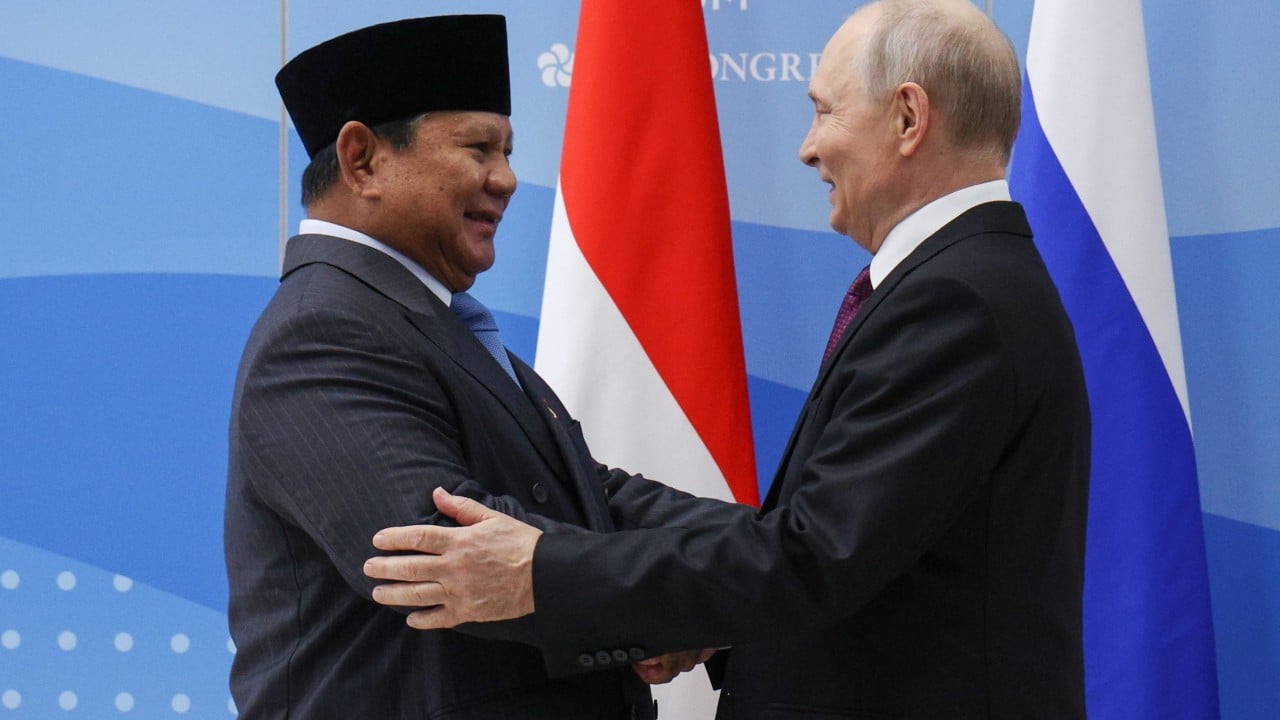
The air conditioning inside the presidential compound hums with a low, mechanical persistence, masking the heavy tropical heat pressing against the glass. Outside, Jakarta pulses in its familiar rhythm—a chaotic symphony of motorcycles, street vendors, and monsoon humidity. Inside, the atmosphere is surgical. Maps rest on polished mahogany. Documents filled with trade figures and diplomatic cables are stacked neatly beside a cup of lukewarm tea.
Prabowo Subianto adjusts his cuff links. He is a man who knows the architecture of power. Decades as a military commander, defense minister, and now president have taught him that diplomacy is rarely about affection. It is about geometry. It is about finding the exact point where competing national interests intersect without collapsing into the void.
Across continents, in a gilded hall in Moscow, Vladimir Putin sits beneath sprawling chandeliers, waiting. The optics are deliberate. Two veterans of statecraft, each shaped by vast, turbulent histories, casting glances toward one another across a shifting global chessboard.
For the casual observer watching the evening news, the embrace and handshakes between the Indonesian president and the Russian leader look like a cinematic twist. Yet, to anyone who understands the DNA of Indonesian statehood, this is not a betrayal of old alliances. It is an old script performed by a new director. It is the continuation of a doctrine born in the fires of the mid-twentieth century, a policy of walking down the middle of a burning street.
To understand why this bond matters, you have to look past the velvet-rope diplomacy and follow the cargo ships.
Consider Budi. He does not live in the marble halls of power. He lives in a crowded suburb of Surabaya, where his family has run a small agricultural supply business for thirty years. Budi wakes up before dawn, checks the global commodity prices on a cracked smartphone screen, and worries about the cost of fertilizer. When crop yields drop, his customers suffer. When fertilizer prices spike, his profit margins vanish into thin air.
Budi has never been to Moscow. He has never met Vladimir Putin, nor has he shaken hands with Prabowo Subianto. But Budi’s livelihood is tethered directly to the decisions made in those high-level rooms.
When Indonesia looks toward Russia, it is rarely driven by ideological romance. It is driven by wheat, energy, and the unyielding necessity of feeding an archipelago of nearly three hundred million souls. Russia possesses commodities that emerging economies need in vast quantities. Indonesia possesses a massive consumer base and a hungry industrial engine that refuses to be bound by the geopolitical preferences of Washington or Brussels.
For decades, Indonesia has clung fiercely to its foundational foreign policy tenet: bebas aktif, meaning free and active. It translates to non-alignment, but in practice, it is an aggressive form of independence. It means Jakarta will drink tea with Western leaders in the morning, discuss defense procurement with European capitals in the afternoon, and negotiate energy contracts with Moscow or Beijing by evening.
Critics in Western capitals watch this balancing act with a twitch in their collective eye. They see sanctions, moral lines, and global divisions. They ask how a nation that prides itself on democratic norms can comfortably shake hands with a leader facing intense international isolation.
The answer lies in history. Indonesia remembers the Cold War. It remembers what happens when developing nations become pawns in a global ideological war. The nation was forged in an era when picking the wrong side meant civil ruin, economic strangulation, and foreign interference. Independence, once won at a bitter cost, is not something Jakarta is willing to outsource to foreign capitals, no matter how loud the admonishments.
Prabowo embodies this historical memory with absolute clarity. His military background gave him a front-row seat to the pragmatism required to keep a fragmented nation intact. He does not view international relations through the lens of moral purity. He views them through the lens of national capability.
If energy security requires buying Russian oil or exploring alternative payment mechanisms to bypass Western financial sanctions, Indonesian strategists will sharpen their pencils and figure out the math. If agricultural cooperation ensures stable food prices for millions of families like Budi’s, the diplomatic friction becomes an acceptable cost of doing business.
Yet, this path is not without peril. Walking a tightrope requires a terrifying balance. Lean too far toward Moscow, and Washington tightens financial restrictions, closes doors to vital technology transfers, or restricts market access. Lean too far toward the West, and Indonesia risks alienating alternative suppliers who offer crucial cushions against global inflation.
Every diplomatic smile carries a hidden price tag.
When Indonesian officials sit down with their Russian counterparts, they are acutely aware of the invisible audience watching from across the Pacific and the Atlantic. They know that every trade agreement, every whispered conversation about defense technology, and every joint military exercise is dissected line by line by intelligence agencies in foreign lands.
This is the hidden reality of modern middle-power diplomacy. Nations like Indonesia are no longer content to wait in the waiting room of history while superpowers dictate the terms of global commerce. They are charting their own courses, hedging their bets, and refusing to be cornered into binary choices.
The bond between Prabowo and Putin is not a permanent marriage. It is a strategic partnership of convenience, forged by intersecting needs and mutual utility. For Prabowo, it is a tool to accelerate economic growth and assert Indonesia’s status as an indispensable voice in the Global South. For Putin, it is an open door to a vital, growing market that refuses to slam shut despite global storms.
Back in Surabaya, the sun begins to climb over the corrugated tin roofs. Budi closes his ledger, rubbing his eyes against the morning glare. He knows nothing of diplomatic cables or geopolitical maneuvering. He only knows that the price of fertilizer is holding steady for now, and that the world feels vast, unpredictable, and entirely beyond his control.
Yet, far above his head, across oceans and conference tables, men in tailored suits are rewriting the maps of his future, one carefully calculated handshake at a time.