The pursuit of absolute temporal precision is no longer an exercise in theoretical physics; it is the foundational infrastructure for the next generation of global positioning, deep-space navigation, and high-frequency financial synchronization. When a strontium-based optical clock achieves a stability where it loses a single second over a span of 30 billion years—roughly twice the age of the universe—the technical achievement signals a transition from microwave-standard dominance to the era of optical lattice supremacy. China’s recent deployment of such a device marks a strategic shift in the metrological landscape, challenging the historical hegemony of the National Institute of Standards and Technology (NIST) in the United States and the PTB in Germany.
The utility of this precision is often misunderstood as a mere race for smaller fractions of a second. In reality, the "error budget" of a clock dictates the resolution of the physical world. At these scales, time becomes a sensor. General relativity dictates that time passes slower closer to a massive body. A clock with a fractional uncertainty of $10^{-18}$ can detect changes in Earth's gravitational potential corresponding to a height difference of just one centimeter. This transforms a clock into an ultra-precise gravimeter capable of mapping subterranean mineral deposits or detecting subtle tectonic shifts long before traditional sensors.
The Three Pillars of Optical Lattice Stability
To understand how the Chinese Academy of Sciences (CAS) reached this threshold, one must decompose the clock’s architecture into three distinct functional systems: the atomic reference, the laser stabilization loop, and the environmental isolation chamber.
1. The Atomic Reference: Strontium-87
The transition from cesium-based "fountain" clocks to strontium optical lattice clocks represents a shift in frequency. Traditional atomic clocks operate in the microwave regime (gigahertz). Optical clocks operate at frequencies approximately five orders of magnitude higher (terahertz).
- The Logic of Scale: Higher frequency allows the "ruler" of time to be divided into smaller, more precise increments.
- The Lattice Mechanism: Thousands of Strontium-87 atoms are trapped in a standing wave of light—the "optical lattice." This trap holds atoms in a "magic wavelength" where the light itself does not shift the clock's transition frequency, effectively neutralizing the Stark effect that would otherwise degrade accuracy.
2. Laser Coherence and the Local Oscillator
The clock is only as good as the laser used to probe the atoms. This laser acts as the local oscillator. Even the most stable lasers drift. The Chinese system utilizes an ultra-stable optical cavity—typically made of Ultra-Low Expansion (ULE) glass—maintained at cryogenic temperatures. The feedback loop between the laser and the atomic transition ensures the laser remains "locked" to the inherent frequency of the strontium atom, correcting for microscopic drifts in real-time.
3. Environmental Decoherence Mitigation
Accuracy at the level of $10^{-18}$ requires the near-total elimination of external interference. The error budget is dominated by:
- Blackbody Radiation (BBR) Shift: Heat from the vacuum chamber walls shifts the energy levels of the atoms. To achieve a loss of only one second in 30 billion years, the system must either operate at cryogenic temperatures or employ high-precision thermometry to calculate and subtract the BBR shift with a high degree of certainty.
- Zeeman Effect: Fluctuations in the magnetic field. Shielding must be multi-layered, often involving mu-metal enclosures that reduce the ambient magnetic field by factors of tens of thousands.
The Cost Function of Global Positioning
Current Global Positioning System (GPS) and BeiDou satellites rely on rubidium or cesium clocks. While highly accurate, they are prone to drift, requiring frequent synchronization with ground-based master clocks. The integration of optical-grade precision into orbital or terrestrial networks changes the math of navigation.
The relationship between timing error ($\Delta t$) and positional error ($\Delta d$) is governed by the speed of light ($c$):
$$\Delta d = c \cdot \Delta t$$
If a clock drifts by one nanosecond, the positional error is approximately 30 centimeters. An optical clock with the stability reported by the Chinese team reduces the intrinsic timing noise to a level where the primary bottleneck in navigation becomes atmospheric interference rather than the clock itself. This level of precision is the prerequisite for "X-ray Pulsar Navigation" and autonomous deep-space probes that cannot rely on Earth-based signals.
Strategic Bottlenecks in Quantum Metrology
Despite the headline-grabbing longevity of these clocks, two primary bottlenecks prevent their immediate transition from laboratory curiosities to industrial standards.
The Portability Barrier
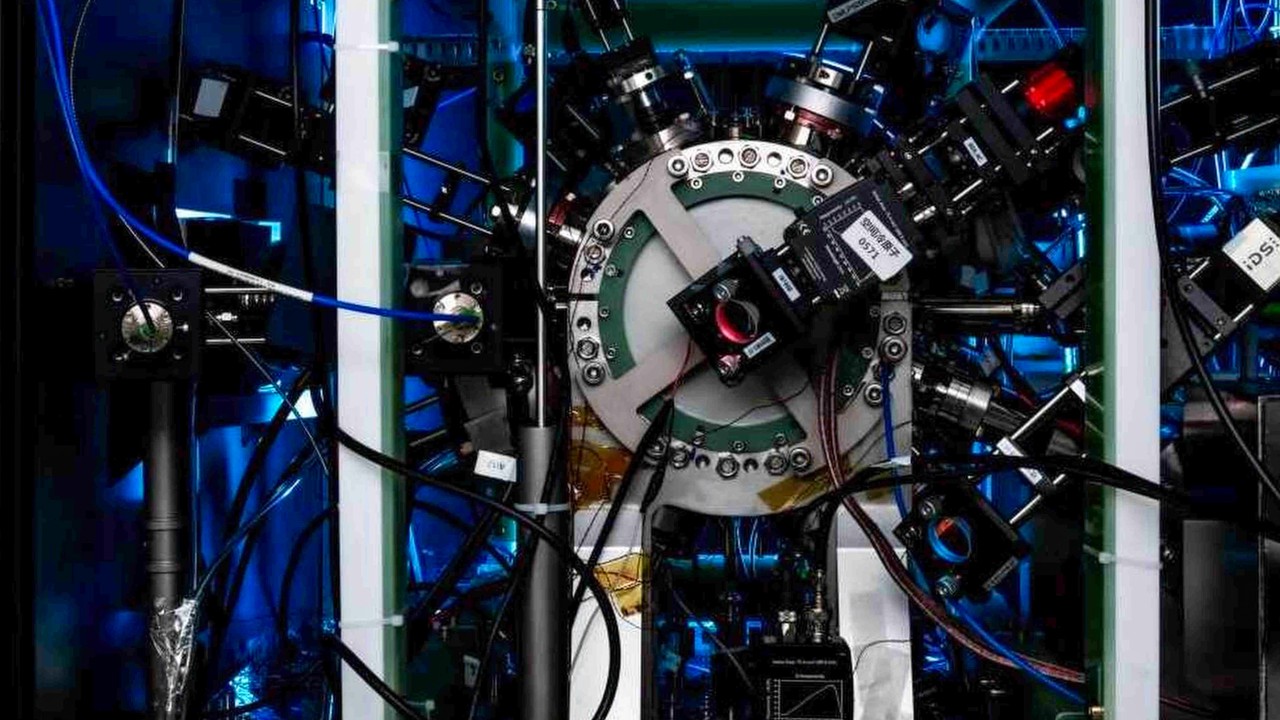
The reported Chinese clock, like its counterparts at NIST, is a massive, room-filling apparatus. It requires high-vacuum systems, complex laser arrays, and significant power overhead. The strategic winner in this space will not necessarily be the lab that achieves $10^{-19}$ stability first, but the lab that achieves $10^{-17}$ stability in a rack-mounted, field-deployable unit.
The Comparison Problem
You cannot prove a clock is accurate to one second in 30 billion years by looking at it; you must compare it to another clock of equal or greater precision. This requires the development of "optical frequency combs"—gears that translate the rapid oscillations of light down to countable electronic signals. China's investment in fiber-optic networks for frequency distribution allows them to compare clocks across different cities (e.g., Beijing and Shanghai), creating a "synthetic" national time scale that is more robust than any single device.
Geopolitical Implications of the "Time Race"
The development of the strontium lattice clock by Chinese researchers is a clear indicator of decoupling in high-end scientific instrumentation. Historically, the components for such systems—specifically specialized lasers and frequency combs—were sourced from Western manufacturers like Toptica or Menlo Systems. The success of this project suggests a maturing domestic supply chain within China for quantum-ready hardware.
This capability has direct military applications, specifically in "GPS-denied" environments. If a vessel or aircraft carries a high-stability optical clock, it can maintain precise positioning for weeks without needing a satellite update, rendering electronic warfare tactics like GPS spoofing or jamming significantly less effective.
Defining the New Standard: The Redefinition of the Second
The international metrology community is currently preparing for a redefinition of the SI second, likely to occur in the late 2020s or early 2030s. The current definition is based on the cesium-133 atom. The Chinese achievement, alongside progress in the US, Japan, and Europe, pushes the world toward an optical definition.
The transition involves a rigorous validation process:
- Redundancy: Multiple labs must achieve the same results independently.
- Continuity: The new optical second must align perfectly with the old cesium second to avoid a "jump" in global time scales.
- Accessibility: The standard must be reproducible by any nation with the requisite technology.
By establishing a clock with $10^{-18}$ uncertainty, China secures a seat at the table where these new global standards are written. This is not merely about scientific prestige; it is about the "Standard-Essential Patents" of the physical world.
Tactical Forecast
The immediate frontier is the shift from terrestrial laboratories to space-based platforms. Operating an optical lattice clock in microgravity eliminates the "gravitational redshift" gradients that complicate ground-based measurements. It also allows for the testing of fundamental physics, such as the search for dark matter or the detection of gravitational waves at frequencies inaccessible to LIGO.
Organizations should monitor the integration of these clocks into China's BeiDou-4 constellation. The first nation to successfully "space-qualify" an optical clock will effectively reset the global standard for timing-dependent infrastructure. This will force a rapid modernization of ground-station hardware and cryptographic protocols, as the increased timing resolution enables new forms of quantum key distribution (QKD) that are reliant on precise photon arrival times.
The strategic play is to move beyond the "accuracy for accuracy's sake" narrative. The value lies in the application of relativistic sensing. Companies and state actors should focus on the software layers that can interpret $10^{-18}$ stability as geospatial data. The clock is no longer a tool for telling time; it is a tool for seeing the earth's interior and navigating the void without a map.
Investment and R&D should be directed toward:
- Miniaturized Optical Combs: Reducing the size of the "translator" between optical and digital signals.
- Vacuum-on-a-Chip: Replacing bulky vacuum pumps with passive, chip-scale ion pumps to enable portability.
- Relativistic Geodesy Algorithms: Software capable of converting clock frequency shifts into real-time gravitational maps.
The mastery of time at this scale creates a permanent asymmetry between those who can sense the gravitational fabric of the planet and those who are still navigating by the microwave standards of the 20th century.