The operational mechanics of executive protection are governed by asymmetric risk functions. When an intelligence agency assigns a low-confidence rating to a threat vector while an executive protection service initiates an emergency asset swap, a fundamental institutional friction becomes visible. This divergence exposes how different branches of the national security state process identical threat streams under competing mandates, operational constraints, and historical error tolerances.
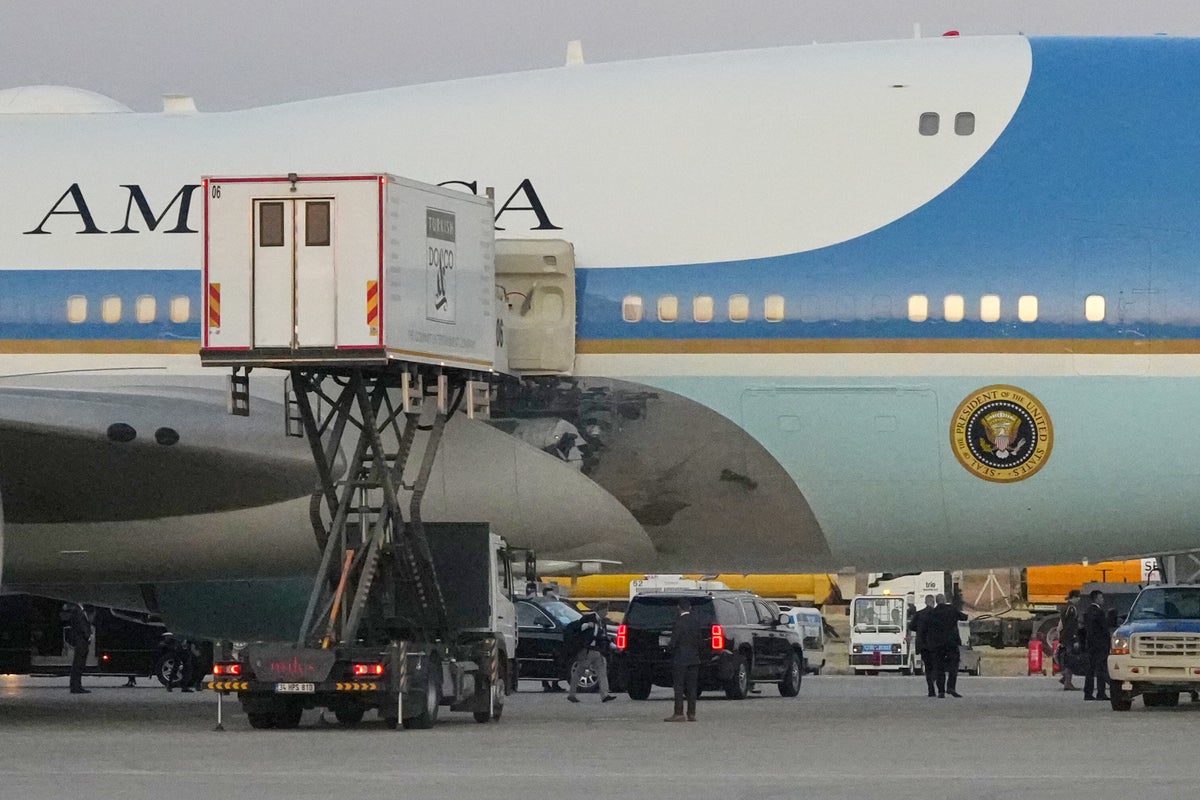
The recent operational diversion involving President Donald Trump's departure from the NATO summit in Ankara, where a clandestine transfer from a primary aircraft to a military transport via a catering truck occurred amid warnings of a surface-to-air missile threat, provides a clear case study in institutional dissonance. Deconstructing this event requires analyzing the split between analytical intelligence production and operational security execution.
The Epistemological Gap Between Collection and Protection
Intelligence agencies and protective details operate on entirely different epistemological frameworks. The Central Intelligence Agency functions primarily as an analytical engine designed to evaluate source reliability, corroborate multi-INT streams, and assign probabilistic confidence scores to foreign actors' intent and capabilities.
When foreign intelligence services—in this case, Israeli counterparts—pass threat information regarding an alleged Iranian surface-to-air missile plot, CIA analysts apply rigorous source validation protocols. If the reporting lacks indigenous verification, depends heavily on third-party collection, or carries ambiguous indicators, the analytical output defaults to a low-confidence designation. For an intelligence analyst, low confidence means the evidentiary threshold required to validate a foreign plot has not been met.
The United States Secret Service operates under a completely different risk calculation. Protective details do not evaluate threats through the lens of academic or probabilistic certainty; they manage catastrophic impact. The cost function for an intelligence analyst who misjudges a threat is an inaccurate analytical report. The cost function for a protective detail that misjudges a threat is the catastrophic loss of the principal.
This structural divergence explains why the Secret Service demanded an immediate tactical pivot despite the CIA's skepticism. Institutional memory within the protective detail heavily dictates this behavior. Following multiple historic security breaches and near-miss incidents targeting the president, the agency's operational tolerance for unverified high-consequence threats dropped to absolute zero. In risk management terms, when the potential severity multiplier is infinite, even a statistically improbable probability requires an immediate mitigation strategy.
The Mechanics of Decoy Operations and Tactical Deception
Executing a high-level executive decoy operation inside a foreign allied airfield requires precise choreography across multiple logistical layers. The Ankara departure sequence demonstrated the implementation of operational obfuscation under severe time constraints:
- Primary Asset Utilization: The principal initially moved toward the primary aircraft, creating a visual and electronic signature that satisfied standard protocol and potential observation.
- Secondary Transfer Vector: Utilizing a non-standard boarding apparatus—specifically an airport catering truck linked to the off-side door of the aircraft—enabled covert physical extraction away from media pools and external surveillance lines.
- Tertiary Asset Transition: The principal was transferred into a C-32A military transport aircraft configured for secure communications and rapid long-range transit.
- Electronic and Physical Decoy Execution: The original aircraft maintained its departure schedule, effectively functioning as a high-value decoy to absorb or misdirect any potential terminal-phase targeting.
This multi-tiered evasion protocol highlights how physical security measures compensate for intelligence ambiguity. By separating the principal's physical location from the expected transit profile, the protective detail neutralizes the tactical advantage of any stationary or mobile threat team, regardless of whether the underlying intelligence payload was verified by domestic agencies.
Strategic Signals and Allied Intelligence Interplay
The friction between the CIA's analytical skepticism and the execution of the protective swap also sheds light on the geopolitical dimensions of intelligence sharing. Intelligence supplied by foreign partners often carries dual utility: operational warning and strategic persuasion.
Former security officials note a recurring pattern where allied intelligence inputs are structured not merely to inform, but to shape executive decision-making and regional policy postures. When an external partner feeds specific, high-urgency threat data regarding adversary actions—such as ongoing Iranian vows of retaliation for historical strikes—it introduces pressure into the host nation's command structure.
If the intelligence is designed to induce a specific defensive or offensive posture, domestic intelligence agencies face the challenge of filtering out the coercive signaling from the raw threat data. The CIA's insistence on designating the Ankara threat as low-confidence reflects an institutional effort to maintain analytical independence against external intelligence crowding. Simultaneously, the decision of certain high-ranking officials to remain aboard the primary aircraft while the principal was diverted suggests that segments of the administration shared the intelligence community's assessment that the immediate empirical backing for the plot was thin, even if the protective apparatus refused to gamble on that assessment.
Institutional Adaptation Under Persistent Asymmetric Threat
The incident establishes a blueprint for how executive protection must evolve in an era of heightened geopolitical volatility and state-sponsored proxy warfare. When state actors openly declare intent to target senior leadership, the traditional boundaries between routine diplomatic travel and tactical combat airspace operations begin to blur.
Security architectures can no longer rely solely on host-nation perimeter security or standard counter-surveillance protocols at international summits. Future protective deployments will increasingly incorporate continuous electronic counter-measures, dynamic flight-path randomization, and pre-planned multi-aircraft staging as standard operating procedure whenever an executive travels through high-risk jurisdictions.
To optimize security outcomes without inducing constant operational paralysis, national security directors must formalize a dual-track decision model. Track one must maintain cold, objective analytical skepticism to prevent foreign partners from manipulating domestic policy through manufactured threat streams. Track two must preserve absolute operational autonomy for protective services to execute zero-tolerance asset swaps whenever a threat indicator touches the catastrophic impact threshold. Separating the intelligence evaluation from the protection mandate ensures that institutional caution protects the principal without compromising analytical integrity.