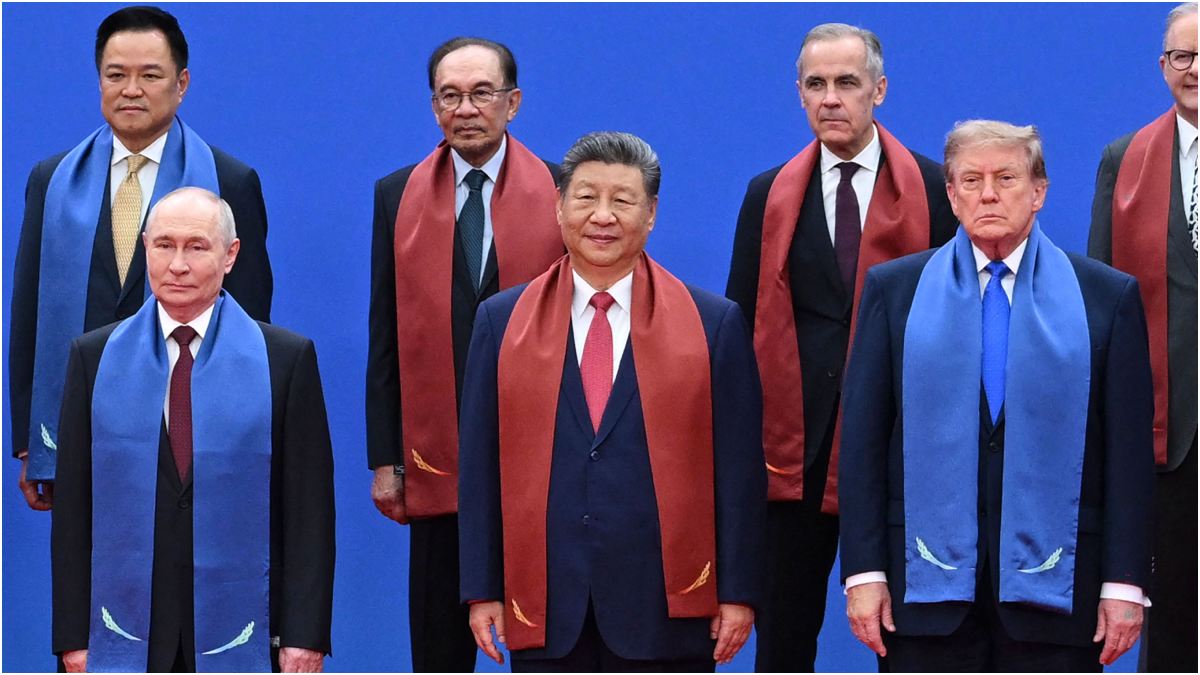
The November 19, 2026 trilateral summit in Shenzhen between Donald Trump, Xi Jinping, and Vladimir Putin formally closed the era of bilateral nuclear governance. Following the February 5, 2026 expiration of the New START treaty—which left the United States and Russia without legally binding warhead caps or on-site verification regimes for the first time since 1972—the Shenzhen meeting established a three-power consultative framework. While the three heads of state issued a joint declaration affirming that a nuclear war cannot be won and must never be fought, rhetorical consensus does not constitute a verifiable arms control architecture.
Transitioning from a bilateral to a trilateral strategic balance introduces severe structural asymmetries. Understanding whether the Shenzhen summit prevents a multi-polar arms race or merely legitimizes an unverified status quo requires breaking down the quantitative force disparities, the game-theoretic constraints of three-body deterrence, and the operational friction points for excluded nuclear states.
The Structural Collapse of Bilateral Verification
For over five decades, strategic stability rested on bilateral parity between Washington and Moscow. Treaties ranging from SALT I in 1972 through New START in 2010 operated on a predictable mathematical foundation: two primary actors maintaining roughly equivalent deployed arsenals under mutually intrusive verification protocols.
Under New START, both the United States and Russia were capped at 1,550 deployed strategic warheads and 700 deployed delivery vehicles—intercontinental ballistic missiles (ICBMs), submarine-launched ballistic missiles (SLBMs), and heavy bombers. Crucially, the treaty mandated 18 annual on-site inspections alongside continuous telemetry data exchanges and notifications. When Russia suspended its participation in February 2023 and the treaty formally lapsed on February 5, 2026, the loss was not merely numerical; it was informational.
Without bilateral inspection regimes, intelligence agencies revert to worst-case scenario modeling. When exact warhead upload capacities on existing missiles cannot be physically verified, defense planners must assume adversaries are maximizing mirror-image payloads. The Shenzhen summit occurred inside this nine-month verification vacuum, attempting to substitute political dialogue at the highest executive level for the missing technical machinery of arms control.
The Asymmetry Problem in Three-Body Deterrence
The core analytical flaw in treating the Shenzhen summit as a direct precursor to a "trilateral New START" lies in the stark quantitative gap between the three participants. Bilateral arms control succeeded because both parties negotiated from positions of rough numerical symmetry. Trilateral negotiations must reconcile three radically different force postures.
- The Bilateral Superpowers: The United States and Russia collectively control approximately 83 percent of all global stockpiled nuclear warheads. Both maintain mature, triad-based delivery architectures capable of absorbing a first strike and executing an assured second-strike retaliation.
- The Rapidly Expanding Challenger: China possesses an arsenal estimated around 600 warheads, having expanded its silo infrastructure and sea-based deterrent over the preceding half-decade. While vastly larger than medium-tier nuclear states, Beijing's stockpile remains roughly a third the size of either Washington's or Moscow's deployed strategic forces.
- The Second-Tier Nuclear Powers: Below the Shenzhen triumvirate sits a distinct tier of regional and medium nuclear states—France (370 warheads), the United Kingdom (225), India (190), Pakistan (170), Israel (90), and North Korea (60).
This distribution creates what strategic theorists call the Three-Body Deterrence Problem. In a two-player game, maintaining parity requires matching one adversary. In a three-player game, if the United States sizes its arsenal to deter both Russia and China simultaneously—the "two-peer" deterrence requirement—Russia will perceive a U.S. buildup as an existential threat to its own second-strike survivability, triggering a reactive Russian expansion. Conversely, if Washington and Moscow cap their arsenals at 1,550 warheads while Beijing builds toward parity, the U.S. faces a combined Sino-Russian warhead advantage.
China's decision to join the Shenzhen table breaks its historical refusal to enter strategic arms talks while its arsenal remained significantly smaller than U.S. and Russian stockpiles. However, sitting at the table to endorse broad principles of non-use carries zero operational cost for Beijing. Agreeing to hard numerical ceilings or intrusive inspections on newly constructed missile silos would require China to freeze its strategic modernization while still in a position of numerical inferiority—a concession no rising power makes without massive compensatory trade-offs in conventional force posture or missile defense limits.
Mechanism of the Shenzhen Declaration Rhetoric vs. Treaty Mechanics
Evaluating the November 19 outcome requires separating diplomatic signaling from enforceable security architecture. The joint U.S.-Russia-China Heads of State Declaration Toward Peace accomplished three specific diplomatic objectives while deferring the hardest technical barriers:
- Re-establishing the Non-Use Norm: By jointly affirming the 1985 Reagan-Gorbachev formulation that a nuclear war cannot be won and must never be fought, the three leaders created a baseline political constraint against nuclear coercion in regional conflicts.
- Institutionalizing Crisis Communication: The commitment to conduct ongoing dialogue on reducing nuclear risks addresses the immediate danger of accidental escalation caused by false early-warning alarms, cyber interference in command-and-control networks, or misread military exercises.
- Asserting Great-Power Primacy: By convening as a self-appointed directory on global stability, Washington, Moscow, and Beijing signaled that foundational rules regarding strategic stability, energy flows, and international jurisdiction will be negotiated directly among the three primary poles rather than through broader multilateral forums like the United Nations Security Council or the stalled Non-Proliferation Treaty (NPT) review process.
What the declaration notably omitted is any binding mechanism for verification, transparency, or force caps. A treaty requires four sequential components:
- Agreed Definitions: Determining what counts as a strategic versus a non-strategic (tactical) weapon. Russia maintains a substantial advantage in non-strategic nuclear weapons, which New START excluded. The United States will not enter a permanent post-New START cap without accounting for Russian tactical warheads and Chinese theater-range systems.
- Data Declarations: Baseline exchanges detailing exact numbers of launchers, warheads, and deployment locations. China treats strategic opacity as a core pillar of its survivability; revealing silo coordinates and warhead counts degrades the ambiguity that protects its smaller force from a disarming first strike.
- Verification Protocols: Satellite monitoring agreements, telemetry sharing, and physical on-site inspections. Rebuilding trust after the collapse of New START inspections requires technical protocols that take years of working-group negotiations to draft.
- Compliance Enforcement: Clear dispute-resolution bodies—equivalent to New START's Bilateral Consultative Commission—to adjudicate suspected treaty violations without collapsing the entire framework.
The Externalities for Non-Participant Nuclear States
By framing strategic stability as a trilateral concert, the Shenzhen summit generates immediate strategic friction for nuclear states excluded from the room—most notably India, France, and the United Kingdom.
For New Delhi, the Shenzhen dynamic presents an acute deterrence dilemma. India's nuclear posture is calibrated against two nuclear-armed neighbors: China and Pakistan. With an estimated 190 warheads, India maintains a minimum credible deterrence doctrine reliant on assured retaliation. If trilateral arms control talks between Washington, Moscow, and Beijing eventually materialize, any resulting framework will focus exclusively on intercontinental systems threatening the American, Russian, and Chinese homelands.
Such a narrow scope creates two specific vulnerabilities for India:
- Theater-Range Unconstrained Growth: A trilateral treaty capping strategic ICBMs would leave China's intermediate-range ballistic missiles (IRBMs) and dual-capable regional delivery systems completely unrestricted, allowing Beijing to modernize theater forces aimed at South Asia while claiming compliance with global arms control.
- Political Containment Pressure: Once the three largest nuclear powers establish a formal "joint-guardian" architecture, they gain immense diplomatic leverage to pressure second-tier nuclear states into freezing their own arsenals or signing onto restrictive testing and fissile-material moratoriums—locking India into permanent numerical inferiority relative to China while Pakistan's 170-warhead arsenal remains tightly coupled to Chinese technical support.
Similarly, European nuclear powers—France (370 warheads) and the United Kingdom (225 warheads)—face exclusion from negotiations that directly affect continental security. Russia has historically insisted that British and French arsenals be counted alongside U.S. forces in any broader European arms limitation framework. A Shenzhen-led trilateral track bypasses European security architecture entirely, forcing London and Paris to re-evaluate the sufficiency of their independent deterrents if Washington and Moscow strike bilateral or trilateral accommodations without European participation.
Limitations and Failure Modes of the Trilateral Model
Treating the Shenzhen summit as an irreversible shift toward disarmament ignores three structural failure modes that could collapse the initiative within 12 to 24 months:
- The Linkage Trap: Arms control rarely survives acute conventional or territorial crises. Deepening friction over the Taiwan Strait, European security architecture, or Middle Eastern proliferation can rapidly freeze working-level nuclear talks. During the Cold War, bilateral arms control remained insulated from regional proxy wars only because both Washington and Moscow prioritized regime survival over ideological expansion. In a three-way dynamic, any bilateral rupture—such as a U.S.-China crisis in the Western Pacific—gives the third party (Russia) immense leverage to extract concessions or stall progress.
- Technological Disruption: Legacy arms control treaties counted physical launchers—silos, submarines, and heavy bombers. Modern strategic stability is increasingly destabilized by non-nuclear capabilities: hypersonic glide vehicles, fractional orbital bombardment systems, anti-satellite weapons, cyber intrusions into nuclear command-and-control networks, and AI-assisted target tracking. None of these technologies fit cleanly into traditional warhead-counting rules, yet each threatens the survivability of second-strike forces.
- Domestic Ratification Bottlenecks: Even if executives in Washington, Moscow, and Beijing negotiate a binding trilateral treaty, domestic ratification remains a severe hurdle. In the United States, a formal arms control treaty requires a two-thirds supermajority in the Senate—a threshold virtually impossible to clear if lawmakers perceive the agreement as granting China parity or failing to restrain Russian non-strategic weapons. Executive agreements without Senate ratification lack durability across U.S. presidential administrations.
Operational Execution Sequence for Post-Shenzhen Stability
To convert the Shenzhen declaration from a diplomatic photo-op into functional risk reduction, defense planners and diplomats across the three capitals cannot jump directly to a comprehensive warhead-reduction treaty. Attempting to negotiate warhead ceilings first will stall immediately over numerical asymmetries. Instead, execution must follow a strict four-phase sequence:
- Phase 1: Tripartite Crisis Communication and AI Guardrails (Months 1–6). Establish a dedicated, encrypted three-way military-to-military crisis hotline distinct from political channels. Simultaneously, codify a binding protocol prohibiting the integration of autonomous artificial intelligence into nuclear launch authority, guaranteeing human-in-the-loop decision-making across all three command structures.
- Phase 2: Advance Launch Notifications and Data Transparency (Months 6–12). Expand existing bilateral ballistic missile launch notification agreements into a unified trilateral registry. Require 48-hour advance notice for all ICBM, SLBM, and space-launch vehicle tests to eliminate false-alarm escalation risks.
- Phase 3: Asymmetric Freeze and Upload Moratorium (Months 12–24). Rather than demanding immediate equal reductions, negotiate an interim political freeze: the United States and Russia agree not to upload reserve warheads onto existing New START delivery vehicles, while China agrees to cap further expansion of fixed ICBM silo fields while working groups define verification metrics.
- Phase 4: Consultative Mechanism for Second-Tier Powers (Months 18–36). Establish a parallel P5-plus-India strategic stability dialogue to address theater-range missile deployments and fissile material production, preventing regional arms races in South Asia and Europe from undercutting central trilateral limits.
The Shenzhen summit proved that Washington, Moscow, and Beijing recognize the systemic danger of an unrestrained, unverified nuclear environment. Yet political recognition is only the entry price. Unless the three powers immediately operationalize transparency measures and launch-notification regimes before deploying additional reserve warheads, November 19, 2026 will be recorded not as the birth of stable tri-polarity, but as a brief diplomatic pause before the most complex arms race in modern history.