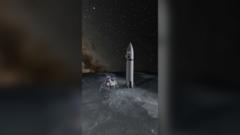
Establishing a permanent infrastructure framework on the lunar surface requires moving past the temporary footprint model of the Apollo era. It requires transitioning to a scalable, industrially viable asset deployment model. NASA’s updated strategic blueprint relies on a three-phase deployment scheduled between now and the mid-2030s. This framework replaces unquantified exploration goals with explicit constraints across logistics, thermal management, energy production, and supply chain dependencies.
The logistical reality of deep space logistics is dictated by mass-to-orbit penalties. Every kilogram of structural mass delivered to the lunar surface requires an exponential expenditure of propellant in the lower stages of the launch vehicle. To establish an enduring infrastructure without escalating cost functions, the architecture must balance commercial cargo acquisition, in-situ resource processing, and localized energy networks.
The Phased Architecture of Surface Asset Deployment
The construction of the Artemis Base Camp near the Shackleton de Gerlache Ridge at the lunar south pole is organized into three sequential phases. Each phase is defined by specific operational capabilities and tech validation targets.
Phase 1: Risk Mitigation and Mobility Priming
The initial phase focuses on deploying uncrewed cargo systems to establish mobile infrastructure before human arrival. NASA's recent award of a $230.4 million contract to Blue Origin for the first two uncrewed missions using the cryogenically propelled Endurance lander establishes the baseline for this phase.
The core objectives of Phase 1 include:
- Volumetric Cargo Verification: Validating the offloading mechanisms of heavy-class commercial landers under 1/6th gravity conditions.
- Mobility Asset Ingress: Deploying unpressurized Lunar Terrain Vehicles (LTV), developed by Astrolab and Lunar Outpost, to allow remote-controlled or autonomous mapping of local topography.
- Thermal and Dust Evaluation: Testing mechanical components against the abrasive, electrostatically charged lunar regolith and the thermal stresses of permanently shadowed regions (PSRs).
Phase 2: Power Microgrids and Fixed Infrastructure
Scheduled to run from 2029 into the early 2030s, Phase 2 shifts focus from mobile reconnaissance to fixed infrastructural permanence. The logistical bottleneck during this phase is the transition from localized battery power to continuous generation.
The structural blueprint introduces the Foundational Surface Habitat (FSH), designed by Thales Alenia Space under a bilateral agreement with the Italian Space Agency (ASI). The FSH functions as a stationary, pressurized Multi-Purpose Habitation module capable of supporting a crew of four for up to 30 days. Concurrently, initial automated components of a localized power grid will be deployed to link habitats, communication relays, and landing zones.
Phase 3: Industrial Scale and Semi-Permanent Habitability
By the mid-2030s, the operational perimeter is projected to expand across several hundred square miles, monitored by specialized automated asset networks. Phase 3 establishes semi-permanent habitability through closed-loop Environmental Control and Life Support Systems (ECLSS) and pilot-scale resource extraction.
The operational goal is to reduce Earth-dependence by achieving high-efficiency recycling loops for water and oxygen, while utilizing local materials for radiation shielding.
Thermodynamic and Power Constraints at the South Pole
The choice of the lunar south pole for infrastructure deployment is dictated by resource availability, but it introduces severe thermodynamic and power constraints.
+-----------------------------------------------------------------------+
|                       LUNAR SOUTH POLE ENVIRONMENT                     |
+-----------------------------------------------------------------------+
                                   |
         +-------------------------+-------------------------+
         |                                                   |
         v                                                   v
+-----------------------------------+               +-----------------------------------+
|    PERMANENTLY SHADOWED REGIONS   |               |     PEAKS OF ETERNAL LIGHT        |
|  - Volatile water ice reserves    |               |  - Near-continuous solar access   |
|  - Temperatures drop to 40 Kelvin |               |  - Topographical constraints      |
+-----------------------------------+               +-----------------------------------+
This stark contrast creates an optimization challenge. Solar arrays must be positioned precisely on elevated ridges to maximize photodetector exposure, while extraction machinery must operate inside sub-40 Kelvin craters.
The Power Function
Solar power alone cannot sustain an industrial surface base due to the moon's complex topography and periodic illumination gaps. To maintain uninterrupted life support and thermal management, the base relies on a dual-source power architecture:
- Vertical Solar Arrays: High-aspect-ratio solar collectors mounted on tracking gimbals positioned on high-altitude rims to capture grazing sunlight.
- Fission Surface Power (FSP): A 10 kW nuclear fission reactor, developed in partnership with the U.S. Department of Energy, designed to operate continuously regardless of solar occlusion or dust accumulation.
The deployment of a nuclear fission unit alters the mission risk profile. It provides a reliable power baseline that eliminates the mass penalty of heavy cryogenic or chemical battery storage systems needed to survive the lunar night.
The Supply Chain Bottleneck: Launch Inelasticity
The primary point of failure for the current architecture lies in launch system inelasticity and vehicle development timelines. The operational model requires tight synchronization between NASA's Space Launch System (SLS) and private landing platforms.
The current flight manifest exposes structural vulnerabilities:
- Artemis III (Mid-2027/2028 Target): Serves as an orbital and landing integration test. Astronauts in the Orion capsule will attempt to dock with commercial human landing systems (HLS) in lower Earth orbit or Near-Rectilinear Halo Orbit (NRHO).
- Artemis IV (Late 2028 Target): Marks the scheduled return of crew to the lunar surface. This mission depends heavily on private launch providers meeting technical milestones for heavy-lift vehicles and orbital propellant transfer.
The technical bottleneck is not the manufacturing of surface habitats, but the unproven execution of rapid, orbital cryogenic refueling. Competing architectures from SpaceX (Starship HLS) and Blue Origin (Blue Moon) require dozens of tanker flights to transfer liquid oxygen and liquid hydrogen in low Earth orbit before a single lander can transit to the moon. Delays in mastering zero-g fluid management will directly postpone the deployment of Phase 2 infrastructure.
Closed-Loop Lifespan Economics
To transition the base from a high-maintenance outpost to a self-sustaining asset, the facility must minimize its resupply coefficient—the ratio of imported mass to total consumed mass. This requires optimizing two technical vectors.
Advanced ECLSS Loops
Current systems on the International Space Station achieve water recovery rates above 98%. However, long-duration lunar surface habitats must replicate this performance while filtering out ultra-fine lunar dust particles that bypass standard seals. The introduction of the Habitable Mobility Platform—a pressurized, long-range mobile rover—requires its own independent, miniaturized ECLSS loop. This increases the mechanical complexity and potential points of failure across the base network.
Regolith Exploitation for Structural Protection
Unshielded habitats are vulnerable to cosmic radiation, solar particle events, and micrometeorite impacts. Transporting heavy shielding materials from Earth is economically unfeasible. The strategic solution involves utilizing local regolith through automated additive manufacturing or mechanical sintering.
By layering processed regolith over inflatable or rigid metal modules, the base can achieve thermal stabilization and radiation mitigation using local resources. This approach lowers the total launch mass requirements for subsequent deployment phases.
Strategic Imperatives for Infrastructure Readiness
To ensure the viability of the lunar base against technical delays and geopolitical competition, space agency administrators and commercial partners must execute two tactical plays immediately.
First, standardise all mechanical, electrical, and docking interfaces across commercial providers. The current division between competing landing architectures creates siloed supply chains. Enforcing strict modular interchangeability for power connections, fuel transfers, and airlock seals will decouple surface infrastructure from the survival of any single commercial vendor.
Second, prioritize the immediate deployment of automated pathfinders dedicated to mapping the sub-surface geometry of volatile ice deposits inside target craters. Operational plans rely heavily on in-situ water extraction for life support and propellant manufacturing. However, the precise physical state, concentration, and depth of these deposits remain unquantified. Securing empirical, ground-truth resource data through automated drilling must occur before finalizing the design of heavy refining machinery.


