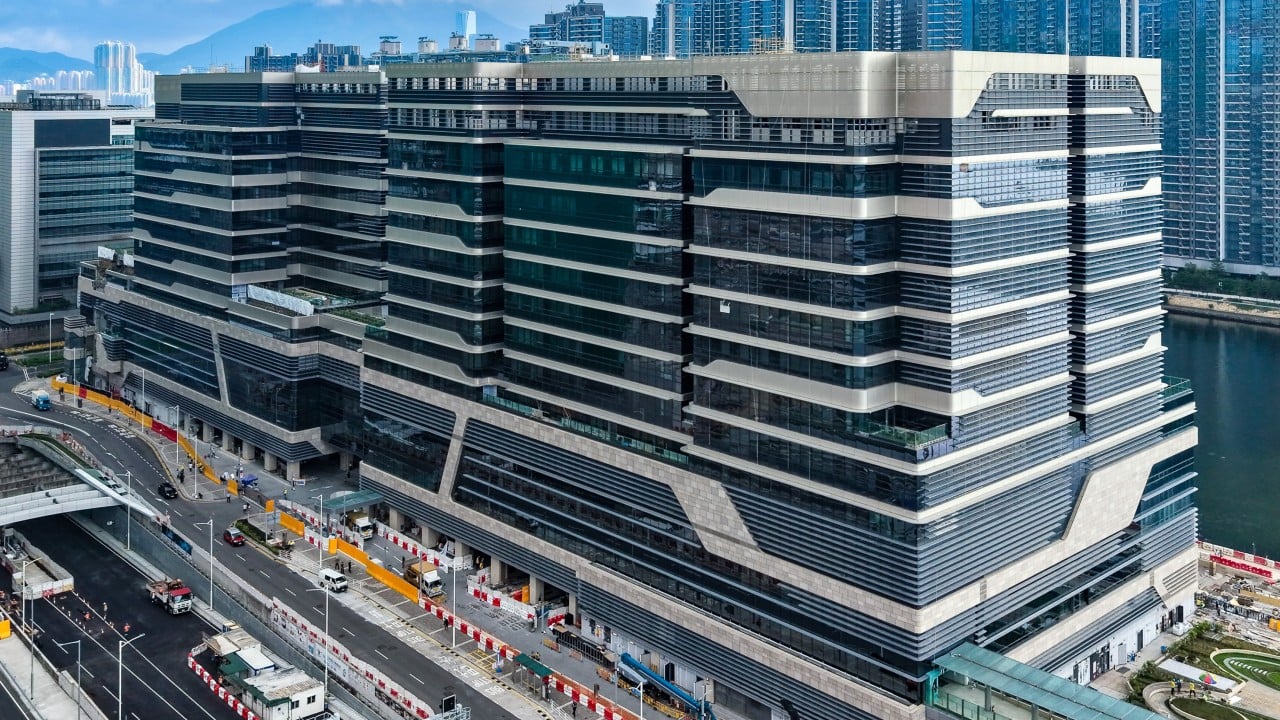
Large-scale healthcare infrastructure projects fail or succeed long before the first patient crosses the threshold, governed entirely by the mechanics of transition management. When a regional tertiary hub initiates a phased deployment, the primary operational challenge is not medical delivery, but cognitive and logistical friction. The transition of the 2,400-bed Kai Tak Hospital in Hong Kong, operating under the Kowloon Central Cluster framework, offers a definitive case study in managing massive institutional migration. Deconstructing the rollout mechanics reveals the underlying variables that dictate whether a massive healthcare asset scales smoothly or collapses under initial throughput bottlenecks.
The Logistics of Phased Service Migration
A common misconception in healthcare administration is that a hospital opens as a binary event. In practice, a modern facility spanning hundreds of thousands of square meters functions as a complex manufacturing plant undergoing a rolling retrofit. The phased commissioning model deployed at Kai Tak—shifting outpatient, specialist clinic, and oncology services in its initial window while deferring core emergency and trauma capabilities to a later phase—creates a distinct operational matrix.
[Legacy Facility (Queen Elizabeth Hospital)]
       │
       ├─► Outpatient & Oncology Migration (Phase 1) ──► [Kai Tak Hospital Core Blocks]
       │
       └─► Emergency & Trauma Retention (Until Phase 2) ──► [Interim Dual-Node Load]

Kai Tak Hospital Phased Rollout Operational Bottlenecks and Structural Stress Tests

health, business

Healthcare delivery systems fail at the intersection of scale and operational friction. When a massive institutional infrastructure like Kai Tak Hospital initiates phased operations, the primary challenge is not the ribbon-cutting ceremony or the acquisition of advanced capital equipment; it is the management of patient flow velocity against a constrained supply of specialized personnel. Deploying on-site staff augmentations and dedicated helplines represents an immediate tactical intervention, but it also signals a deeper structural vulnerability in load balancing. Hospital leadership cannot simply absorb surges in patient volume without introducing severe latency into triage and diagnostic pipelines. Deconstructing this phased launch requires analyzing the friction coefficients inherent in large-scale healthcare commissioning, the economics of queue management, and the systemic dependencies that dictate whether a new facility relieves regional healthcare congestion or exacerbates it.

The operational architecture of a phased hospital launch relies on compartmentalized risk reduction. By opening services incrementally—starting with specific outpatient clinics, ambulatory care, or specialized diagnostics before scaling to full inpatient and emergency capabilities—administrators attempt to isolate failure domains. If a software glitch hits the electronic health record system or if staffing ratios fall below safety thresholds during week one, the impact remains bounded within a single department rather than cascading across the entire facility.

However, this compartmentalization introduces its own friction. Patients rarely arrive with neatly categorized symptoms that map cleanly onto partial hospital capabilities. A patient presenting to a newly opened outpatient unit with acute complications forces an immediate cross-departmental transfer, testing communication channels that have not yet been stress-tested under load. The deployment of on-site staff and telephone helplines functions as a kinetic shock absorber designed to catch these routing errors before they manifest as critical clinical delays.

Queue theory provides the mathematical framework for understanding why new medical facilities immediately encounter congestion. When a hospital opens, pent-up regional demand converges on the new node. Even with a phased rollout, the arrival rate of patients far exceeds the processing rate of the newly assembled medical teams, who are still acclimatizing to unfamiliar physical layouts and integrated workflows.

$$\lambda > \mu$$

When the arrival rate ($\lambda$) surpasses the service capacity ($\mu$), queue lengths approach infinity, leading to exponential wait times. The introduction of a dedicated hotline acts as a pre-filtering mechanism designed to artificially deflate the effective arrival rate by deflecting non-urgent inquiries and directing patients to alternative community clinics. Yet, a helpline only succeeds if the information architecture behind it is synchronized with real-time bed and staff availability. If the hotline operators lack live telemetry on emergency department wait times or clinic capacity, they merely redistribute the bottleneck from the physical reception desk to the telephonic queue.

Staffing constraints represent the absolute ceiling of hospital operational capacity. Modern medical facilities are capital-intensive but labor-bound; you can buy an MRI machine in weeks, but training a specialized nursing cadre takes years. During a phased launch, nurse-to-patient ratios are frequently skewed by the necessity of running dual systems: maintaining administrative and training overhead while simultaneously servicing live clinical loads.

Deploying temporary on-site staff mitigates head-count shortages, but it introduces variance in clinical execution. Contract or redeployed staff lack institutional memory and familiarity with localized protocols, which increases the cognitive load on permanent supervisors and slows down decision-making chains. Every handoff between a permanent clinician and a temporary support worker increases the probability of omission errors, from medication administration to diagnostic ordering.

The economic reality of hospital commissioning involves managing the burn rate of fixed overhead against restricted variable revenue. Operating a massive medical plant at twenty percent capacity during phase one generates substantial capital drag. Administrators face intense pressure to accelerate the phasing schedule to capture revenue and relieve external political pressure, but accelerating the timeline before internal feedback loops are stabilized invites catastrophic operational failures.

To evaluate whether a phased hospital launch is achieving its structural objectives, analysts must track specific operational metrics rather than relying on qualitative impressions of activity.

- *First-Contact Resolution Rate on Helplines*: Measures what percentage of inquiries are resolved without requiring an in-person visit. A low percentage indicates poor public messaging or inadequate triage authority among helpline operators.
- *Triage-to-Doctor Time Variance*: Evaluates the predictability of patient flow inside the facility. High variance points to internal bottlenecks in bed management or diagnostic turnaround.
- *Overtime and Burnout Indices for Core Staff*: Tracks the hidden cost of early operations. If permanent staff are logging excessive overtime to compensate for onboarding gaps, attrition rates will spike by month six, collapsing institutional capacity just as the hospital attempts to expand into its next operational phase.

The transition from a phased deployment to full operational capacity requires shifting from reactive interventions—such as emergency staff redeployments and ad-hoc hotline expansions—to predictive load balancing. Healthcare systems must integrate regional referral networks so that patient surges are smoothed across multiple facilities rather than crashing against the newest, most vulnerable node in the network.

The long-term viability of Kai Tak Hospital depends entirely on whether leadership treats the initial phase as a period of genuine systemic calibration or merely as a public relations exercise. If the operational feedback loops identified during this phase are used to re-engineer internal workflows, the facility will stabilize into a high-performance regional anchor. If the feedback is ignored in favor of maintaining political momentum, the facility will institutionalize chronic bottlenecks, turning a multi-billion-dollar infrastructure investment into a localized point of systemic failure.


