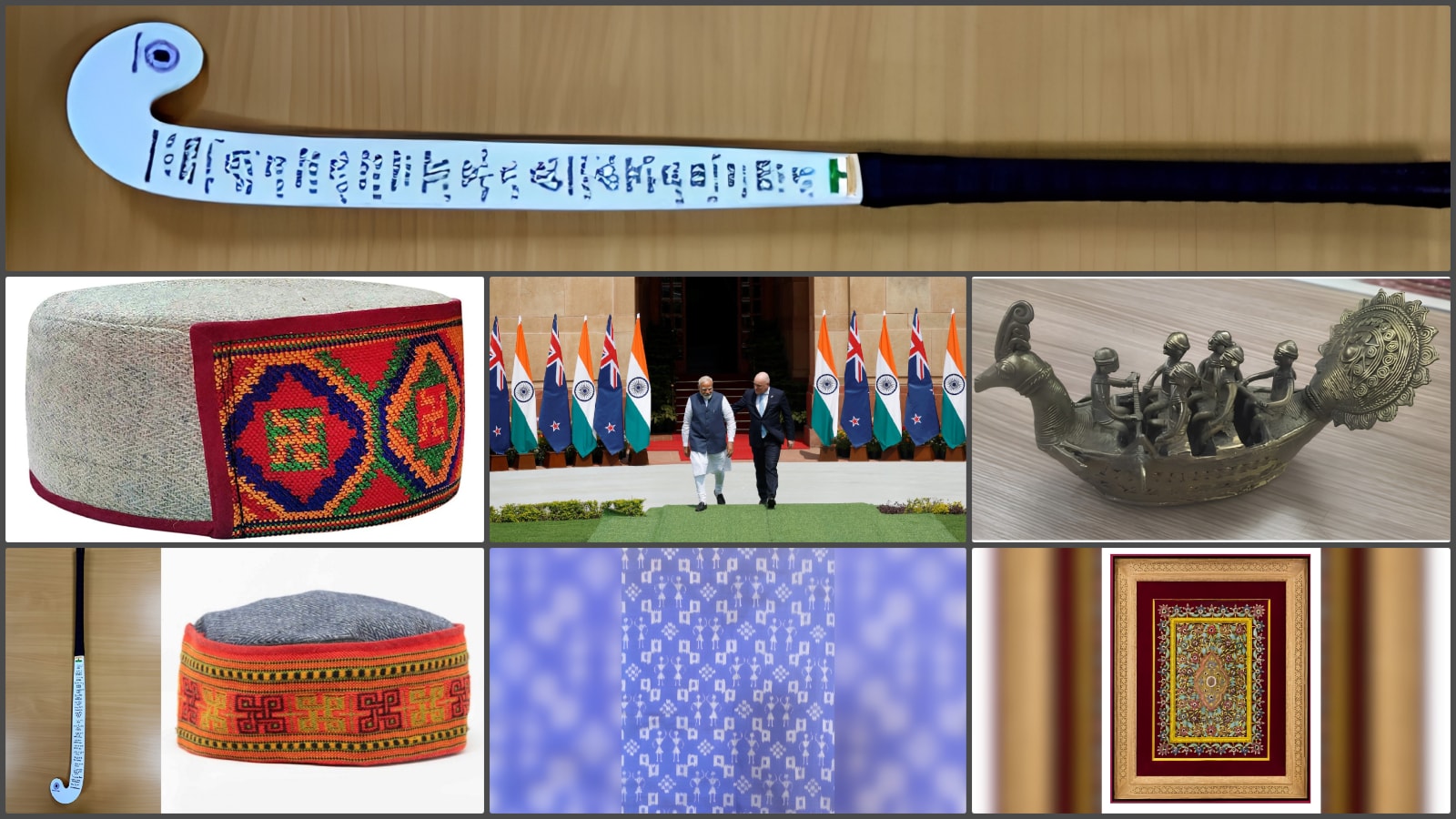
Statecraft operates on two concurrent vectors: tangible economic architecture and symbolic soft power optimization. The bilateral summit at Government House in Auckland between Indian Prime Minister Narendra Modi and New Zealand Prime Minister Christopher Luxon represents the first visit by an Indian head of government to New Zealand in over forty years. While the formal output of this engagement is defined by an elevation to a Strategic Partnership and a mandate to double bilateral trade by 2030, the mechanical execution of the summit relied heavily on calculated cultural diplomacy. The exchange of specific physical artifacts—a traditional Uttarakhandi Pahari cap and a signed stick from the Indian Women’s Hockey Team—serves as a case study in high-precision geopolitical signaling rather than mere ceremonial courtesy.
To analyze this engagement with structural rigor, the interaction must be stripped of narrative sentimentality and evaluated through the lens of asymmetric diplomatic investment, institutional signaling, and economic roadmap alignment.
The Dual Axis Framework of State Gifting
The selection of state gifts is an exercise in resource allocation and thematic alignment. Governments use these artifacts to project internal industrial capabilities, historical legacies, or socio-political values directly into the domestic discourse of the recipient nation. In Auckland, the Indian delegation executed a dual-axis strategy, balancing regional domestic preservation with global institutional achievement.
                  [Global Institutional Achievement]
                                  ^
                                  |  (Signed Hockey Stick)
                                  |
                                  |
    [Internal Preservation] <-----+-----> [External Integration]
                                  |
                                  |  (Uttarakhandi Pahari Cap)
                                  |
                                  v
                   [Regional Domestic Preservation]
The Axis of Regional Domestic Preservation: The Uttarakhandi Pahari Cap
The presentation of the traditional Uttarakhandi Cap, or Pahari cap, addresses the axis of cultural preservation and regional identity transmission. Manufactured from high-grade indigenous wool and characterized by its distinctively woven geometric band, the artifact functions as a live demonstration of India's micro-economic textile ecosystems.
The strategic choice of an Uttarakhandi artifact over more globally recognized textile products from the Indian subcontinent targets specific diplomatic variables:
- Sub-National Differentiation: It highlights India's internal cultural pluralism, signaling to foreign partners that the nation operates as a union of distinct regional economies rather than a monolithic market.
- Artisanal Supply Chain Validation: The inclusion of hand-loomed woolens projects an administrative commitment to preserving indigenous manufacturing techniques, aligning with domestic policies aimed at formalizing rural craft economies.
- Geographic Positioning: The Himalayan origin of the cap subtly underscores India's northern alpine geography, establishing a subtle atmospheric resonance with the mountainous terrains of New Zealand's South Island.
The Axis of Global Institutional Achievement: The Commemorative Hockey Stick
The second artifact—a hockey stick signed by the entirety of the Indian Women’s Hockey Team—shifts the vector from regional tradition to global institutional performance. This object explicitly commemorates the team’s historic triumph at the FIH Hockey Women’s Nations Cup, an event hosted within New Zealand itself.
This selection optimizes diplomatic capital through several distinct mechanisms:
- Historical Reciprocity: The stick marks a century of documented sporting contact between the two nations, providing an uncontroversial, shared historical anchor that predates modern multilateral trade tensions.
- Performance Metrics as Soft Power: By showcasing a championship-winning team, the artifact shifts the narrative of the global South from one of developing-nation potential to one of realized, high-tier performance execution.
- Demographic Alignment: The focus on a women's sports team serves as a progressive institutional signal, matching New Zealand’s domestic socio-political emphasis on gender equity and inclusive athletic representation.
Structural Metrics of the India New Zealand Strategic Partnership
While cultural artifacts provide the psychological scaffolding for diplomacy, the material baseline of the Auckland summit rests on quantifiable commitments. The elevation of bilateral relations to a Strategic Partnership demands an objective assessment of current trade deficits, tariff bottlenecks, and structural variables.
The Trade Doubling Mandate
The declared objective to double bilateral trade by the year 2030 requires an analytical breakdown of current trade velocities. The primary constraint on bilateral trade expansion has historically been asymmetric tariff structures, particularly concerning New Zealand’s primary export sectors—dairy, agriculture, and fruit—and India's protectionist domestic agricultural frameworks.
The mechanism to achieve the 2030 target cannot rely on standard consumer goods. Instead, the strategy prioritizes non-tariff barrier reductions and deep integration across specific, highly technical verticals:
- Agri-Tech and Yield Optimization: India’s agricultural sector faces structural constraints regarding post-harvest loss and supply chain refrigeration. New Zealand's advanced agricultural management systems offer operational solutions that do not threaten Indian domestic farmers via direct product dumping.
- The Educational Services Corridor: International education remains one of New Zealand's most critical export earners. The strategic roadmap seeks to streamline visa processing architectures and formalize degree-recognition frameworks to capture a larger share of India’s high-skilled demographic export.
- Dairy Technology Transfers: Rather than focusing on the high-tariff import of raw dairy products into India, the bilateral framework emphasizes the transfer of processing technologies, herd management software, and genetic optimization techniques from New Zealand firms to Indian co-operatives.
The Maritime Security and Hydrography Vector
The signing of Memoranda of Understanding in defense, maritime security, and hydrography reveals a shared geopolitical imperative in the Indo-Pacific theater. The strategic reality dictates that both nations require stable, rules-based maritime corridors to maintain open commercial shipping lanes.
Hydrographic cooperation represents a highly technical entry point for deep defense integration. By sharing mapping data, oceanic research, and maritime domain awareness metrics, both militaries establish baseline interoperability without requiring explicit, high-friction mutual defense pacts. This layer of cooperation acts as a hedge against regional maritime revisionism, securing vital supply lines across the Pacific and Indian Oceans.
The Diaspora Diaspora Asset Integration
A critical component of the Auckland engagement occurred during the address to the Indian diaspora, where an calculated appeal to historical memory was deployed. The presentation of a thirty-year-old muffler, cap, and gloves received by the Indian Prime Minister during a private visit to New Zealand decades prior serves as an analytical study in diaspora mobilization.
The Sailor Theory of Diplomatic Execution
The administration explicitly defined the diaspora population across Auckland, Wellington, Christchurch, and Queenstown not as passive expatriates, but as active "sailors" of the bilateral relationship. This phrasing shifts the operational burden of foreign policy from state bureaucracies to organic market actors.
The diaspora functions as an economic force multiplier through three measurable channels:
- Remittance and Capital Infusion: The structured flow of capital back into regional Indian economies provides steady liquidity to domestic banking systems.
- Lobbying and Policy Influence: A highly integrated, economically prosperous diaspora exerts natural upward pressure on New Zealand’s domestic political apparatus, making long-term anti-India trade positions politically expensive.
- Knowledge and Technology Arbitrage: Indian-origin professionals working within New Zealand’s tech, biotech, and agricultural firms act as direct conduits for bilateral technology transfers, bypassing formal corporate bottlenecks.
Structural Constraints and Strategic Bottlenecks
A clinical evaluation of the India-New Zealand relationship requires outlining the structural limitations that prevent immediate, friction-free integration. No bilateral framework operates in a vacuum, and several systemic challenges remain unresolved by the Auckland agreements.
The primary impediment is the fundamental divergence in trade philosophies. New Zealand’s economic model is built on comprehensive, high-standard Free Trade Agreements (FTAs) that demand extensive market access for its agricultural exports. India's trade policy, conversely, remains anchored in defensive agricultural positioning to protect hundreds of millions of subsistence farmers from international price volatility.
This core divergence creates a persistent bottleneck in formal FTA negotiations. The reliance on sector-specific MoUs—such as those signed in food technology and disaster management—is an explicit acknowledgment that a comprehensive tariff-free trade regime is structurally unfeasible in the near term. The current strategy bypasses this bottleneck by focusing on volume expansion within existing permitted sectors rather than attempting to force a sudden dismantling of defensive tariffs.
The Strategic Blueprint
The immediate operational priority for corporate and state actors following the Auckland summit requires a pivot toward execution metrics. The transition from a comprehensive bilateral relationship to an operational Strategic Partnership requires a disciplined focus on capital allocation and institutional reforms.
The first strategic play must center on the institutionalization of the agri-tech and logistics corridor. Enterprises looking to capitalize on the 2030 trade target should focus investment on joint ventures that pair New Zealand’s cold-chain logistics software with India’s expanding domestic rural infrastructure. This approach generates commercial value while remaining entirely insulated from the protectionist political crosswinds that govern direct agricultural trade.
The second focus requires the formalization of the sports and cultural infrastructure signaled by the hockey stick exchange. This involves building out commercially viable athletic exchange academies that leverage New Zealand’s high-performance sports science frameworks to upgrade India's grassroots athletic pipeline. By anchoring the relationship in high-value services, technology transfers, and maritime data cooperation, both states can systematically engineer a resilient economic architecture capable of meeting the 2030 mandates despite structural tariff limitations.


