Rain blurred the neon signs of New Delhi, streaking the pavement in long, bleeding lines of amber and crimson. Inside the secure briefing room, the air smelled of stale coffee and damp wool. A junior diplomat, let us call him Anand, adjusted his collar. He had spent three sleepless nights prepping binders full of trade data, missile defense telemetry, and semiconductor supply chain maps.
Across the mahogany table sat his American counterparts. They looked polite. They looked professional. Meanwhile, you can read related developments here: Why Trump's White House Ballroom Obsession Misses the Mark for Everyday Americans.
But Anand noticed how the lead U.S. negotiator kept glancing at his watch, a subtle tick that signaled a deeper, unvoiced assumption: We are the superpower. You are the partner we need for our next chess move.
This is the invisible friction that defines the modern relationship between Washington and New Delhi. It is not a crisis of policy. It is a crisis of memory. To see the complete picture, we recommend the detailed article by Reuters.
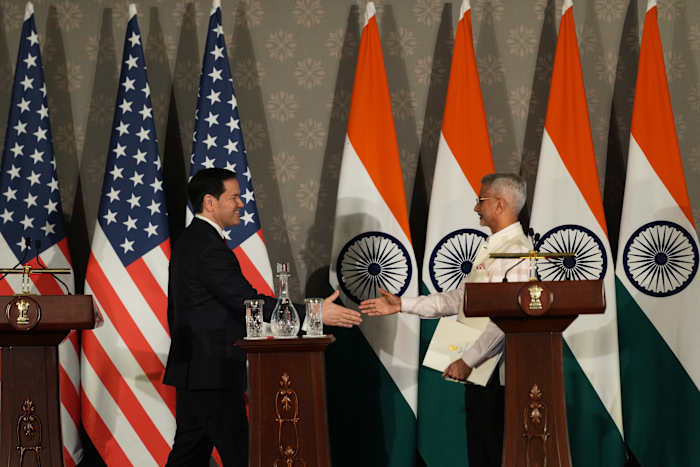
When Marco Rubio stepped off the plane for his first official diplomatic mission to India as America's top diplomat, he did not just carry briefcases of bilateral agreements. He carried fifty years of baggage. For decades, the bond between the world’s oldest democracy and the world’s largest democracy has been described in glowing terms by speechwriters. They call it an indispensable alliance. They praise shared values.
The reality on the ground feels entirely different.
The Ghosts in the Room
To understand why a visit from a Secretary of State feels less like a meeting of minds and more like a high-stakes poker game, you have to look at the ghosts sitting at the table.
Consider the Cold War. While Washington viewed the world through a binary lens of capitalism versus communism, India chose non-alignment. To American lawmakers, this looked like betrayal. To Indian leaders, it was survival. Forged in the painful crucible of colonial rule, India vowed never again to let a foreign power dictate its destiny.
Then came 1971. During the Bangladesh Liberation War, the U.S. sent the USS Enterprise aircraft carrier into the Bay of Bengal, a direct, chilling show of force aimed at India.
Anand’s grandfather had been a naval officer during that era. He passed down a piece of advice that Anand never forgot: Trust the Americans for a season, but rely on your own strength for a lifetime.
That sentiment remains baked into the institutional memory of New Delhi. When American officials arrive today talking about a "free and open Indo-Pacific," Indian strategists do not just hear a shared vision for checking China’s regional ambitions. They hear an invitation to a dance where Washington always insists on leading.
The Asymmetry of Need
The core tension is simple. Washington wants an ally. Delhi wants a multipolar world where it is an independent pole.
Imagine two people trying to build a house together, but one is using a blueprint for a fortress while the other is drawing plans for a marketplace. They will constantly argue over where to lay the bricks.
Take the issue of Russia. When the war in Ukraine broke out, Washington expected immediate, total condemnation from Delhi. Instead, India bought Russian oil. It maintained deep-seated defense ties with Moscow. To the average American voter, this looked hypocritical. How could a democracy support an autocrat?
But look at it through the eyes of a clerk in Delhi managing India’s energy grid.
If India stops buying affordable energy, inflation spikes. Factory lights go dark in Uttar Pradesh. Millions of families face economic ruin. For India, foreign policy is not an exercise in moral signaling; it is an extension of domestic survival. Russia has historically provided the spare parts for India’s fighter jets and the fertilizer for its fields. You do not burn down an old bridge until you are absolutely certain the new one can hold your weight.
Rubio’s challenge on this trip was not to convince India to change its worldview. It was to prove that America understands that worldview exists.
The View from the Tech Parks
Step away from the government buildings of Lutyens' Delhi and drive into the sprawling tech hubs of Bengaluru. Here, the geopolitics of the Indo-Pacific are translated into code, silicon, and venture capital.
In these glass towers, the trust deficit is measured in visa waiting times and export controls.
Engineers who graduated at the top of their classes from the Indian Institutes of Technology face decades-long backlogs for green cards if they move to America. Meanwhile, Indian tech firms watching Washington’s aggressive use of economic sanctions wonder if those same tools could one day be turned against them if policies diverge.
True partnership cannot be built solely on shared anxiety about Beijing. Fear is a powerful motivator, but it makes for a brittle foundation. If the only thing holding two nations together is a common adversary, what happens if that adversary changes behavior? The bond dissolves.
The real work of diplomacy happens when the cameras are turned off, when the formal banquets end, and when leaders have to confront the uncomfortable truths they usually hide behind press releases.
Learning to Listen in a Different Key
During the bilateral sessions, Rubio reportedly shifted the focus toward technology transfers and co-production of defense equipment. This matters. For years, India complained that America treated it like a consumer rather than a creator. Washington wanted to sell weapons; Delhi wanted to build them.
By pivoting toward joint development—sharing the crown jewels of American military and industrial know-how—the U.S. is attempting to signal a fundamental shift. It is an acknowledgment that India is no longer just a swing state in a global competition, but a primary actor.
Yet, changing bureaucratic habits is like turning an oil tanker in a narrow channel.
American export control laws are notoriously rigid, designed during an era when technology flowed one way: out of the United States. Reforming these systems requires political capital that is hard to find in a fractured Washington. Indian officials know this. They watch American domestic politics with a mixture of fascination and dread, wondering if a deal signed by one administration will be torn up by the next.
The Dinner Table Test
Late on the final night of the summit, away from the grand halls, a smaller group gathered for a working dinner. The menu featured a blend of American and Indian flavors, a culinary metaphor that felt almost too deliberate.
The conversation turned away from trade percentages and focused instead on the human ties that bind the two nations. Millions of Indian-Americans now form a living bridge between the two societies. They run Fortune 500 companies, teach in universities, and serve in the highest echelons of the American government.
This human capital is the real anchor of the relationship. It exists independently of who occupies the White House or the Prime Minister’s Office.
As the night wore on, Anand watched Rubio listen intently to an Indian counterpart explaining the complexities of navigating a border dispute in the high Himalayas. For a moment, the posture of the superpower dropped away. In its place was something rarer in international relations: genuine curiosity.
That is where the trust deficit begins to shrink. Not in the signing of massive defense contracts, but in the slow, agonizing work of seeing the world through the other side's eyes. It requires Washington to accept that India will always walk its own path, sometimes in step with America, sometimes parallel to it, but never behind it.
Outside, the monsoon rain finally stopped, leaving the streets of Delhi quiet, washed clean, and reflecting a pale, uncertain dawn.