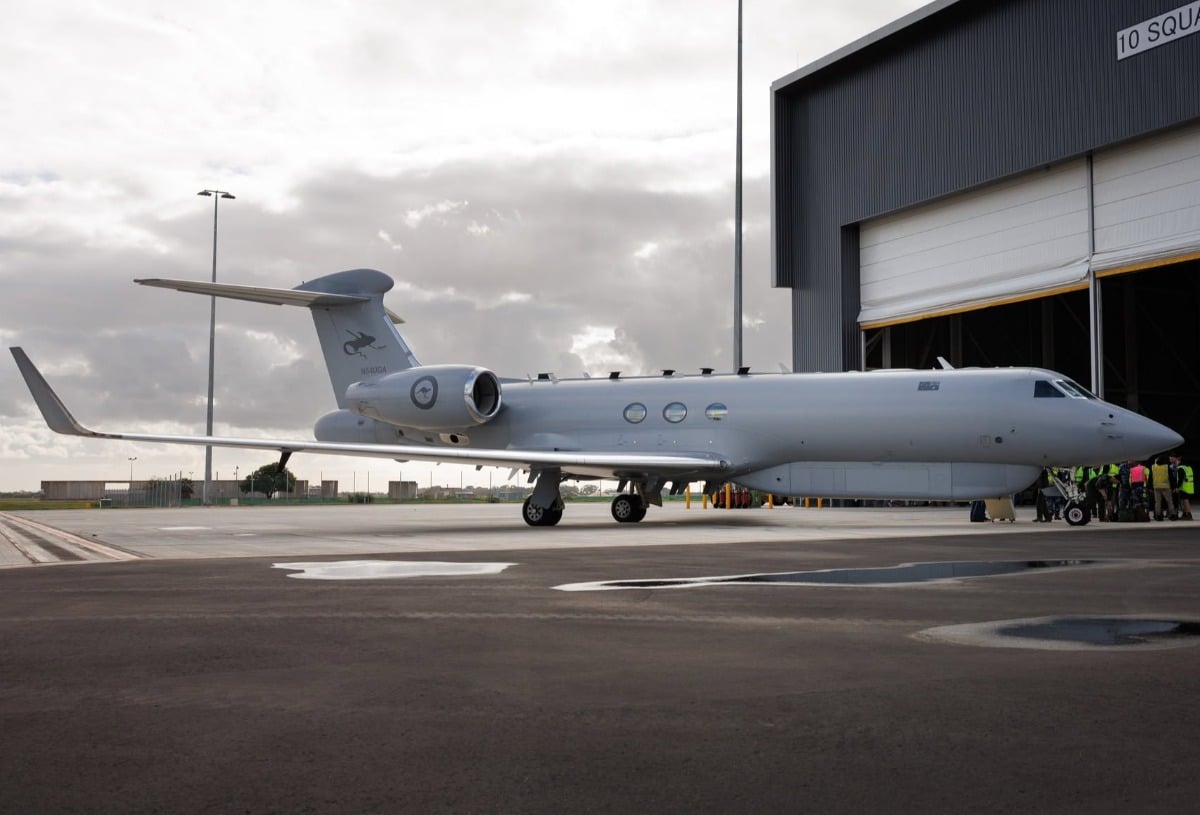
Australia is shifting its defense posture from a reactive regional force to an asymmetric, long-range denial enterprise. The arrival of the first MC-55A Peregrine airborne intelligence, surveillance, reconnaissance, and electronic warfare (ISREW) platform at RAAF Base Edinburgh marks a structural reorganization of how data is captured, analyzed, and distributed across the Indo-Pacific. This acquisition is part of a broader $2.4 billion program delivering four highly modified Gulfstream G550 platforms by the end of the year, signaling a pivot toward integrated sensor systems.
Rather than looking at individual aircraft acquisition in isolation, analyzing the strategic utility of this development requires a clear understanding of the structural network dependencies, economic trade-offs, and operational limitations inherent to Australia's airborne intelligence architecture. The current defense blueprint relies on a three-tier sensor network designed to achieve regional domain awareness, yet its real-world effectiveness depends entirely on resolving specific processing bottlenecks and maintenance realities. You might also find this related story interesting: Why Travis Kalanick Returning to Robotaxis is a Billion Dollar Mistake.
The Three Pillars of Contemporary Air Domain Awareness
To monitor vast maritime approaches stretching across the Indian Ocean, South China Sea, and Pacific approaches, the Royal Australian Air Force (RAAF) has engineered an integrated "family of systems." This architecture separates tasks based on altitude, endurance, and sensor specificity, operating across three primary tiers:
- The Persistent Broad-Area Layer (MQ-4C Triton): Operating as a high-altitude, long-endurance remotely piloted system, the Triton provides continuous wide-area maritime surveillance. With three units delivered to RAAF Base Tindal and a fourth in production, these uncrewed platforms operate at altitudes above 50,000 feet, utilizing maritime radar and electro-optical sensors to establish foundational situational awareness without risking human crew over long-duration missions.
- The Kinetic and Multi-Mission Layer (P-8A Poseidon): Consisting of a fleet of 14 aircraft operated by No. 92 Wing, this tier bridges data collection with offensive capabilities. Modified from the commercial Boeing 737-800 airframe, the P-8A focuses on anti-submarine warfare and maritime strike operations. It carries up to 129 sonobuoys, lightweight torpedoes, and AGM-84 Harpoon anti-ship missiles, translating intelligence into localized sea denial.
- The Signals and Electronic Warfare Layer (MC-55A Peregrine): The Peregrine functions as a theatre-level electronic intelligence collector. Utilizing a high-altitude commercial business jet airframe (the Gulfstream G550), it operates at a ceiling of 45,000 feet with cruise speeds of 988 km/h. Its explicit purpose is to intercept, analyze, and disrupt electromagnetic emissions, map enemy radar networks, and jam adversary communications.
The operational mechanism linking these layers relies on data fusion. The Triton detects an anomalous surface contact; the Peregrine intercepts and fingerprint-identifies the contact's electronic emissions; the P-8A is then routed precisely to the coordinate to engage or track the target. As extensively documented in latest reports by ZDNet, the implications are significant.
The Cost Function of Sub-Fleet Proliferation
While an integrated multi-tier network offers diverse sensor inputs, it introduces a significant operational cost burden driven by sub-fleet proliferation. Managing three separate airframes—each with independent supply chains, structural engineering requirements, and training pipelines—increases the complexity of sovereign sustainment.
Total Operating Cost = F(M_t + M_p + M_g) + C_s + L_b
Where:
M_t = Maintenance and supply chain costs for Triton (Northrop Grumman)
M_p = Maintenance and supply chain costs for Poseidon (Boeing)
M_g = Maintenance and supply chain costs for Peregrine (Gulfstream/L3Harris)
C_s = Specialized software and cryptographic integration costs
L_b = Logistics bottlenecks from geographically dispersed forward bases
The first structural vulnerability lies in maintenance decentralization. The Triton fleet operates out of RAAF Base Tindal in the Northern Territory, while the P-8A and MC-55A fleets are headquartered at RAAF Base Edinburgh in South Australia. Forward operations require infrastructure duplication across remote locations, such as Darwin and the Cocos (Keeling) Islands. The geographical separation between the primary maintenance depots and forward operating locations introduces transit lag for specialized components, directly impacting fleet availability rates.
The second limitation is structural airframe availability. The civilian G550 airframe, while highly efficient for long-range transit with an operational range of 7,685 kilometers, ended production in 2021. Though hundreds remain in global commercial service, the structural parts supply chain will face a naturally contracting market over the next two decades. This requires the Australian Department of Defence to invest heavily in long-term rotables and component stockpiling to prevent obsolescence.
Data Processing Bottlenecks and Bandwidth Constraints
The primary constraint of modern airborne intelligence is no longer sensor sensitivity, but bandwidth and processing throughput. A single MC-55A Peregrine generates massive streams of raw electronic intelligence, communications data, and radar imagery. Moving this information from the airborne collector to tactical decision-makers creates an immediate processing bottleneck.
The operational architecture splits the mission crew into both airborne and ground elements. This means the platform relies on high-bandwidth satellite communications to offload raw or semi-processed data to analysts at RAAF Base Edinburgh in real time. Under combat conditions or high-intensity electronic warfare environments, satcom links face degradation from intentional jamming, atmospheric interference, or satellite bandwidth oversubscription.
If the data transmission rate drops below the sensor generation rate, the aircraft is forced to rely entirely on its onboard human analysts—consisting of airborne electronic analysts and air intelligence officers—or store the data locally for post-mission download. This internal processing cap introduces latency, transforming real-time actionable intelligence into retrospective analysis, which undermines the objective of providing early threat detection.
Interoperability as a Sovereign Dependency
The MC-55A Peregrine is heavily optimized for integration within allied networks, specifically alongside the United States and the United Kingdom via secure data links and common cryptographic architectures. This high degree of technical interoperability is a critical force multiplier, enabling real-time intelligence distribution across coalition assets in the Indo-Pacific.
[Image diagram showing real-time data link integration between RAAF, US Navy, and UK RAF assets]
However, this tight technical integration introduces a sovereign dependency vector. The structural modifications for the Peregrine were executed in the United States by L3Harris Technologies under Foreign Military Sales mechanisms. Consequently, deep-tier software upgrades, sensor reprogramming, and highly classified electronic warfare library updates remain dependent on US defense industrial pipelines.
During a crisis, any divergence in national strategic priorities could impact the prioritization of software patches, electronic warfare library updates, or specialized spare parts allocation. Australia's sovereign capability is therefore fundamentally tethered to foreign industrial capacity and export controls.
Strategic Realities and Force Deployment
To maximize the utility of its expanding spy plane fleet, defense planners must shift away from treating platforms as standalone assets. The optimal play involves three immediate structural moves.
First, establish a unified data processing cell at RAAF Base Edinburgh that integrates data streams from the 9 Squadron (Triton), 10 Squadron (Peregrine), and 92 Wing (Poseidon) into a single, automated intelligence pipeline. This requires deploying edge-computing algorithms on the aircraft to filter out electromagnetic background noise before transmission, reducing the required satcom bandwidth by processing raw data at the sensor point.
Second, harden the infrastructure at forward operating locations. The runway and hangar upgrades at Darwin and the Cocos (Keeling) Islands must include shielded, decentralized fuel reserves and independent maintenance packages specific to the G550 and Triton airframes. This ensures that forward-deployed aircraft can sustain a high operational tempo during localized communication blackouts or logistics interruptions.
Finally, pursue formal agreements with regional security partners to enable cross-servicing of maritime patrol assets. For example, establishing maintenance commonality with the United States Navy's P-8A and MQ-4C infrastructure in Guam and Japan will mitigate the supply chain vulnerabilities of Australia's small, specialized sub-fleets, ensuring sustained operational presence across the Indo-Pacific.


_000062.jpg)