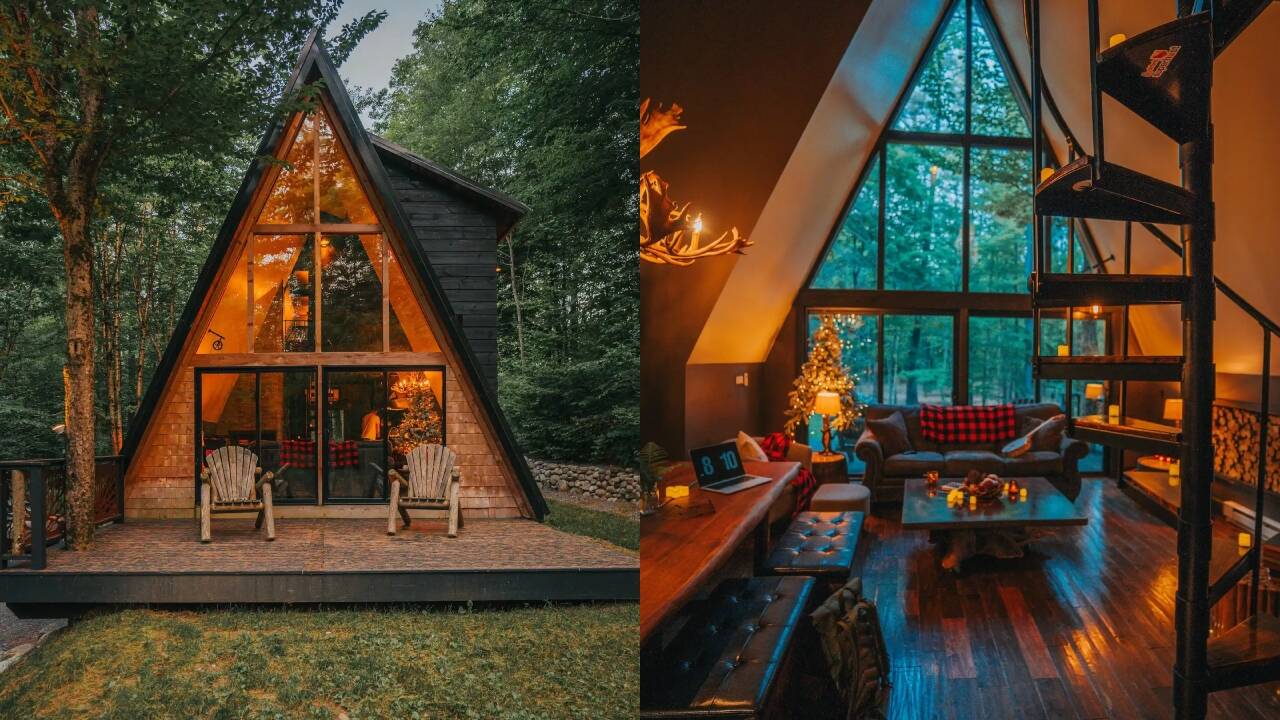
Capital allocation in real estate is fundamentally an exercise in unlocking asymmetric value through physical transformation. While most retail investors evaluate real estate purely on yield cap rates or turnkey acquisition models, micro-scale land development offers an alternative financial engine: the conversion of raw acreage into high-yield commercial hospitality assets through direct labor arbitrage.
Analyzing how a five-acre parcel purchased for $27,000 scales into a multi-million-dollar operating enterprise requires stripping away the narrative of lifestyle entrepreneurship to examine the underlying financial mechanics.
The Acquisition and Cost Basis Model
The foundation of high-margin real estate development rests on minimizing the initial capital outlay relative to future cash-flow potential. Raw land—parcels lacking municipal hookups, improved access roads, or structural zoning—trades at a steep discount precisely because of its liquidity risk and the high friction of development.
Acquiring five acres for $27,000 establishes an extremely low cost basis of $5,400 per acre. In the context of hospitality development, land cost is a fixed capital overhead that dictates debt service and break-even occupancy thresholds. A low initial denominator changes the risk profile of the entire project:
- Sunk Capital Minimization: Total initial exposure is low enough to self-fund without complex debt instruments or high-interest bridge loans.
- Carrying Cost Efficiency: Raw rural land carries minimal annual property tax burdens compared to developed suburban or urban lots.
- Option Value: Owning the underlying dirt outright grants complete control over the phasing of capital expenditures.
The structural limitation here is time and execution risk. Raw land yields zero organic cash flow. To transform a zero-yield asset into an income-generating engine, the developer must absorb the friction of utility integration, zoning compliance, and vertical construction.
Labor Arbitrage and Vertical Construction Economics
In traditional real estate development, vertical construction is the largest capital expenditure, frequently consuming 60 to 70 percent of total project budgets due to subcontractor markups, general contractor overhead, and specialized trade billing rates.
When the developer possesses primary trade skills—such as advanced carpentry—the cost function changes entirely. The project substitutes outsourced cash outflows for sweat equity, capturing the developer's margin directly into the asset's equity value.
Traditional Model: Land Cost + Outsourced Labor (100% Market Rate) = High CapEx
Arbitrage Model:   Land Cost + Direct Labor (Material Cost Only)   = Low CapEx
By self-performing the framing, structural shell assembly, and custom interior finishing, the capital requirement for the initial A-frame structure was constrained primarily to raw materials (lumber, hardware, glazing, and insulation) rather than fully loaded contractor billing rates.
However, this model introduces a production bottleneck. A single-operator build cycle is bounded by human time constraints. The first flagship structure required three years of weekend-only labor cycles to complete. During this phase, capital is locked and unproductive. The trade-off for eliminating labor costs is an extended development timeline during which no revenue is realized.
Scaling from Craftsmanship to Enterprise Operations
Transitioning from a single custom-built asset to a multi-unit compound requires a strategic shift in operational philosophy. Continuing with a purely manual, single-operator building model limits enterprise growth. Scaling demands the introduction of external capital and outsourced labor.
When the initial property gained digital visibility and achieved high nightly rates (scaling from an introductory rate of $60 to peak pricing between $380 and $700 per night), the cash flow generated enabled a pivot in the development model:
- Capital Reinvestment: Operating revenues were funneled directly into subsequent builds (such as the 14-foot elevated treehouse and the spa cabin featuring indoor water mechanics).
- Labor Transition: Subsequent builds abandoned the pure self-execution model in favor of hired specialized crews, compressing build times from years to weeks (e.g., a thirteen-week construction window for the secondary treehouse unit).
- Asset Diversification: Expanding the product line from basic A-frames to specialized high-amenity units (indoor waterfalls, soaker tubs, suspension bridges) allowed for price discrimination across different customer segments, lifting average daily rates (ADR) across the entire portfolio.
The Operating Margin Structure
A multi-unit short-term rental business on rural land operates on a distinct financial ledger compared to traditional urban hospitality assets. Once construction debt is cleared, the ongoing P&L statement relies on specific fixed and variable expenditures:
- Fixed Overheads: Annual property taxes (estimated around $18,000) and periodic utility management.
- Variable Operating Costs: On-site payroll, cleaning staff, linen turnover, and ongoing maintenance, scaling proportionally with occupancy rates (averaging approximately $8,000 monthly).
- Top-Line Revenue Velocity: With individual units generating annualized revenues exceeding $119,000 to $143,000 each, the aggregated enterprise gross surpassed $2.1 million over a multi-year operating window.
The structural vulnerability of this model lies in market concentration and platform dependence. Rural drive-to destinations rely heavily on regional economic health, macro travel trends, and algorithmic visibility on dominant booking platforms like Airbnb. Unlike urban hotels that capture corporate and convention travel year-round, rural cabins face seasonal compression and weather-dependent demand shifts.
Strategic Forecast for Rural Land Conversion
The economic window for replicating raw land micro-hospitality arbitrage requires precise site selection criteria. Future projects cannot rely purely on scenic proximity; they require rigorous verification of municipal short-term rental regulations, zoning allowances for multi-structure density on single parcels, and localized infrastructure capacity for waste and water management.
To maximize return on invested capital in similar developments, operators must deploy a phased capital deployment strategy: acquire raw parcels under market value using internal liquidity, self-perform initial validation builds to minimize early capital burn, and leverage generated cash flow to institutionalize operations before scaling unit count.