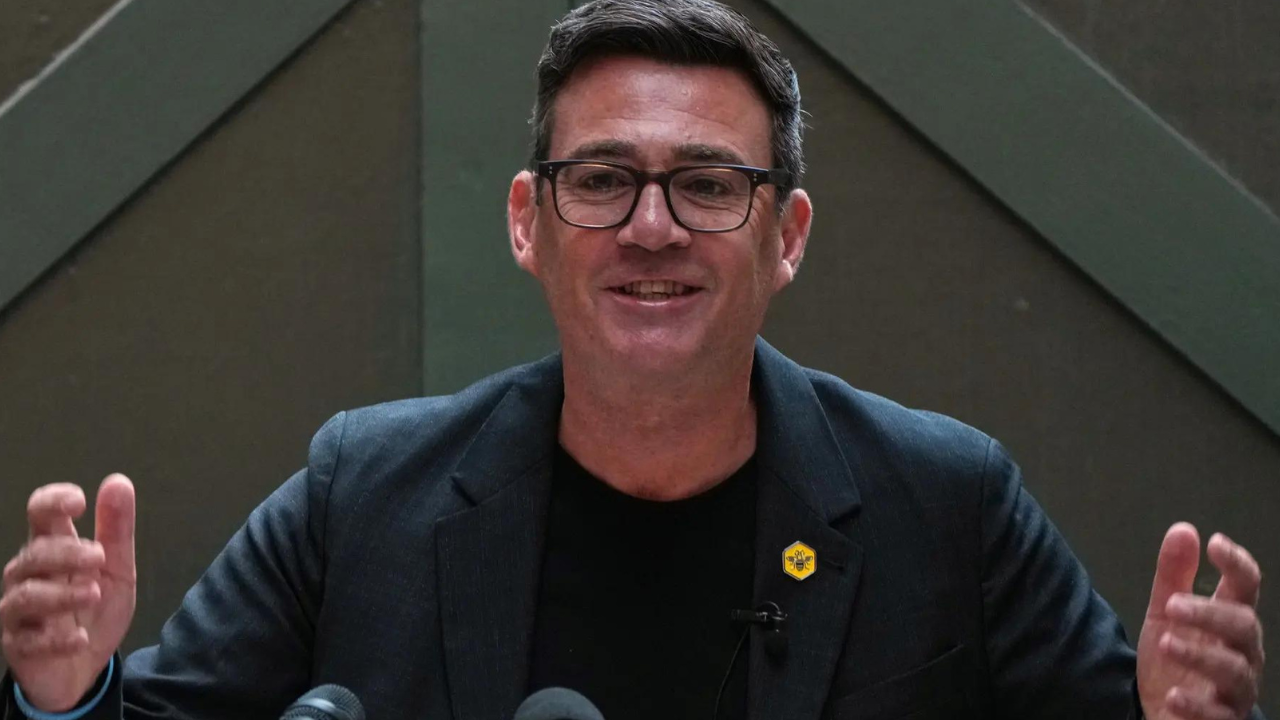
Andy Burnham Isn't Saving the Labour Party: He Is Westminster's Favorite Distraction
The political commentary class loves a regional savior.
Whenever a Prime Minister stumbles, the same tired script gets dusted off in SW1. The pundits look north, point toward Manchester, and sigh with collective relief. Andy Burnham is coming to rescue the party. Burnham is the authentic voice of the working class. Burnham is the pragmatic bridge between radical activism and electoral survival.
It is a fantasy. A comfortable, lazy narrative constructed by journalists who rarely venture north of the M25 unless there is a campaign launch or a photo opportunity in a high-vis jacket.
The mainstream consensus insists that swapping Keir Starmer for the King of the North solves Labour’s identity crisis overnight. They claim Starmer’s bloodless managerialism is the problem, and Burnham’s emotive regionalism is the cure.
They are dead wrong.
Replacing one Westminster insider with a former Westminster insider who spent eight years playing regional kingmaker does not alter the structural decay of British politics. It accelerates it. If Andy Burnham steps into Downing Street, he will not dismantle the status quo. He will simply give it a fresh coat of paint and a flat cap.
The Myth of the Outsider
Let us clear up the historical revisionism surrounding Andy Burnham before it becomes gospel.
To read current political commentary, you would think Burnham emerged fully formed from a Liverpool picket line, spent his life fighting municipal battles, and only learned what Parliament was yesterday.
Here is the actual record:
- Cambridge Educated: Read English at Fitzwilliam College.
- Special Adviser: Spent his twenties drafting lines for New Labour ministers.
- Member of Parliament: Represented Leigh for 16 years.
- Cabinet Minister: Served as Chief Secretary to the Treasury, Culture Secretary, and Health Secretary under Gordon Brown.
Andy Burnham is not an outsider. He is a career politician created in the exact same political incubator that produced the rest of the New Labour apparatus. He voted for the Iraq War. He defended the Private Finance Initiative deals that saddled the NHS with billions in long-term debt—deals we are still paying off today.
When he ran for the Labour leadership in 2010 and 2015, he ran as the consummate establishment candidate. In 2015, his campaign was so cautious, so relentlessly focused-group, that he was utterly consumed by Jeremy Corbyn’s insurgency.
His transformation into the rebellious "King of the North" was not an ideological awakening. It was a masterclass in political survival.
When the door to Whitehall closed, he found a side door in Greater Manchester. He reinvented himself by doing what every clever politician does when out of favor in the capital: he blamed Westminster for everything.
Regional Mayoralty is a PR Campaign, Not a Government
I have worked alongside public sector strategists and political campaign teams through three separate general elections. I have seen how regional devolution functions behind closed doors.
Devolution in the UK is largely an exercise in blame management. Central government delegates responsibility for difficult local services without giving mayors total tax-raising autonomy. In return, regional mayors get a pulpit, a press office, and a license to complain.
Burnham used that pulpit brilliantly. His stand against central government funding during the 2020 lockdown was a political stroke of genius. It gave him national media coverage, built a populist brand, and severed his association with the drab corridors of Whitehall.
But rhetoric is not policy.
Look past the headlines and inspect the actual mechanics of governance in Greater Manchester:
1. Transport Reform
The Bee Network is routinely praised as a triumph of municipal socialism. Franchising buses and integrating fares is a solid, common-sense reform. But it is standard municipal administration, not a revolutionary economic blueprint. Cities across Europe did this decades ago without declaring a political renaissance.
2. Housing and Homelessness
Burnham promised to end rough sleeping. While his initiatives brought attention and temporary resources to the crisis, systemic housing shortages, soaring rents, and local planning gridlocks remain brutally present across Greater Manchester.
3. Economic Growth
The economic boom in Manchester was driven by capital investment, property development, and corporate relocation—mechanisms set in motion long before Burnham took office, largely initiated by Sir Howard Bernstein and George Osborne's "Northern Powerhouse" strategy. Burnham inherited a growing metropolitan engine and took credit for the smoke.
Being Mayor of Greater Manchester is politics in easy mode. You do not manage nuclear deterrence. You do not set national interest rates. You do not balance the national fiscal deficit. You take credit for every local win and blame the Treasury for every local failure.
Moving from the Mayor’s office to 10 Downing Street is not a promotion in the same career pipeline. It is a completely different trade.
The Trap of Empathy-First Governance
The argument for Burnham usually boils down to one word: relatability.
Starmer is criticized for being robotic, lawyerly, and cautious. Burnham is praised for being passionate, approachable, and emotionally expressive.
Since when did emotional output become the primary metric for executive leadership?
Governments do not fail because their leaders lack empathy. Governments fail because their policies are structurally unviable, their fiscal plans are arithmetic fantasies, and their bureaucracies are immune to reform.
Empathy does not fix trade barriers. Empathy does not rebuild crumbling public infrastructure. Empathy does not solve the demographic crisis blowing a hole through the welfare state.
The Hard Truth: Voters say they want authenticity, but they vote based on economic stability and functional services. A Prime Minister who cries on television when public services fail is still a Prime Minister presiding over failure.
If Burnham enters Downing Street on a wave of sentimentality, he will hit the exact same structural walls that crushed his predecessors:
- An aging population driving healthcare costs beyond tax capacity.
- Low productivity growth stalling real wage increases.
- High energy costs crippling domestic manufacturing.
- A sclerotic civil service that absorbs political directives and outputs procedural delays.
No amount of emotional speeches at party conferences changes those mechanics.
What the Commentators Get Wrong About the Electorate
The common assumption among political strategists is that the electorate is split cleanly along simple geographic and cultural lines: North versus South, Working Class versus Metropolitan Elite.
This is a lazy caricature.
The modern British voter is hyper-pragmatic and deeply cynical. They do not care if a politician speaks with a Northern accent or a London cadence. They care whether their trains run on time, whether their local hospital answers the phone, and whether their mortgage payments double next year.
The belief that Northern voters will automatically rally behind Burnham simply because he represents a Northern metro-region is inherently patronizing. Northern voters are not a monolith waiting for a knight from Manchester to save them. They are small business owners, nurses, tradespeople, and retirees with wildly divergent interests.
In fact, Burnham’s brand of soft-left, council-led interventionism faces massive resistance from the very voters Labour needs to retain:
+-----------------------------------+-----------------------------------+
| What Westminster Thinks Voters Want| What Voters Actually Care About   |
+-----------------------------------+-----------------------------------+
| Regional identity politics       | Functional local services         |
| Passionate speeches against SW1   | Lower tax burdens and cost of living|
| Symbolism and moral posturing     | Real economic growth and security |
+-----------------------------------+-----------------------------------+
Replacing Starmer with Burnham does not expand the Labour coalition; it reshuffles the same deck of cards. It pleases the activist base and the media commentators who want a more compelling narrative, but it leaves the core economic questions completely unanswered.
The Real Crisis Facing Any Labour Prime Minister
The debate over whether Starmer or Burnham should lead misses the entire point of current British political economy.
The United Kingdom is facing a systemic growth crisis.
For fifteen years, productivity has stagnated. National debt sits at levels not seen in decades. The tax burden is at an all-time high, yet public services are visibly deteriorating.
When a nation reaches this point, there are only two paths forward:
- Radical Supply-Side Reform: Overhaul planning laws to build infrastructure instantly, dismantle regulatory barriers, cut unproductive state spending, and force efficiency into public services.
- Managed Decline: Increase taxes slightly, redistribute wealth at the margins, issue emotional press statements, and pretend that minor administrative tweaks will fix structural decay.
Keir Starmer chosen a version of managed decline disguised as technocratic competence.
Andy Burnham offers managed decline disguised as regional empathy.
Neither strategy addresses the underlying reality. If you do not fix the fundamental incentives that prevent housebuilding, energy production, and business investment in the UK, it does not matter who sits in the Cabinet room. The numbers will not add up.
Imagine a scenario where Burnham takes over on Monday. He delivers an impassioned speech outside Downing Street about unifying the country and ending the North-South divide. The media applauds. The markets move on.
Then comes Tuesday.
The Treasury hands him the exact same spending sheets. The Department of Health gives him the exact same waiting list figures. The Bank of England warns him about inflation if he attempts to spend his way out of trouble.
What changes?
Nothing. Because a change in personality is not a change in strategy.
Stop Looking for Champions and Start Demanding Mechanics
The UK's obsession with political messiahs is a substitute for serious policy analysis.
We did it with Boris Johnson, believing charisma could bypass the realities of international trade. We did it with Keir Starmer, believing legal precision could cure political division. Now, the media wants to do it with Andy Burnham, believing Northern charm can fix a broken state apparatus.
It is time to kill the myth.
Andy Burnham is an experienced, capable municipal administrator. He is a talented political communicator who knows how to ride the news cycle. But he is not the radical alternative to the current political order. He is its product.
If you want a country that works, stop caring about who wears the crown in Downing Street and start demanding radical, uncomfortable reforms to how the state actually functions.
Until then, swapping Starmer for Burnham is just changing the narrator of a bad play.


