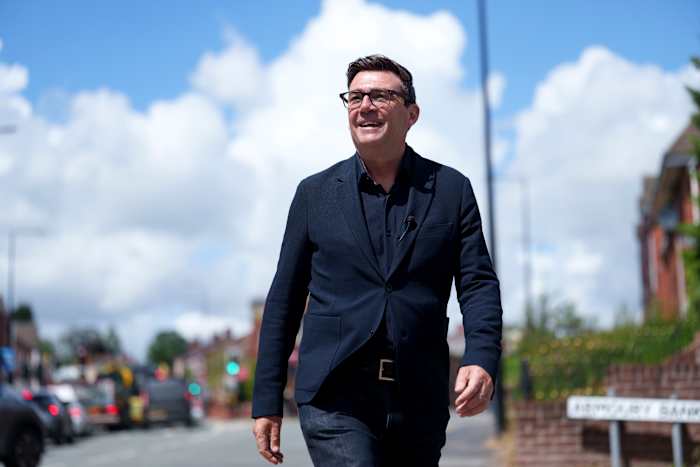
Andy Burnham will walk into Downing Street on Monday as Britain’s next prime minister, completing an extraordinary political resurrection that caught Westminster completely off guard. On Friday morning, the Labour Party officially declared him leader after he ran completely unopposed, securing the nominations of 379 out of 403 parliamentary colleagues. This was not an accidental vacancy. It was the culmination of a meticulously planned, year-long operation that systematically dismantled Keir Starmer’s grip on power from the outside in.
While the national media spent the last year focusing on parliamentary infighting in London, the real movement was being built on regional dancefloors, in town halls, and across municipal boundaries. Burnham used his position as the mayor of Greater Manchester to build an alternative power base, waiting for the national leadership to buckle under its own administrative caution. When disastrous local election results in May cracked open the door, Burnham didn’t just walk through it; he re-engineered the entire hallway.
The Blueprint of a Municipal Insurgency
To understand how a regional mayor managed to bypass the traditional hierarchy and seize the highest office in the country, one must look back to May 2025. While Starmer was bogged down in exhausting legislative battles over welfare and public spending, Burnham was quietly rallying discontented factions of the party. A key moment occurred at a centre-left conference in London, where the seeds of an internal alliance were planted. It was there that figures who felt alienated by the leadership’s rigid centralization began discussing a structural shift.
Burnham’s strategy relied on a basic structural reality. The British public had grown deeply tired of Westminster’s perceived indifference to life outside the capital. By positioning himself as the defender of regional equity, Burnham built a national profile without needing a seat in parliament. He spent years running Greater Manchester like a laboratory for left-of-centre policies, from public control of buses to targeted housing initiatives. Every time London faltered, Manchester offered a counter-narrative of local competence.
The machinery of his return to Westminster required perfect timing. A parliamentary by-election in the safe seat of Makerfield this past June provided the necessary vehicle. Burnham resigned his mayoral post, won the seat, and immediately established himself as the prime-minister-in-waiting within the House of Commons. The speed of the transition left internal rivals with no time to coordinate a counter-strategy.
The Breakdown of the Starmer Status Quo
Starmer’s exit was accelerated by a widening gulf between his cabinet and the backbenches. The local elections in May revealed a collapse in core voter enthusiasm, a warning sign that the parliamentary party could no longer ignore. Members of Parliament panicked about their own seats, realizing that administrative caution was no longer a viable political shield.
Burnham presented himself as the only unifying figure capable of preventing a total electoral rout. His team worked behind the scenes to lock down endorsements from every wing of the party, pulling in left-wing socialists and moderate traditionalists alike. By the time the leadership contest opened, the nomination count was so overwhelmingly in Burnham's favour that potential rivals realized a challenge was mathematically impossible.
The transition reveals a profound shift in how political authority is secured in modern Britain. Traditional party management, which relies on patronage and strict discipline within the Westminster bubble, proved useless against an opponent who had spent nearly a decade building authority from a regional government.
The Economic Traps Waiting in Downing Street
Winning the internal battle was the straightforward part. On Monday, Burnham inherits an economic reality that will test his regional rhetoric to its absolute limits. Growth remains low, national debt is severely high, and the cost of servicing that debt continues to drain public finances.
Burnham has built his reputation on the promise of public spending and public control. He wants to expand regional devolution, reform social care, and take greater public ownership of national infrastructure. Doing so requires significant capital, but traditional avenues for raising money are severely restricted. The global money markets will be watching his first fiscal announcements with immense scrutiny, ready to penalize any sign of unhedged spending.
The incoming prime minister will have to choose between two difficult paths. He can either scale back his grand promises of regional renewal, alienating the base that brought him to power, or he can push through tax increases that will provoke immediate hostility from the business sector and middle-class voters. The illusion of easy solutions will disappear the moment he takes the oath of office.
Reorganizing the British State
The core tenet of Burnham's political philosophy is that the British state is fundamentally broken because it is too centralized. He has frequently argued that major economic mistakes of the past forty years stemmed from decisions made by a small group of officials in London who had little understanding of life in northern towns. His proposed remedy is a massive transfer of tax-raising powers and legislative control to regional mayors and local authorities.
This vision faces immense institutional resistance. The Treasury is notoriously protective of its spending powers, and civil servants in Whitehall are built to maintain centralized control. Rewiring how Britain is governed will require years of bureaucratic warfare, distracting the government from immediate crises in health and education.
There is also a geographic risk to this strategy. Lawmakers from the Midlands and the South are already expressing concern that a Burnham administration will disproportionately favor northern interests. If the new government creates a northern base for Downing Street in Manchester, as has been suggested, it risks alienating other regions that feel equally left behind. Managing these regional rivalries will require a level of diplomatic finesse that Burnham rarely had to display while acting as a regional advocate.
The Geopolitical Reality
Beyond domestic policy, Burnham must quickly establish credentials on the world stage, a territory where he has very little recent experience. Relations with Washington are already complicated by his past criticisms of American political instability. With conflicts continuing to strain international supply chains and energy markets, any misstep in foreign policy will have immediate economic consequences at home.
He will no longer have the luxury of speaking as an outsider criticizing national policy. Every statement he makes will carry the weight of a nuclear-armed state. The transition from a local champion who can easily express popular frustrations to a global leader who must make compromising decisions is a notoriously difficult shift.
Burnham's rapid ascent has rewritten the rules of British political campaigns, showing that regional governance can be a direct path to national leadership. But the unique structure that allowed him to capture the party without a fight offers no protection against the structural economic realities awaiting him on Monday. The quiet coup is over; the brutal reality of governing begins now.
Central Lobby - July 2026: Andy Burnham looks set to become the UK's next Prime Minister
This broadcast provides crucial context on the regional political debates surrounding Burnham's sudden rise to the premiership and how different parts of England are reacting to the shift in power.