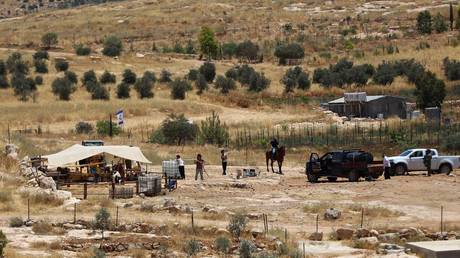
The discourse surrounding territorial friction in the occupied West Bank frequently misdiagnoses systemic state-backed engineering as sporadic civil unrest. When international monitors issue warnings regarding escalating friction between Israeli settlers and indigenous Palestinian communities, mainstream reports routinely frame the crisis through the lens of episodic lawlessness. This perspective obscures the underlying operational mechanics. The conversion of rural agricultural land into consolidated settlement outposts follows a predictable economic and logistical blueprint. By analyzing the structural variables driving this friction—namely state-sanctioned resource deprivation, physical coercion, and institutional impunity—we can map the precise vectors of territorial displacement.
The Three Pillars of Territorial Coercion
The systematic transfer of populations in regions such as Area C and the South Hebron Hills does not rely on sudden military expulsions. Instead, it operates through a continuous cost-infliction loop designed to make indigenous habitation economically and physically untenable.
The first pillar involves resource expropriation. Access to water cisterns, electrical grids, and grazing corridors is systematically restricted. State-backed administrative demolition orders target agricultural infrastructure, forcing communities into a state of chronic infrastructural deficits. When pastoral families cannot water livestock or irrigate crops, their primary economic engine collapses, leaving voluntary migration as the sole remaining survival mechanism.
The second pillar centers on asymmetric physical intimidation. Unofficial outposts function as localized operational bases for armed civilian actors. The strategic deployment of daily harassment—ranging from the torching of olive groves to live-fire incidents during harvest seasons—creates an environment of perpetual hyper-vigilance. Quantitative tracking by humanitarian agencies reveals that monthly attack frequencies have scaled drastically, driving cumulative displacement metrics to historical peaks.
The third pillar is institutional insulation. The enforcement apparatus of the occupying power rarely penalizes aggressive civilian actors. Data compiled by human rights monitoring groups indicates that a significant majority of complaints filed by Palestinian victims yield no indictments. This structural lack of accountability effectively lowers the legal risk for aggressors to zero, creating a moral hazard that accelerates expansionist activities.
The Economic Cost Function of Retained Presence
For rural Palestinian enclaves, daily survival is dictated by a punishing economic equation. Every riyal, dinar, or shekel spent repairing vandalized property or truck-hauling potable water represents a direct drain on capital reserves. The destruction of capital assets—such as centuries-old olive trees, solar panels, and residential structures—destroys generational wealth.
The macro-level consequences are equally quantifiable. Regional gross domestic product contraction and spikes in localized unemployment stem directly from mobility restrictions. Checkpoints, roadblocks, and gate installations fracture the territorial continuity of the West Bank, turning short commutes into logistical nightmares. This fragmentation isolates local markets, destroys supply chain efficiency, and prevents labor forces from reaching employment centers. The resulting economic strangulation achieves the same strategic objective as direct physical displacement, but through financial attrition.
The Strategic Failure of Traditional Deterrence
Calls for international intervention, such as proposals for armed United Nations peacekeepers or enhanced monitoring missions, repeatedly stall against diplomatic deadlocks and sovereignty disputes. Traditional peacekeeping frameworks require the consent of governing authorities or a functional peace process—neither of which exists in the current operational environment.
When diplomatic bodies issue statements condemning settlement expansion or urging adherence to international humanitarian law, they address the symptoms rather than the structural incentives. Because the domestic political economy of the occupying state rewards territorial expansion through budgetary allocations, retroactive legalization of outposts, and security coordination, external verbal censure carries zero deterrent weight.
The Institutional Endgame
The trajectory of the West Bank points toward irreversible territorial fragmentation. As outposts multiply and encircle historical villages like Umm al-Kheir or Kusra, the physical space available for Palestinian civic and economic life contracts into isolated cantons.
The strategic reality is unambiguous: without the imposition of severe, tangible bilateral economic and diplomatic costs on the occupying power's expansion apparatus, the incentives driving coercive displacement will remain entirely unchecked. International actors seeking to preserve the viability of a two-state framework must pivot from monitoring humanitarian fallout to targeting the financial and political pipelines sustaining the settlement enterprise.