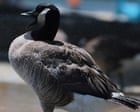
A sleepy Texas family owes their lives to an aggressive, honking farm bird. This unusual headline crossed the wire recently, capturing public fascination with a classic man-versus-nature absurdity. A pet goose named Honkers allegedly raised the alarm during a midnight house fire, waking the household before flames consumed the structure. The media loves a quirky animal hero story. It sells papers and generates clicks.
Beneath the whimsical surface of avian heroics lies a stark reality about rural survival, animal behavior, and the absolute limits of modern domestic infrastructure. When a residential fire breaks out in a rural county, response times can stretch past twenty minutes. High-tech smart home systems often fail when electrical grids melt down in the opening seconds of a blaze.
We need to look past the novelty of a noisy bird and examine why an unselected domestic goose succeeded where million-dollar safety systems frequently falter. This is an exploration of biological sentinel mechanisms, rural emergency dynamics, and the quiet failure of consumer-grade safety electronics when catastrophic failure strikes.
The Sensory Edge of Avian Sentinels
Geese are not domesticated pets in the traditional sense of a lapdog or a housecat. They are territorial, hyper-vigilant descendants of migratory waterfowl with sensory apparatuses fine-tuned by millions of years of evolutionary pressure. They possess an acute awareness of atmospheric shifts, auditory anomalies, and unusual thermal signatures long before human senses register the danger.
Consider the physics of a house fire in its earliest, most lethal phase. Smoldering electrical wiring or a spark in a utility room produces invisible, odorless gases and subtle crackling sounds well before smoke thickens into a visible cloud. Standard ionization smoke detectors require particulate density to reach a specific threshold before sounding an alarm.
A goose does not wait for a threshold. Their resting state is an active, low-level surveillance mode. They sleep with one eye open, literally engaging in unihemispheric slow-wave sleep while one half of the brain stays awake to monitor environmental threats.
When a structural fire begins, the subtle expansion of building materials, the low-frequency hum of failing electrical lines, and the microscopic scent of scorching timber trigger an immediate behavioral response. The bird perceives a breach of its perimeter. The resulting vocalization is not a conscious act of heroism. It is a territorial alarm, deployed with maximum volume and relentless repetition.
The Failure Point of Modern Consumer Safety
We place an immense amount of trust in plastic boxes mounted to drywall. Residential smoke alarms and smart home security hubs represent a multi-billion-dollar industry built on standardized compliance. Yet, these systems operate under optimal laboratory conditions that rarely match the chaotic reality of a rural residential fire.
Battery-powered detectors fail when homeowners neglect bi-annual replacements. Hardwired systems drop offline the instant a breaker trips or a localized fire severs the main trunk line. Smart hubs rely on Wi-Fi routers that lose connectivity the moment power fails, rendering remote alert features useless before emergency services can be notified.
Rural living introduces an entirely separate layer of vulnerability. Distance is the primary antagonist in country settings. A volunteer fire department twenty miles away cannot save a structure if the alarm is delayed by even five minutes.
When a technological safety net drops its connection, you are left with baseline physics and whatever biological early-warning systems happen to inhabit the property. The Texas family did not survive because their smoke detector was state-of-the-art. They survived because an animal with an unyielding territorial instinct filled the sensory gap left by failing electronics.
The Historical Precedent of Animal Sentinels
Using non-human sentinels to guard human habitations is older than written history. The most famous historical instance involves the sacred geese of the Capitoline Hill in ancient Rome. In 390 BC, Gallic attackers attempted a stealth night scaling of the citadel. The guard dogs failed to wake, distracted or fatigued. The sacred geese of Juno, despite being underfed due to wartime rationing, heard the approach, raised a cacophony, and roused Marcus Manlius just in time to repel the assault.
We tend to view these accounts as historical folklore, quaint anecdotes of a primitive era before closed-circuit cameras and motion-activated floodlights. That view is dangerously naive.
Biology does not obsolesce the way silicon does. A goose deployed on a modern homestead operates on the exact same neurological hardware that saved Rome. They do not require software updates, firmware patches, or subscription fees. Their operational lifespan outlasts many cheap security gadgets, and their maintenance cost consists of basic feed and access to water.
The security industry prefers consumers who buy into the replacement cycle every three years. A biological sentinel disrupts that economic model entirely.
The Practical Mechanics of Homestead Defense
Integrating a goose into a residential safety protocol is not as simple as buying a bird from a local hatchery and turning it loose in the backyard. Geese are loud, messy, and fiercely territorial. They will attack the mail carrier, chase visiting children, and leave copious amounts of organic waste across manicured lawns.
They are living perimeter alarms with teeth—or rather, serrated beaks designed to inflict painful, bruising pinches.
To understand their utility, one must look at how rural property owners manage risk. A multi-layered security approach balances three distinct elements:
- Mechanical deterrents: Fencing, motion lighting, and physical locks.
- Technological monitoring: Hardwired smoke alarms, thermal cameras, and cellular backup systems.
- Biological early-warning: Guard animals, including livestock guardian dogs, geese, and occasionally camelids like llamas.
No single layer is foolproof. Fencing can be cut. Technology can short out. Animals can fall ill or become habituated to false alarms. The synergy between these layers creates actual safety, rather than the illusion of it purchased in an electronics aisle.
When a goose sounds off at three in the morning, you do not check an app to see if it is a false positive. You get out of bed, because you know the bird is reacting to a physical reality in its environment.
The Vulnerability of Automated Comfort
Our modern obsession with automation has dulled our baseline survival instincts. We outsource our situational awareness to algorithms, sensors, and cloud servers. We assume that if something goes wrong, a chime will sound on our smartphones, a dispatcher will coordinate a response, and we can sleep soundly behind insulated walls.
The Texas incident serves as a jarring reminder of how fragile that chain of custody really is. When the grid fails, when the battery dies, when the router reboots, you are entirely on your own.
Urban and suburban dwellers rarely think about this because municipal infrastructure absorbs the friction of daily life. Fire hydrants are spaced every few hundred feet. Response times are measured in single-digit minutes. In that environment, a pet goose is nothing more than a viral curiosity.
Move thirty miles outside the city limits, however, and the math changes completely. The distance between life and death shrinks to the time it takes for someone—or something—to notice that the air is changing.
Evaluating the Real Cost of Security
Consumer spending on home security topped fifty billion dollars globally. Families invest in high-definition cameras that track every movement on their front porch, yet remain wholly unequipped to detect a silent electrical fire smoldering behind the drywall of a spare bedroom.
We buy complexity when what we actually need is sensitivity.
An animal like a goose operates outside the digital panopticon. It cannot be hacked, it does not download malware, and its operational readiness is not contingent on a broadband connection. While maintaining a flock of guard geese comes with distinct lifestyle compromises—noise complaints from neighbors and aggressive yard management—the underlying principle remains sound.
Biological sentinels offer an analog redundancy that our digital infrastructure desperately lacks.
The family in Texas woke up coughing, guided by the furious screams of an avian sentinel standing watch in the dark. The house sustained damage, but the lineage of human survival continued unbroken for one more night.
We can marvel at the strangeness of the headline, or we can recognize the deeper lesson. In the ongoing contest between fragile human engineering and the raw, unyielding mechanics of the natural world, the simplest warning system is often the one that refuses to be ignored.
Listen to the noise in the dark. It might be saving your life.