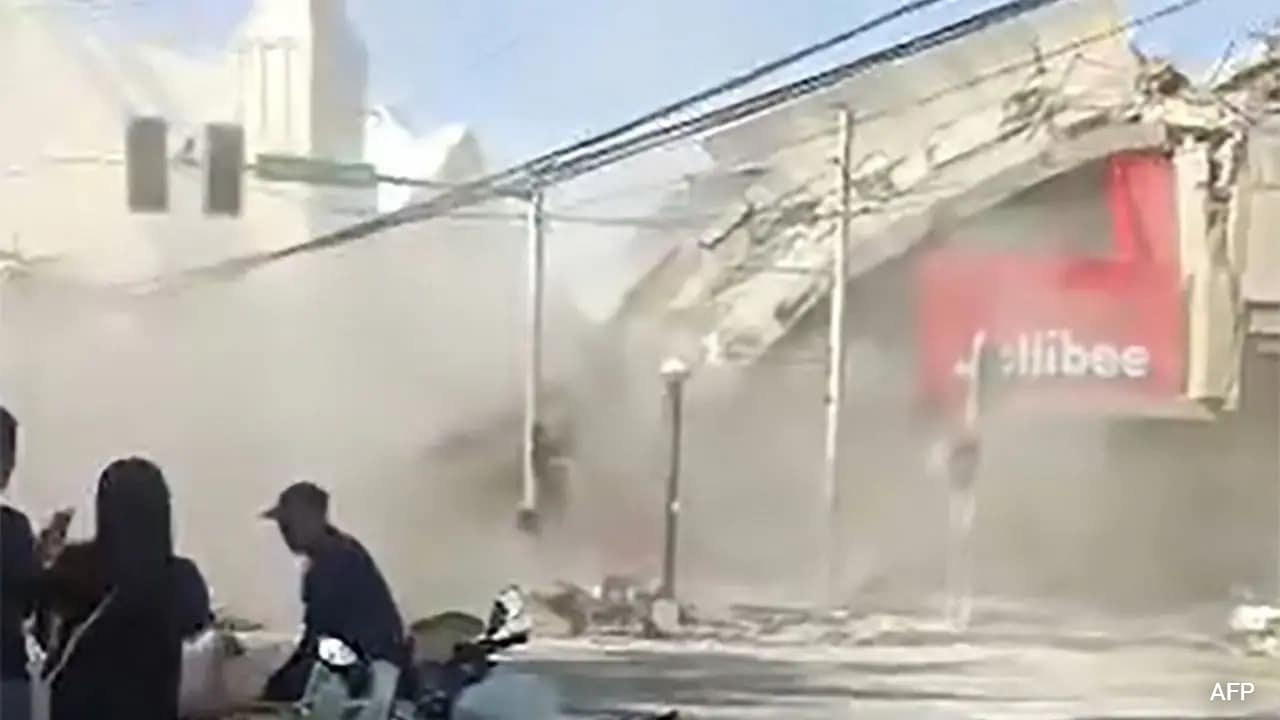
Seismic events expose the structural vulnerabilities of modern civil engineering, converting latent design and construction deficits into catastrophic physical failures. The June 2026 magnitude 7.8 earthquake off Mindanao island in the Philippines serves as a raw dataset for this dynamic. While standard news coverage prioritizes the immediate sensory chaos of the event—focusing on viral videos of crumbling facades at commercial centers in General Santos City and panicking occupants—a rigorous structural diagnostic isolates a recurring industrial vulnerability: the failure of non-structural components and adaptive commercial architecture during high-frequency lateral loading.
To understand why a modern shopping mall or commercial structure sheds its exterior and creates immediate life-safety hazards, one must deconstruct the system into its core mechanical realities. The breakdown is not a random occurrence of chaos; it is an entirely predictable interaction between tectonic acceleration and structural engineering choices.
The Tri-Particle Threat: Structural vs. Non-Structural Integrity
The physical degradation observed in retail environments during major seismic events is rarely a case of total progressive collapse. Instead, the hazard profile splits into three distinct mechanical failure mechanisms:
- Primary Structural Failure: This involves the degradation of the main lateral force-resisting system (columns, beams, shear walls, and moment frames). When a 7.8 magnitude offshore quake occurs at a depth of approximately 39 miles, it propagates energy that tests the ductility of these reinforced concrete elements. If the columns experience shear failure before forming plastic hinges in the beams, total structural collapse occurs.
- Non-Structural Component Shedding: This is the primary driver of the visual damage recorded in recent footage. Non-structural elements include exterior claddings, architectural canopies, interior drop ceilings, and false walls (often constructed of lightweight insulation like expanded polystyrene or foam board held by metal cladding and rivets). These elements are highly susceptible to relative displacements.
- The Drift Bottleneck: During an earthquake, the floors of a multi-story retail complex move relative to one another. This movement is defined as inter-story drift. While the main concrete frame may flex safely within its elastic limits, rigid non-structural components attached across these floors cannot accommodate the movement. The rivets shear, the welds break, and hundreds of kilograms of architectural debris fall directly into evacuation pathways.
This creates an immediate operational bottleneck. The human instinct inside a commercial space is to flee outward toward open air. However, because non-structural cladding and entry canopies are highly susceptible to acceleration-induced damage, the perimeter of the building becomes the highest-risk zone for falling debris.
The Physics of Panicked Evacuation Dynamics
Human behavior during an active tremor operates under severe cognitive load, which frequently invalidates theoretical building evacuation models. In high-density environments like shopping centers, crowd dynamics shift from orderly egress to fluid-like turbulent flow.
When structural components begin shedding, the perceived threat level spikes, initiating a rapid transition from rational navigation to competitive survival behavior. This transition alters the physical capacity of exits through several clear mechanisms:
Arching and Clogging at Exit Portals
As a crowd rushes simultaneously toward a single exit door or narrow corridor, a physical phenomenon known as "arching" occurs. Individuals wedge against one another at the bottleneck, creating a structural arch of human bodies that resists forward movement. This paradoxically reduces the flow rate of the exit to near zero, trapping the bulk of the population inside an active impact zone where drop ceilings and light fixtures are actively detaching.
Acceleration Decoupling
Evacuees attempting to run across a floor undergoing severe horizontal acceleration experience a loss of traction and balance. The floor velocity changes direction multiple times per second, decoupling the friction between footwear and the ground surface. This leads to falls, which instantly turn into stationary obstructions within the crowd flow, triggering a domino effect of trampling hazards.
Structural Auditing as a Predictive Mitigation Model
The systemic failure of commercial facilities under seismic stress underscores the limitations of reactive maintenance. Mitigating this risk requires transitioning to mandatory structural auditing frameworks, particularly for commercial properties with high daily occupancy limits. A rigorous audit acts as a diagnostic tool to map structural capacities against expected localized peak ground acceleration.
The implementation of a predictive auditing framework relies on specific, non-destructive methodologies:
- Ductility and Reinforcement Verification: Utilizing ground-penetrating radar and ultrasonic testing to map the internal rebar configuration of columns and beam-column joints. This determines whether older structures meet modern ductile detailing requirements, such as closely spaced ties designed to confine the concrete core during cyclic loading.
- Cladding Fastener Fatigue Mapping: Manually auditing the connections of all exterior facades, false walls, and decorative canopies. Rivets, bolts, and welds must be evaluated for normal atmospheric wear and tear, which can significantly lower their failure threshold when subjected to sudden lateral forces.
- Inter-Story Drift Capacity Calculations: Simulating structural response under targeted lateral loads to identify if non-structural interior elements are isolated from the main structural frame. If interior drop ceilings and storefront glass are rigidly fixed to the columns without expansion joints, they are flagged for immediate structural remediation.
The clear limitation of this strategy lies in economic viability. While an audit can identify points of failure with high precision, retrofitting existing high-rise and expansive commercial real estate requires substantial capital expenditure. Property managers frequently delay these upgrades, balancing structural insurance premiums against the immediate cost of structural reinforcements—a calculation that fails to account for the catastrophic liabilities incurred during a major tectonic rupture.
Seismic Resilience via Targeted Structural Intervention
The long-term management of public safety in seismically active regions like the Pacific Ring of Fire requires an immediate shift in commercial construction mandates. Relying on basic life-safety building codes—which are designed merely to prevent total collapse to allow evacuation—is insufficient for high-density public hubs.
The primary strategic play for asset owners and civil regulators is the decoupling of non-structural architectural elements from the primary load-bearing skeleton. All future commercial constructions must implement flexible seismic joints for interior ceilings, structurally isolated facade systems that slide independently of inter-story drift, and reinforced egress paths shielded from overhead architectural features. Upgrading these systems reduces immediate economic losses, prevents localized perimeter collapses, and ensures that when the ground moves, the paths to safety remain clear.