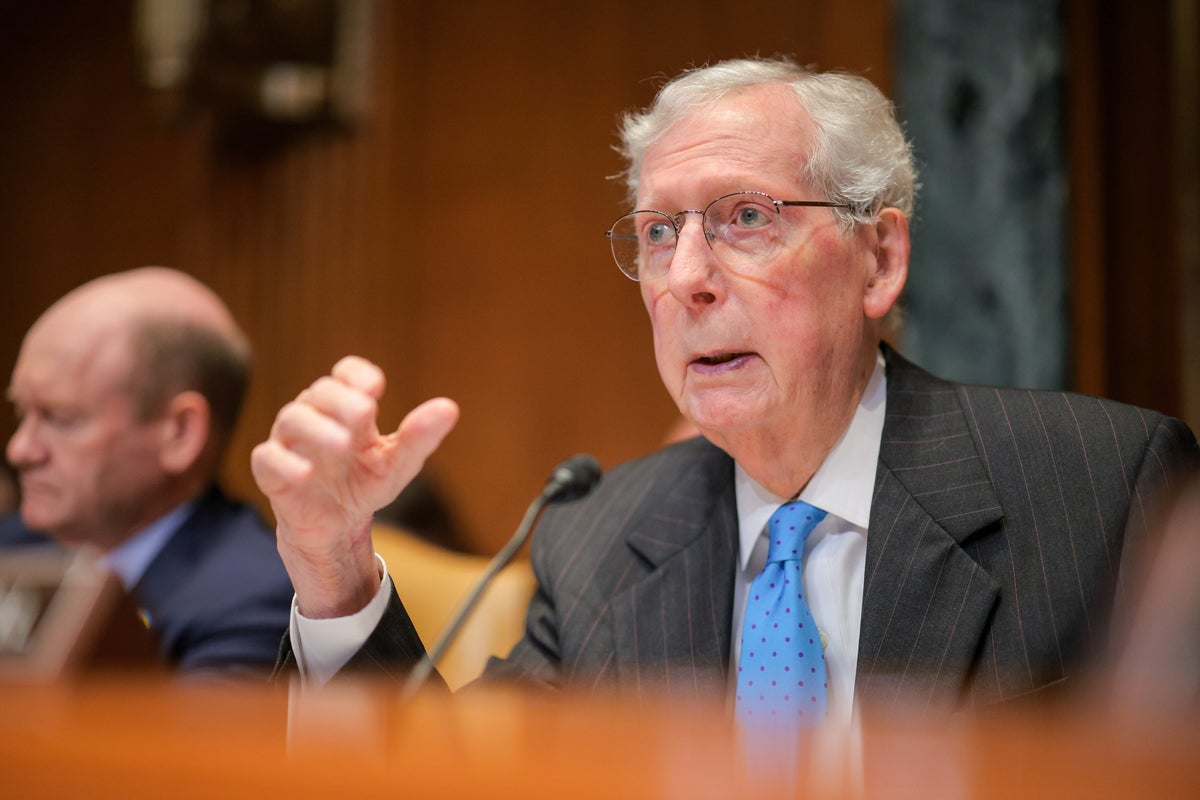
The confrontation between Kentucky Governor Andy Beshear and Senator Mitch McConnell is not merely a dispute over public transparency; it is a calculated maneuvering for federal legislative leverage wrapped in the language of constituent care. When an 84-year-old senior lawmaker remains hospitalized for over three weeks following a June 14 emergency response involving reported cardiac arrest, the information vacuum naturally triggers intense political recalculations. By issuing a formal letter demanding a public health update, Beshear leverages the structural vulnerability of a razor-thin 53–47 Republican Senate majority to pressure a defensive Republican establishment.
Understanding this conflict requires analyzing the mechanics of Senate vacancy laws, the legislative bottlenecks caused by single-vote margins, and the specific statutory framework governing Kentucky’s representation.
The Succession Mechanism and Statutory Vulnerability
Political succession in the United States Senate relies on an intersection of federal constitutional baselines and highly variable state statutes. The Seventeenth Amendment establishes popular election as the mechanism for filling vacancies but permits state legislatures to empower governors to make temporary appointments. In Kentucky, the statutory framework has been repeatedly rewritten over the past five years to insulate the seat from a Democratic gubernatorial appointment.
The evolution of Kentucky's succession laws reveals a structural effort to limit the executive authority of the governor:
- Pre-2021 Framework: The governor possessed broad, unilateral authority to appoint an interim successor of any political affiliation to fill the vacancy until the next regular congressional election.
- The 2021 Amendment: The Republican-controlled legislature overrode a gubernatorial veto to mandate that the governor select an interim appointee from a three-person shortlist provided by the executive committee of the departing senator’s political party. This design guaranteed partisan continuity.
- The 2024 Reformulation: The legislature eliminated gubernatorial appointment capacity entirely. Under current statute, a vacancy triggers a special election. The governor’s sole functional role is to issue an administrative proclamation calling for the vote.
However, this untested 2024 statute introduces a critical legal and temporal vulnerability. The law dictates that a vacancy occurring prior to August 3 requires a special election process to fill the remainder of the term, but it omits strict statutory caps on the maximum window between the governor's proclamation and the actual election date.
Because Beshear has previously questioned the constitutionality of these legislative restrictions, any actual vacancy would almost certainly trigger a prolonged litigation bottleneck. The executive branch could delay the election proclamation, while legislative leadership would counter with immediate lawsuits to enforce an accelerated timeline. While courts litigate the statutory mechanics, the seat would remain entirely vacant, functionally shrinking the working Republican majority.
The Margins of Senate Power: The Single-Vote Bottleneck
The urgency behind the disclosure demands stems directly from the tight arithmetic of the current Senate floor. With a 53–47 Republican advantage, any single absence alters the operational threshold required to pass controversial legislation, clear judicial confirmations, or execute specific foreign policy maneuvers.
Senate rules explicitly forbid proxy voting. A senator must be physically present on the floor to cast a vote. Consequently, an extended hospitalization introduces an immediate cost function to party leadership:
$$\text{Effective Majority Margin} = (\text{Total Majority Seats} - \text{Absent Majority Senators}) - \text{Minority Seats}$$
With McConnell absent, the maximum achievable Republican voting bloc drops from 53 to 52. In this state, a defection by just two majority senators can stall party-line initiatives or compel a tie-breaking intervention from the Vice President.
This dynamic is already impacting specific policy fronts. McConnell has served as a critical legislative firewall, anchoring the defense against war powers resolutions designed to restrict military options regarding foreign adversaries like Iran. Conversely, his absence alters internal party mechanics regarding domestic policies, such as the sweeping election law overhauls where his historical alignment diverged from the populist wing of his party.
Information Asymmetry and Public Relations Risk Management
The strategic behavior of both camps during this three-week absence demonstrates classic information asymmetry management. The sender of information seeks to control the narrative, while the receiver seeks to force disclosures that reveal underlying vulnerabilities.
[Information Vacuum: 3 Weeks of Hospitalization]
       │
       ├──► McConnell Camp Strategy: Distributed Verification
       │     └── High-profile phone calls (Thune, Barrasso, Jennings)
       │     └── Objective: Reassure markets/voters without formal medical data
       │
       └──► Beshear Camp Strategy: Transparency Lever
             └── Formal gubernatorial letter demanding direct updates
             └── Objective: Force explicit confirmation of fitness or expose physical limitations
To counter external speculation, the McConnell camp relies on distributed verification. Instead of releasing a definitive medical bulletin signed by attending physicians, they rely on high-profile surrogates—including Senate Majority Leader John Thune, Senator John Barrasso, and political commentators—to verify his cognitive engagement via reported 20-minute phone conversations. This approach seeks to project stability and operational continuity to the political markets without exposing concrete diagnostic data that could fuel further debates regarding long-term fitness.
Beshear's counter-strategy weaponizes the standard norms of political transparency. By framing the demand around the right of constituents to know if their representative can fulfill their constitutional duties, Beshear forces a difficult choice. The McConnell camp must either remain silent—allowing media speculation to intensify—or issue a formal statement that could bind them to specific timelines regarding a physical return to the Senate floor.
The tactical path forward depends on the August 3 statutory deadline. If McConnell’s recovery allows him to maintain his seat past this date, the legislative leverage shifts back to Senate leadership, minimizing the immediate risk of a disruptive special election cycle before the expiration of the current Congress. If the absence extends indefinitely without a clear medical resolution, expects McConnell's team to maintain this decentralized verification strategy to protect their slim voting majority on the Senate floor for as long as procedural rules permit.