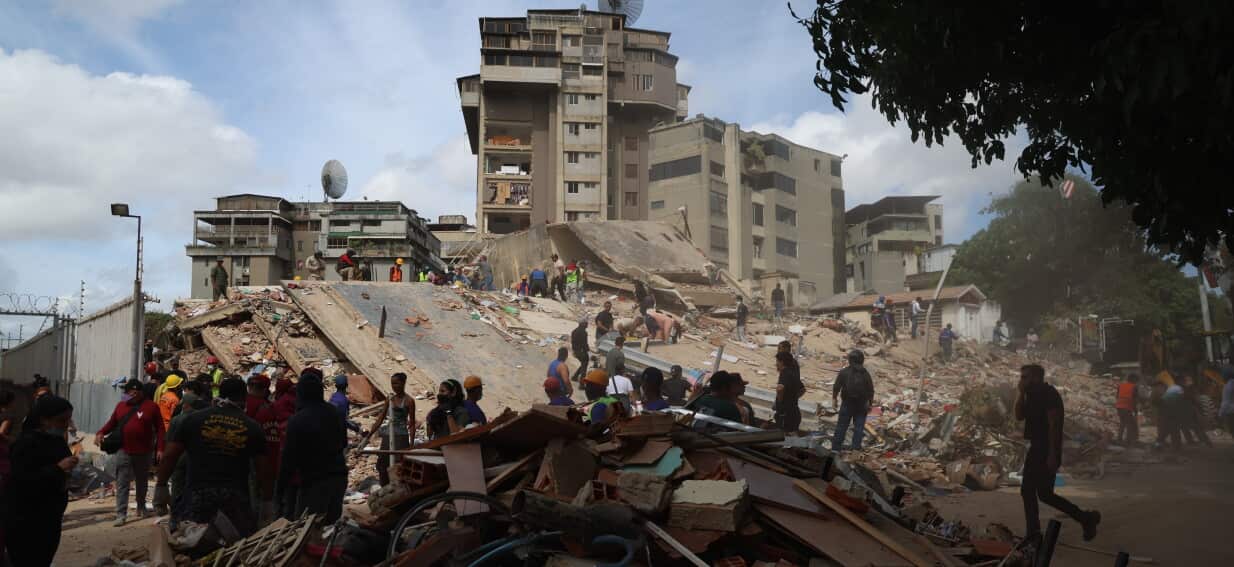
A rare tectonic phenomenon known as a seismic doublet has compromised the structural and operational core of northern Venezuela, leaving at least 235 individuals dead and more than 4,300 injured. The disaster, comprising two high-intensity earthquakes measuring 7.2 and 7.5 magnitude on the Richter scale, occurred within less than a minute of each other. The compounding energy output of these near-simultaneous ruptures exposed acute, systemic vulnerabilities in the nation’s infrastructure, public health networks, and emergency response capabilities.
Understanding the true scale of this crisis requires moving past raw casualty figures and analyzing the specific engineering failures, medical bottlenecks, and logistical constraints that now dictate the survival rate of thousands still trapped or displaced.
The Physics of Composed Failure: The Seismic Doublet
The destruction witnessed across the northern Caribbean coast of Venezuela is not the result of a standard mainshock-aftershock sequence. Instead, it represents the catastrophic potential of a seismic doublet—a sequence where two major tectonic events occur within a highly condensed temporal and spatial window.
The first event, a 7.2 magnitude shock, occurred at a depth of 22 kilometers west of Morón. Just 39 seconds later, a second, more destructive 7.5 magnitude shock struck at a shallower depth of 10 kilometers, centered southwest of Morón.
This sequence created a compounding destruction mechanism. When a building experiences seismic waves, the initial shock alters its structural frequency, compromises load-bearing joints, and introduces micro-fissures throughout the concrete matrices. When a second, more powerful wave hits less than a minute later, the compromised structures have no residual resistance. The secondary shallow shock amplified the ground acceleration, effectively triggering immediate progressive collapse in buildings that might have otherwise survived a singular event.
The fault dynamics of the South American and Caribbean plates typically feature lower frequencies of high-magnitude quakes compared to the Pacific Rim. This relative infrequency resulted in a built environment that lacked seismic resilience.
Infrastructure Collapse Vectors and the Isolation of La Guaira
The epicenter’s proximity to the coastal state of La Guaira created a geographic epicenter of destruction. Initial assessments confirm the structural failure of at least 346 major infrastructure sites, including 250 high-density apartment buildings and 20 commercial centers.
The structural failure modes fell primarily into three categories:
- Soft-Story Collapses: Multi-story residential complexes suffered immediate failure of their ground levels, which are frequently engineered with open spaces for parking or retail, creating a top-heavy structural weight that crushed lower floors.
- Concrete Shear Failures: Non-ductile concrete frames, prevalent in building booms from previous decades, lacked the necessary steel reinforcement detailing to bend under lateral loads, leading to brittle snapping of primary columns.
- Soil Liquefaction: The coastal geography of La Guaira, characterized by saturated alluvial and sandy soils, lost its shear strength under the rapid, successive vibrations, causing multi-story buildings to tilt precariously and foundations to slip.
The immediate consequence of this concentrated structural failure is the total immobilization of critical logistics nodes. The Simon Bolivar International Airport in Maiquetía, located in La Guaira and serving as the primary aerial gateway to the capital of Caracas, was forced into immediate closure due to severe runway fracturing and terminal structural damage. This creates a critical operational bottleneck: the very infrastructure needed to ingest heavy international search-and-rescue assets is incapacitated, forcing relief efforts to rely on slower maritime routes or secondary, distant airfields.
Healthcare System Under Maximum Load
The influx of more than 4,300 trauma patients has systematically overwhelmed a public health system already strained by a decade of economic contraction. Health Minister Carlos Alvarado reported that the 235 confirmed fatalities largely comprised individuals who either arrived at medical facilities without vital signs or expired within minutes of admission due to severe crush syndromes, internal hemorrhaging, and traumatic brain injuries.
The capability of the medical system to respond is restricted by a dual-capacity failure:
1. Structural Attrition of Medical Facilities
At least eight regional hospitals suffered structural compromise during the doublet. Emergency personnel were forced to execute rapid evacuations of existing critical-care patients into open-air parking lots and makeshift field triage centers. The loss of vertical clinical spaces means that operating rooms, sterile environments, and diagnostic machinery are offline precisely when surgical demand is peaking.
2. Supply-Chain Exhaustion
The consumption rate of specialized medical assets—specifically whole blood, intravenous fluids, orthopedic stabilization hardware, and broad-spectrum antibiotics—has outpaced local reserves by orders of magnitude. Trauma units are operating under field-rationing protocols, prioritizing patients based on survivability indices rather than treating all incoming casualties on a first-come, first-served basis.
Geopolitical and Logistical Relief Bottlenecks
International aid deployment introduces an intricate layer of geopolitical and logistical friction. While countries including the United States, Spain, Mexico, and Brazil have mobilized assets, translating geopolitical intent into real-world rescue operations faces severe friction.
The United States Treasury issued a temporary waiver of certain economic sanctions until October 23, explicitly allowing transactions tied to earthquake relief. This regulatory shift unblocks banking corridors for international NGOs and state actors, allowing financial resources to flow toward procurement.
The physical deployment of aid, however, depends on military and defense assets capable of bypassing ruined commercial infrastructure. United States Southern Command (SOUTHCOM) has mobilized transport aircraft, helicopters, and two naval vessels to establish a sea-to-air bridge. The closure of the main airport requires the use of ship-launched heavy-lift helicopters to move urban search-and-rescue teams directly onto collapsed coastal sites.
The efficacy of these teams diminishes exponentially with every passing hour. The standard survival window for individuals trapped under non-ductile concrete rubble drops sharply after 48 to 72 hours due to dehydration, crush syndrome, and asphyxiation. Delayed international entry caused by airport damage and initial political coordination directly correlates with an escalating final mortality rate.
Critical Resource Scarcity Matrix
The immediate recovery operation requires managing three distinct, competing resource demands, each with a specific bottleneck:
+----------------------+--------------------------+---------------------------+
| Operational Phase    | Critical Resource Needed | Primary Bottleneck        |
+----------------------+--------------------------+---------------------------+
| Search & Extraction  | Heavy Excavators & Cranes| Ruined Coastal Roads      |
| Clinical Triage      | Field Surgical Theaters  | Sterilization & Power     |
| Civil Stabilization  | Potable Water & Power    | Grid Gridlock & Aftershocks|
+----------------------+--------------------------+---------------------------+
The state’s announced $200 million reconstruction fund represents a fraction of the capital required to address this matrix. Structural replacement of 250 high-density apartment buildings, stabilization of compromised hillsides prone to landslides, and the complete overhaul of corrupted municipal water networks in La Guaira will require billions of dollars in sustained capital injection.
Operational Directives for Response Management
The immediate stabilization of northern Venezuela depends entirely on executing a strict, decentralized response strategy over the next 96 hours.
First, engineering priority must shift from urban Caracas to clearing and securing a heavy-vehicle ground corridor between the capital and La Guaira. Without a functional road artery capable of sustaining heavy machinery, the removal of heavy concrete slabs is impossible, rendering manual search efforts ineffective.
Second, international aid agencies must bypass centralized municipal warehouses and establish immediate, point-of-impact field hospitals equipped with autonomous power generation and water purification units. Relying on the damaged domestic grid guarantees a failure of clinical care.
Third, regional authorities must execute mandatory structural tagging of all standing buildings within a 50-kilometer radius of Morón. Given that over 138 aftershocks have already been recorded, any structure showing minor shear cracks must be cleared of civilian populations immediately to prevent secondary mass-casualty events caused by structural fatigue.