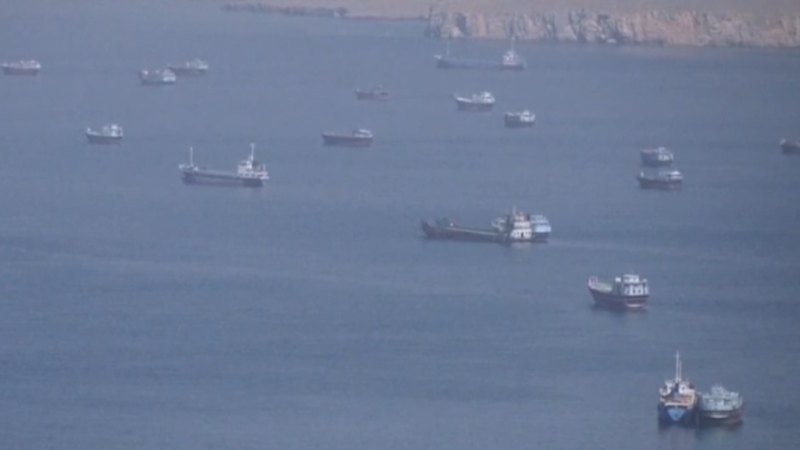
The binary framing of maritime chokepoints—evaluating a waterway as strictly open or closed—fails to accurately model the economics of modern state conflict. When a state actor declares a maritime passage closed, the primary mechanism of disruption is not the physical immobilization of every hull, but rather the systematic escalation of operational friction until transit becomes commercially irrational. Closing a shipping lane is an exercise in escalating risk metrics until the global maritime insurance and logistics architecture self-selects out of the zone.
Understanding the modern landscape of maritime blockades requires separating political rhetoric from the mathematical realities of maritime logistics. Total physical denial of a waterway by a littoral state is rarely achievable against a first-rate naval coalition. Instead, sea denial operates through an optimization model where localized asymmetric strikes alter the cost function of commercial shipping, effectively choking off trade without requiring a continuous naval line of battle.
The Triad of Maritime Friction
The operational status of a strategic chokepoint relies on three distinct layers of deterrence. A failure or restriction in any of these vectors alters commercial behavior independent of formal diplomatic declarations.
- Kinetic Exposure Rate: The mathematical probability of a hull sustaining physical damage from localized weapon systems within a defined geographic corridor.
- The Insurance Risk Premium Multiplier: The escalating cost curve of Hull and Machinery (H&M) and Protection and Indemnity (P&I) war risk cover, which dictates whether a voyage remains profitable at a given spot freight rate.
- The Verification and Compliance Bottleneck: The operational delays induced by mandatory structural inspections, demining delays, or aggressive regional boardings that degrade the asset utilization rate of a shipping fleet.
This friction function was clearly demonstrated following the military escalations of early 2026. Prior to the conflict, the waterway supported a baseline of approximately 140 to 150 commercial transits per day, carrying roughly 20.5 million barrels of crude oil and petroleum products, alongside 20% of global liquefied natural gas (LNG). Following targeted military interventions and reciprocal threats of blockade, visible commercial crossings dropped by more than 90% within a 72-hour window. The physical infrastructure of the strait remained intact; the commercial viability of navigating it did not.
The Structural Inadequacy of Pipeline Bypasses
A common analytical error is treating overland pipeline infrastructure as a seamless substitute for seaborne transit capacity. When maritime pathways suffer degradation, supply-side economic models often assume that regional producers can pivot to redundant land routes without a net loss in throughput. The volumetric realities of global energy logistics expose this as a mathematical impossibility.
Global Energy Flow Pipeline Constraints (Maximum Daily Throughput Capacity)
======================================================================
Pre-Crisis Seaborne Volume:  ==================== 20.5M bbl/d
Saudi East-West Pipeline:    ======= 7.0M bbl/d (Max Theoretical)
UAE Habshan-Fujairah Line:   == 1.5M bbl/d
Net Stranded Volume:         =========== 12.0M bbl/d
The data shows that even if every regional pipeline network operates at absolute mechanical limit, more than half of the typical daily baseline volume remains physically bottlenecked inside the Persian Gulf. This creates an immediate structural deficit in the global energy market. The physical layout of these alternative networks presents three major operational limits:
- The Ultimate Volumetric Ceiling: The combined max capacity of the Saudi East-West pipeline system and the UAE’s Habshan-Fujairah line caps out at approximately 8.5 million barrels per day. This leaves a structural deficit of over 12 million barrels per day that cannot escape seaborne reliance.
- The Friction of Flow Conversion: Converting pipelines from natural gas liquids to heavy crude oil requires significant system overhauls. These conversions lower pumping efficiency and degrade the long-term operational lifespan of the pipeline infrastructure.
- Symmetric Vulnerability Fields: Fixed infrastructure like pump stations, storage terminals, and exposed pipeline junctions present highly visible, static targets for precise long-range drone and missile assets. Shifting transit from sea to land does not remove strategic risk; it merely trades a mobile target for a stationary one.
The resulting gap between global demand and available pipeline delivery mechanisms triggers a rapid depletion of floating storage assets and near-term inventories.
The Asymmetric Capital Cost Ratio
A nation attempting sea denial does not need to match the capital expenditure or technological sophistication of an opposing blue-water navy. The core strategy relies on a highly favorable asymmetry of cost: using low-cost, mass-produced tools to force an adversary into unsustainable defensive capital expenditures.
The Asymmetric Cost Matrix (Capital Expenditure vs. Interception Cost)
----------------------------------------------------------------------
Attacking Asset Cost (Iranian Pop-Up Fleet / Shahed-Type Loitering Drone)
$20,000 to $50,000 Base Cost
[x] High scalability, low manufacturing footprint

Defensive Intercept Cost (SM-2 / SM-6 Naval Air Defense Missile)
$2,100,000 to $4,300,000 Base Cost
[x] Limited magazine capacity, highly complex supply chain
----------------------------------------------------------------------
This economic imbalance creates clear vulnerabilities for defensive coalitions during a prolonged attrition campaign. The cost equation favors the defending littoral state across three core metrics:
- The Magazine Depth Problem: Modern guided-missile destroyers possess a finite number of Vertical Launch System (VLS) cells. Reloading these cells requires returning to a specialized weapons station outside the combat theater, temporarily removing a front-line combatant asset from the area of operations.
- The Launch Velocity Mismatch: The manufacturing time and supply-chain complexity of a high-tier anti-air interceptor are orders of magnitude greater than those of a rudimentary loitering munition. A defending navy can deplete its deep-magazine inventory faster than defense contractors can replenish it.
- The Detection Silhouette: Littoral forces can utilize civilian dhows, fast attack craft, and mobile shore-based launchers concealed within mountainous coastal terrain. This high-clutter environment degrades the predictive tracking models of advanced naval radar systems, forcing defensive forces to maintain a constant state of costly, high-alert surveillance.
The Post-Conflict Inventory Glut and Legal Gridlock
When diplomatic breakthroughs occur—such as an interim peace agreement or a formal memorandum of understanding—the immediate analytical consensus often predicts a rapid return to baseline economic conditions. This view overlooks the complex operational lag built into maritime commerce. The signing of a treaty does not instantly clear a shipping lane; it initiates a prolonged period of unwinding operational and legal gridlocks.
The first operational bottleneck stems from the accumulation of floating inventory stranded during the period of high friction. For instance, following a prolonged disruption, up to 80 to 90 million barrels of non-sanctioned crude can sit loaded on dozens of Very Large Crude Carriers (VLCCs) idling inside the protected waters of the Gulf.
When the chokepoint reopens, this concentrated wave of supply cannot be absorbed simultaneously by global destination ports. It triggers localized discharge delays, spikes spot charter rates for vessels outside the zone, and creates a near-term pricing collapse in spot crude differentials due to regional oversupply.
The Reopening Bottleneck Sequence:
[Treaty Signed] ➔ [Demining & Ordnance Sweep (30-Day Min)] ➔ [Underwriter Risk Re-Rating] ➔ [Fleet Release & Destination Port Congestion]
The second, more persistent bottleneck is the legal and physical clearing of the waterway. A maritime channel subjected to active sea-denial tactics is inevitably contaminated by acoustic, magnetic, and pressure-sensitive sea mines, alongside unexploded ordnance.
The physical removal of these hazards is a meticulous, slow process. Under international maritime standards, commercial hull underwriters will not normalize war risk premiums based on a political declaration alone. They require objective verification from recognized hydrographic surveying bodies. Until this clearing phase concludes, the passage remains effectively restricted, as the cost of uninsured transit remains prohibitive for non-state-backed shipping fleets.
The Strategic Outlook
The structural changes observed in maritime chokepoints point toward a definitive shift in global trade security. The traditional assumption that Western naval dominance can guarantee uninterrupted transit through narrow waterways has been replaced by a more fragmented reality. Littoral states now possess the asymmetric tools required to challenge open navigation at a fraction of the cost of traditional fleets.
Moving forward, international shipping firms must budget for permanent volatility across strategic corridors. This means supply chains will transition away from just-in-time inventory models for critical commodities toward a permanent state of high-inventory buffers and regionalized near-shoring.
Governments and corporate entities will be forced to fund capital-intensive pipeline redundancies and alternative shipping routes, even when those paths are economically inefficient during peacetime. The threat of closure has become as effective a strategic lever as an actual physical blockade, permanently altering the risk premiums of global commerce.